“AI or traditional development?” is the wrong question. The right one is how much speed, control and risk your business can afford.
Most teams frame AI vs traditional development as a binary choice. That framing is the first mistake.
I see it a lot. Teams chase AI because it feels faster, or reject it because it feels messy.
Both directions land in the same place: rushed systems with weak foundations, or polished systems that ship too late.
The better move is to understand where each approach wins, where it breaks and where a hybrid gives you the best return. Both work. They solve different problems.
AI-powered development: built for speed
AI changes how I build software. Instead of writing every repetitive piece by hand, I use tools that understand context, generate scaffolding, speed up testing and remove a lot of drag from delivery.
I dig into the day-to-day of this in my post on vibe coding, where taste and intent matter more than raw typing speed.
The core advantage: speed
This is where AI shines.
For standard workflows, admin panels, CRUD-heavy systems, internal tools and first-pass prototypes, AI can cut a serious amount of time. What used to take weeks can often shrink to days if the scope is clear and the review process is tight.
That speed usually comes from a few places:
- Automated code generation. Prompts turn into usable boilerplate and feature drafts.
- Faster testing. AI can draft test cases and edge-case coverage quickly.
- Debugging support. It helps narrow down likely failures faster.
- Documentation help. It turns rough implementation details into clean internal docs.
How much of that speed you capture depends on where you sit on the AI coding workflow levels. Copy-pasting into a chat window and orchestrating agents against your real codebase are not the same tool.
Who benefits most from AI development
I lean toward AI-heavy workflows when speed matters more than perfect customization on day one. That usually means:
- Startups trying to reach product-market fit before the runway gets tight.
- Small teams that need more output without more hires.
- Businesses shipping standard features that follow familiar patterns.
- Teams where non-technical stakeholders want to help with discovery and prototyping.
In those cases, AI acts like a power tool. It does not replace the builder. It makes the first cut much faster.
Where AI-first teams get burned
AI is fast at common patterns. It is weaker at deep product nuance, strange business rules and systems that need careful long-term architecture.
If you skip review, you can ship something that looks finished but behaves like a prototype wearing a production costume.
Know which kind of AI you lean on
The trade-offs differ between predictive models and generative ones, which I break down in machine learning vs generative AI.
The debt bill arrives later
Some studies of AI-accelerated codebases report more duplicated code, larger pull requests and faster technical-debt buildup. The upfront speed can quietly shift effort into later debugging and rework.
That is the trap. The fix is treating AI output as a draft, not as truth, the same discipline I argue for in the architectural shift to agentic workflows.

Traditional development: the control champion
Traditional development is slower, but it gives me tighter control over how the system is shaped.
This is the path I trust most when the business rules are complex, the architecture matters or the cost of failure is high. Every part of the system is designed with intent instead of inferred from a prompt.
The core advantage: control
Traditional development is better when the software needs precision. That matters for:
- Complex enterprise systems: lots of moving parts and layered business logic.
- Regulated industries: where auditability and traceability matter.
- Mission-critical applications: where downtime or bad behavior is expensive.
- Custom architectures: where the product does not fit common patterns.
The predictability factor
One underrated benefit of traditional development is predictability.
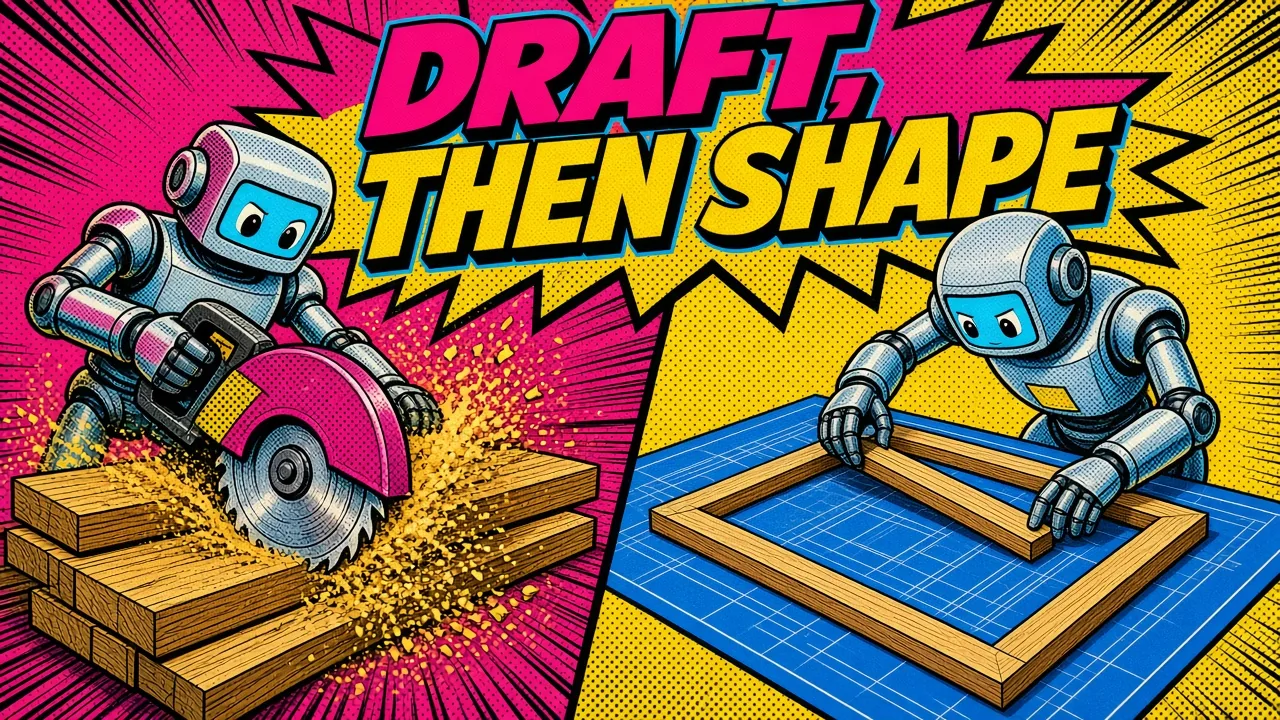
Manual design, explicit code reviews, architecture decisions and planned testing give me a clearer picture of trade-offs. It is like building with blueprints instead of assembling furniture from a photo.
That slower process often saves time later because fewer assumptions make it into production.
The time investment reality
The downside is obvious. Manual coding, reviews, debugging, refactoring and testing take time.
You need stronger engineering talent, and the discipline to keep standards high when deadlines start squeezing the team. You pay for control in time and cost.
AI vs traditional development: head-to-head
| Factor | AI-assisted development | Traditional development |
|---|---|---|
| Upfront speed | Often significantly faster | Standard industry timelines |
| Cost structure | Cheaper to start, debt-prone later | Higher labor cost, steadier |
| Team requirements | Still needs senior review | Requires senior expertise |
| Customization level | Strong on common patterns | Unlimited customization |
| Quality assurance | Fast drafts, human review required | Manual review from the start |
| Risk management | Variable, depends on review rigor | Predictable risk factors |
| Scalability | Scales output, not judgment | Scales with team growth |
Making the right choice for your business
Choose AI integration when
Choose AI when your bottleneck is delivery speed and the work is close to known patterns. That usually applies when:
- Your market window is tight.
- You are building standard business apps like portals, dashboards, e-commerce flows or content systems.
- Your team wants quick prototypes before committing engineering time.
- Your budget is better spent on iteration than on deep custom engineering from day one.
Choose traditional development when
Choose traditional development when the cost of being wrong is higher than the cost of being slower. That usually means:
- The app needs a unique architecture.
- Compliance and audit trails are mandatory.
- Reliability matters more than release velocity.
- Your team wants direct ownership of code quality and system design.
The hybrid strategy
This is the option I recommend most often. The strongest teams do not treat this like a religion. They use AI where speed helps and switch to traditional engineering where judgment matters.
AI does it
Humans own it
The hybrid model works because it treats AI like a junior accelerator, not like an autopilot.
Implementation guidelines
Starting with AI integration
If I were introducing AI into an existing team, I would start small:
- Begin with low-risk features.
- Define a review process for all AI-generated code, one that scales past line-by-line reading.
- Choose tools that fit the current workflow.
- Train the team on prompting, verification and code quality checks.
Maintaining traditional excellence
If the team stays mostly traditional, I would protect the basics:
- Invest in strong senior review.
- Keep documentation current.
- Use clear architecture standards.
- Avoid rushing complex work into fragile implementations.
Building hybrid capabilities
If the goal is balance, the workflow matters more than the tools:
- Identify which tasks are repetitive and safe to automate.
- Keep humans responsible for architecture and business logic.
- Add quality gates before merge and deployment. Here is the gate I run on AI-authored PRs.
- Measure outcomes, not only speed.
The future-ready approach
The teams that will win in 2026 are not the ones that blindly choose AI or reject it.
They know where speed is enough, where control is non-negotiable and where a hybrid gives them speed without chaos.
Use AI to remove friction. Use traditional engineering to protect the parts that matter. Combine both when the business needs speed and reliability at the same time.
Key takeaways
- Pick by risk, not by trend: known patterns go AI-first, high-stakes logic stays human-led.
- AI speed comes with a debt bill if you skip review.
- Traditional engineering buys control and predictability at the cost of time.
- A hybrid with clear ownership and quality gates gives most teams the best return.
Your development strategy should match your business goals, not the trend cycle. If you’re deciding where AI belongs in your delivery process, here’s how I help teams pick and ship the right mix, or reach out to talk it through.
If you had to choose today, which matters more for your next product: speed, control or a hybrid path?