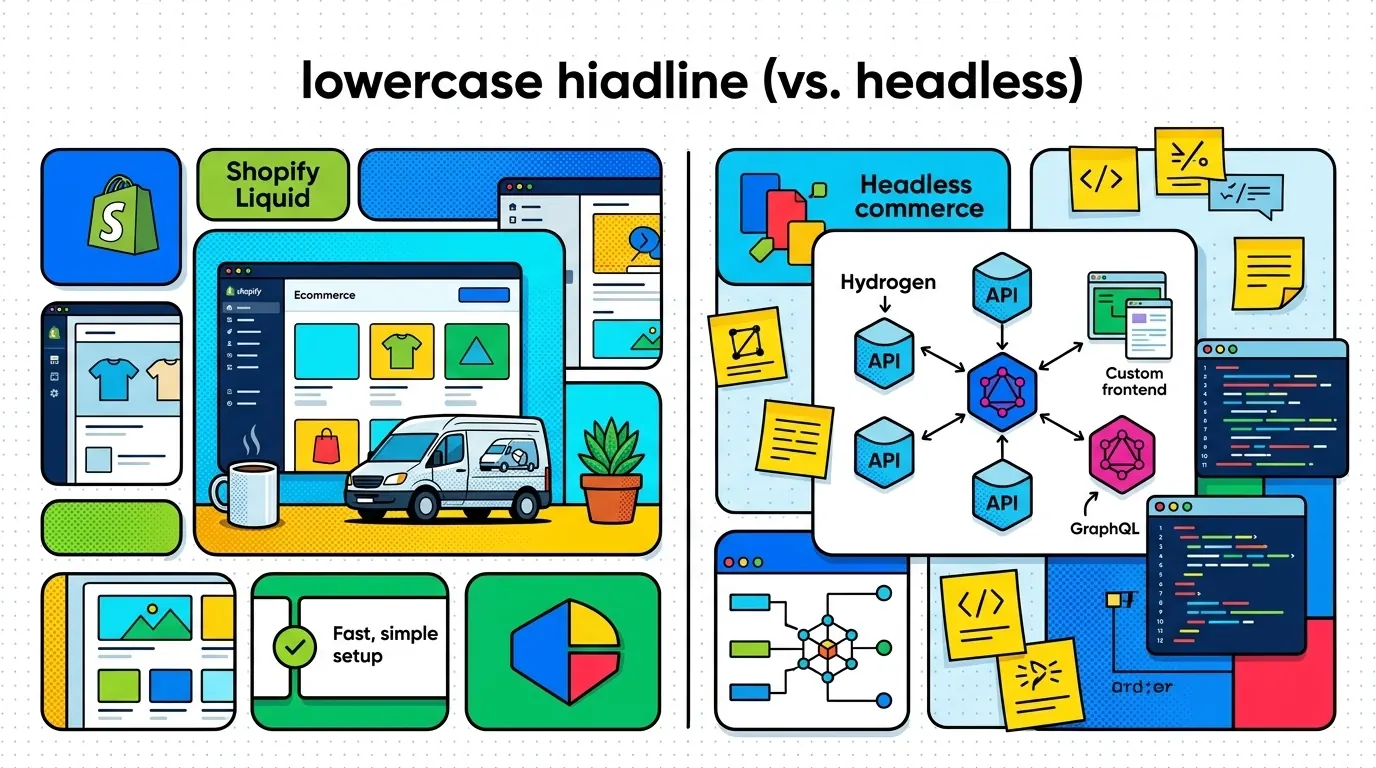
Headless can fix real problems, or hand your team a second system to babysit. Pick the simplest stack that removes your actual bottleneck.
Your store is making money, but every change feels like surgery on a moving car.
Traffic is up, orders are up and so is the pressure. The theme layer starts to push back: feature requests turn into fragile hacks, app scripts pile up and mobile performance slips with every install.
The pull of headless
This is when brands start weighing Shopify Liquid vs. headless. The pitch sounds great: more freedom, better performance, cleaner frontend architecture. It’s also where expensive mistakes happen.
The real question is which stack fits your stage, your team and how you actually operate.
Why Liquid still wins for most stores
Liquid is the default for a reason. It’s tightly integrated with Shopify, fast to ship and much easier to maintain than a custom headless frontend.
For most growth-stage stores, Liquid gives the best speed to market. Online Store 2.0 made themes far more modular, so a solid theme setup goes a long way before it becomes a blocker.
The production van
A good Liquid stack is like a well-tuned delivery van. Not flashy, but it moves product reliably, takes updates quickly and doesn’t need a pit crew every week.
When the theme becomes the ceiling
The problem shows up when business needs outgrow theme constraints. Maybe the storefront needs deeply custom interactions. Maybe product data has to come from an ERP, a PIM and a custom backend at once. Maybe merchandising logic is too complex for theme code to stay clean.
That’s usually when headless becomes a serious conversation.

Performance is the main driver
Performance is the most common reason teams look at headless, and milliseconds matter. On e-commerce storefronts, small delays add up to lower conversion, weaker ad efficiency and a worse mobile experience.
What Hydrogen and Oxygen give you
Hydrogen is Shopify’s headless framework: a React Router app preconfigured for Shopify’s APIs. Oxygen is Shopify’s serverless hosting for Hydrogen storefronts at the edge.
A well-built Hydrogen stack gives you finer control over rendering, data loading, caching and frontend execution. That opens the door to a lower LCP and a more responsive storefront.
Headless is only as fast as its frontend
If the team over-fetches Storefront API data, hydrates too much JavaScript or ships a bloated component tree, the custom storefront can end up slower than a decent Liquid theme. That happens more often than people admit.
There’s also a middle path. Shopify storefront web components add dynamic, framework-light commerce to a page without a full headless rebuild.
The hidden complexity of going headless
Going headless splits commerce from presentation. Shopify still handles products, checkout and admin workflows. Your custom frontend handles the customer experience.
That sounds clean on paper. In practice, you now own two systems instead of one.
Everything becomes your job
You manage hosting, deployments, caching, GraphQL queries, error handling, observability and integration behavior across services. Every app in the stack has to be checked for API compatibility. If an app only works by injecting snippets into a theme, that convenience is gone.
In Liquid, many features feel plug and play. In headless, reviews, loyalty, search, subscriptions, personalization and analytics can all turn into custom integration work.
The same thinking applies to newer surfaces like agentic commerce on Shopify, where the store has to expose clean, machine-readable APIs whatever stack you pick.
Renting vs building
Liquid is renting a well-equipped shop. Headless is designing your own building. You get more freedom, and the plumbing, wiring and maintenance become your problem.
| Factor | Liquid (Online Store 2.0) | Headless (Hydrogen + Oxygen) |
|---|---|---|
| Time to launch | Often weeks | Months, with a bigger team |
| App compatibility | Most apps work out of the box | Each app needs an API integration |
| Performance ceiling | Good with clean theme code | Higher, if the frontend is disciplined |
| Ongoing ownership | Theme updates | A software product to run |
Time and money: the cost of freedom
Time and budget usually decide this faster than architecture opinions.
A custom Liquid theme can often launch in weeks: faster testing, faster iteration and lower cost. If the business mainly needs merchandising flexibility, better UX and cleaner performance hygiene, Liquid usually gives the better return.
Headless is an operating model
Headless is a different kind of investment. The build takes longer, the team needs stronger frontend engineering and the integration surface is bigger. Maintenance doesn’t stop after launch.
You’re paying for a redesign and also taking on a software product. Deployments, monitoring, API changes, dependency updates, caching strategy and developer ownership become part of normal operations. Shopify releases a new API version every quarter, and my Shopify API version calendar shows how long the one your storefront uses is supported.
For many stores that trade isn’t worth it yet. Freedom is expensive when the business doesn’t fully need it.
Slow theme, rebuild plan
Slow theme, cleanup first
My decision framework
I reduce this decision to four practical questions.
- Is the current theme actually blocking revenue? If conversion is healthy and the pain is taste or minor flexibility, Liquid is probably still right.
- Can the team own a custom storefront long term? Someone has to own it after launch, every month.
- Are the integration requirements genuinely complex? If the storefront has to combine Shopify with custom product logic, external systems or a bespoke application layer, headless starts to make sense.
- Is performance a code problem or an architecture problem? Many slow stores get faster with script cleanup, better images, fewer apps and tighter theme code.
The simplest stack that fixes the real bottleneck is usually the best one. Building a spaceship to cross the street is still a bad decision. You can see how this plays out across real Shopify builds I’ve shipped.

Key takeaways
- Audit site speed before changing architecture. If LCP is acceptable, the stack may not be the problem.
- Remove app bloat. Many slow Liquid stores carry too many scripts and too much leftover code.
- Map every integration. What works natively, what depends on theme injection, what would break in headless.
- Estimate ownership cost, not only build cost. Launch is the first invoice.
- Look at Hydrogen if the business really needs headless, and keep the scope tight.
Choosing a stack is a long-term commitment. The right answer solves the current bottleneck without creating three new ones. If you’re weighing a rebuild, here’s how I help Shopify brands choose between Liquid, Hydrogen and the middle path, or drop me a line for a 30-minute architecture sanity check.
Are you hitting real technical limits in Shopify, or feeling the pull of a more customizable stack?