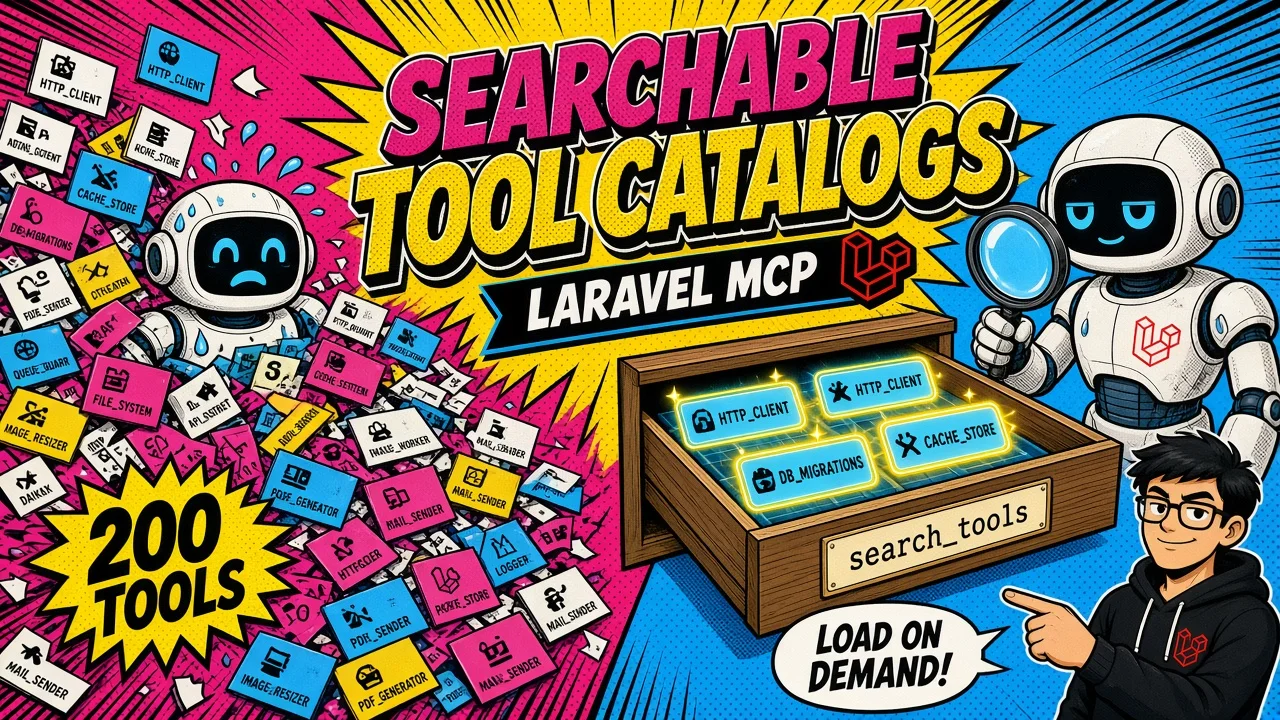
Every tool you advertise to a model costs tokens, up front.
Names, descriptions, input schemas, output schemas. A SaaS MCP server with forty admin actions can burn a surprising slice of the context window before the user asks a single question.
Laravel MCP 1.0 (as of the stable release covering protocol revision 2026-07-28) gives you two levers for that problem: searchable tool catalogs and cache hints. One shrinks what the model sees. The other reduces how often clients re-fetch discovery and resource payloads.
This post is the practical split: which tools stay in the hot list, which go behind ToolSearch, and how to set ttlMs / scope without lying to shared caches.
Pair it with the MCP first framing and the Laravel MCP safety trilogy when you wire real mutations. Official docs: Laravel MCP (Searchable Tool Catalogs and Cache Hints sections).
The context tax of a fat tools/list
When a client calls tools/list, every returned tool definition becomes candidate context for the model. That is fine for five crisp tools. It hurts when you expose:
- Rare seasonal ops (
close_year_end_books) - Deep admin toggles nobody asks for in chat
- Large schemas with nested enums and long descriptions
- Tenant-specific tools that only matter after a search
The agent does not need those definitions on turn one. It needs a short path to find them when the user asks.
Laravel MCP’s answer is ToolSearch: keep hot tools in $tools as normal classes, and park the long tail under a ToolSearch::class => [...] entry.
How ToolSearch works in Laravel MCP 1.0
As documented, a searchable catalog registers two meta-tools for the client:
search_tools: query by name, description, and input schema; returns matches with names, descriptions, and expected inputs (respect a result limit)execute_tools: invoke one or more tools by name from what search (or prior knowledge) surfaced
Minimal server shape:
use Laravel\Mcp\Server;
use Laravel\Mcp\Server\Tools\ToolSearch;

class OpsServer extends Server
{
    protected array $tools = [
        // Always advertised...
        CreateInvoiceTool::class,
        ListDelayedOrdersTool::class,

        // Discovered on demand...
        ToolSearch::class => [
            HistoricalAuditTool::class,
            RotateApiKeyTool::class,
            ExportComplianceCsvTool::class,
        ],
    ];
}CurrentWeatherTool-style examples in the docs make the same point: advertise the common case; search for historical weather and alerts.
Limits and conditional registration
Limits for batched execution live in config:
mcp.tool_search.max_tool_callsmcp.tool_search.max_output_bytes
Tune those before an agent can fan out ten heavy tools in one execute_tools call.
Conditional registration still applies. If a catalog tool’s shouldRegister returns false, it will not appear in search results and cannot be executed. That matters for plan-gated or tenant-gated features.
When to expose vs discover
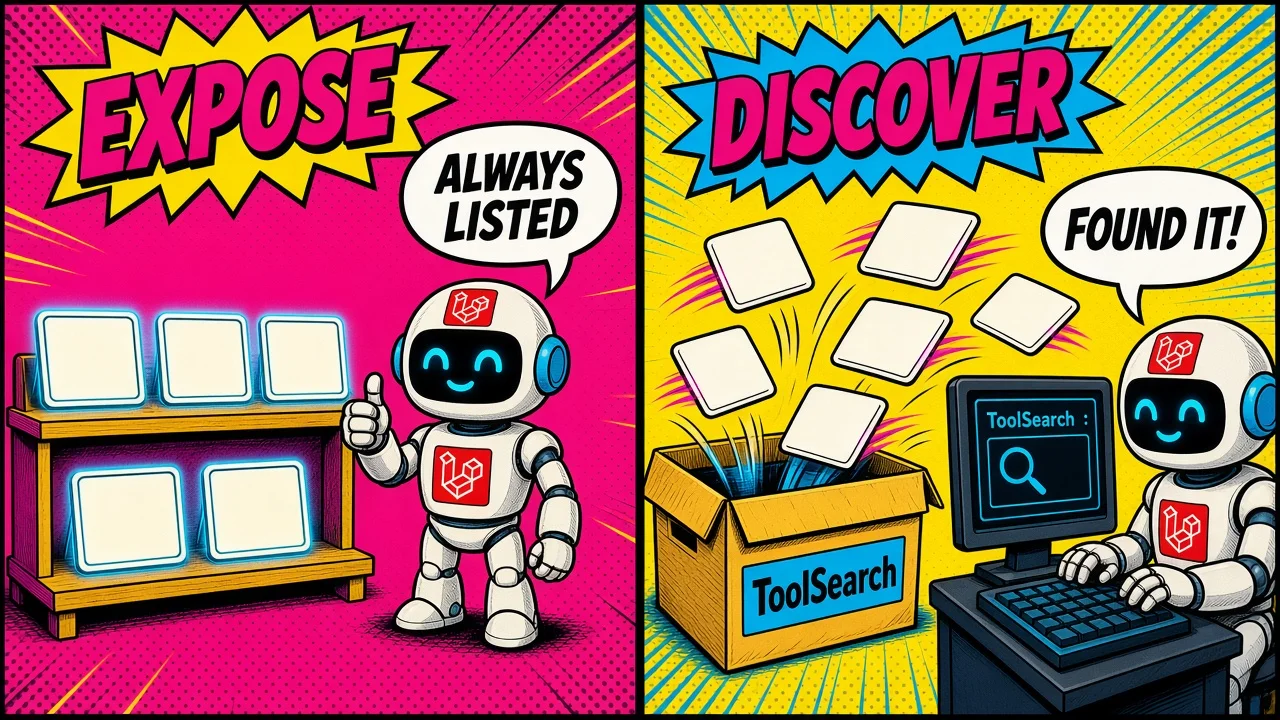
Use this as a decision table, not a vibe:
| Put it in the hot list when… | Put it behind ToolSearch when… |
|---|---|
| It is the main outcome users ask for | It is long-tail or seasonal |
| Search wording is ambiguous (“fix order” could mean five tools) | The name and description search cleanly |
| You need zero discovery latency | An extra search turn is acceptable |
| It is the safe entry point into a skill | It is a deep follow-up after triage |
| Schema is small and stable | Schema is large or rarely needed |
Examples from a multi-tenant ops server:
- Expose:
list_delayed_orders,get_order,draft_customer_message - Discover:
issue_partial_refund(after policy skill),export_tax_csv,rotate_webhook_secret
Exposing every mutation “so the model can see it” is how you get eager refunds. Discoverability plus a skill that says when to search is safer.
That is the same discipline as MCP first.
If your agent already struggles with wrong tool choice, searchable catalogs alone will not fix bad descriptions. Write #[Description] like a product brief. Ambiguous copy poisons both the hot list and search rankings.
Cache hints: stop refetching discovery
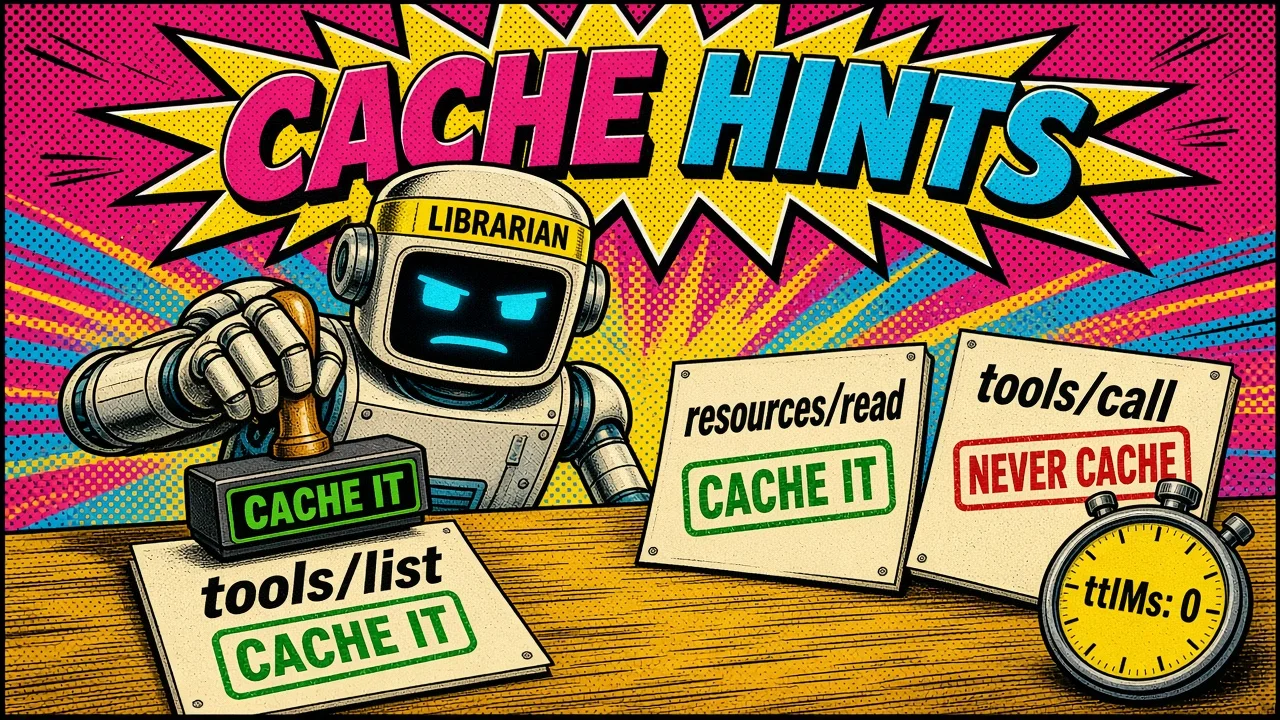
Laravel MCP attaches advisory cache hints to responses that may be cached: server discovery, primitive listings, and resource reads. Defaults are conservative: private scope, ttlMs of zero (do not cache).
You can set a server default with #[Cacheable] and override per method via cacheHints():
use Laravel\Mcp\Enums\CacheScope;
use Laravel\Mcp\Server\Attributes\Cacheable;

#[Cacheable(ttlMs: 60_000, scope: CacheScope::Public)]
class OpsServer extends Server
{
    protected function cacheHints(): array
    {
        return [
            'tools/list' => new Cacheable(
                ttlMs: 30_000,
                scope: CacheScope::Public,
            ),
        ];
    }
}
Rules of thumb
From the docs and MCP caching draft:
CacheScope::Public: safe to share across users (same tool list for everyone)CacheScope::Private: tied to the authorization context (filtered lists, user-specific resources)- Resource-level
#[Cacheable]wins over method and server defaults - Missing or zero
ttlMsmeans do not cache - Tool calls are never cacheable (mutations and live reads stay fresh)
On the client side, Laravel’s MCP client honors hints when you opt in with withCache(). Installing 1.0 does not enable caching by itself.
That is good: accidental public caching of a private tools/list is a tenancy bug waiting to happen.
Wrong
tools/list is cached as public because the route is authenticated.Right
For multi-tenant SaaS, default private unless you are sure every authenticated caller sees the same primitives. If plan features change the tool list per shop, public scope is wrong even if the HTTP route is authenticated.
A practical split for a Laravel SaaS MCP
Here is a pattern that holds up on real products:
- Three to seven hot tools that cover 80% of chat intents.
- Everything else under
ToolSearch, with descriptions that include synonyms users actually say. - Skills / playbooks that tell the agent to
search_toolsbefore inventing a workflow. - Public short TTL on
tools/listonly when the catalog is identical for all callers. - Private longer TTL on stable docs resources; zero TTL on anything tenant-flavored.
- Auth, idempotency, structured errors on mutations (auth and audit, idempotency, tool errors).
Searchable catalogs reduce tokens. They do not replace permission checks. An agent that finds rotate_api_key via search still needs the same actor, tenant, and audit line as a hot tool.
If you are connecting agents as MCP clients rather than only hosting servers, the Laravel AI SDK path of spreading Client::web(...)->tools() into an agent still benefits: fewer advertised tools means less noise in the agent loop.
Cache the listed collection when it is stable, as the AI SDK docs suggest for remote OAuth servers.
What this is not
- Not “hide unsafe tools and hope search never finds them.”
shouldRegisterand authorization still decide availability. - Not a substitute for pagination and concise schemas on the tools you do expose.
- Not a reason to mark tenant-specific lists
Publicfor a cheap cache hit. - Not automatic speed: hints are advisory; clients must opt in.
Protocol note: Laravel MCP 1.0 speaks 2026-07-28 (including server/discover) while still negotiating older initialize clients. If your host is mid-upgrade, check the Laravel MCP docs for your installed package version.
Key takeaways
- Fat
tools/listpayloads tax the context window before the user speaks. - Laravel MCP 1.0
ToolSearchkeeps hot tools advertised and parks the long tail behindsearch_tools/execute_tools. - Expose high-frequency, ambiguous, or entry-point tools; discover long-tail and heavy-schema tools.
- Cache hints (
ttlMs, public/private) apply to discovery and resource reads, not tool calls. - Prefer private scope for tenant-filtered catalogs; public only when every caller sees the same list.
- Pair catalogs with skills, auth, and idempotency. Discovery without governance is just a shorter path to the wrong mutation.
If you listed every tool your admin UI exposes into MCP tomorrow, which five would earn a permanent slot in the hot list, and which ones should stay invisible until search_tools earns them?