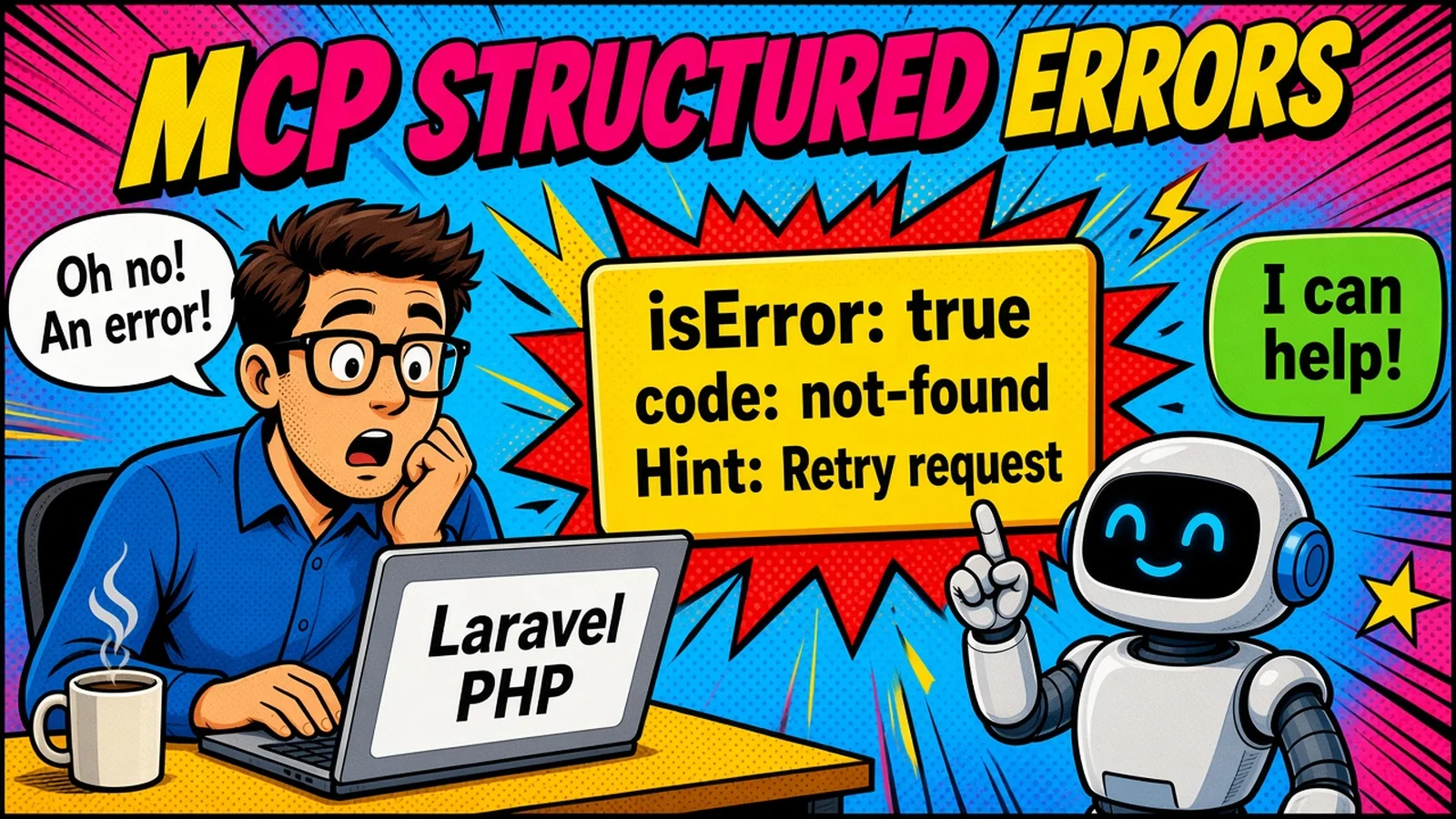
When a tool fails, the model needs a sentence it can act on, not a crashed server.
Auth and audit logging keep a tool attributable. Idempotency keys keep a retry from charging twice. Neither helps if a failed tool call looks like a crashed server to the model.
I keep seeing the same bug in Laravel MCP servers. A domain failure throws, the transport turns it into a JSON-RPC error (or an empty 500), and Claude never gets a sentence it can use to self-correct.
The agent retries the same bad invoice ID, invents a different tool, or apologizes to the user. The invoice was simply not in that tenant.
This post is the third gate I ship with every mutating MCP surface: tool execution errors that stay inside the tool result, carry a stable code, and tell the model what to try next, without leaking stack traces or other tenants’ IDs.
The failure mode
A support agent asks Claude to fetch invoice inv_9f2. Your tool does this:
public function handle(string $invoiceId, McpActor $actor): array
{
    $invoice = Invoice::query()
        ->where('tenant_id', $actor->tenantId)
        ->where('id', $invoiceId)
        ->firstOrFail(); // ModelNotFoundException → 500 / JSON-RPC error

    return $this->present($invoice);
}
firstOrFail() is correct for an HTTP controller that should return 404. Over MCP it is wrong.
Two channels for errors
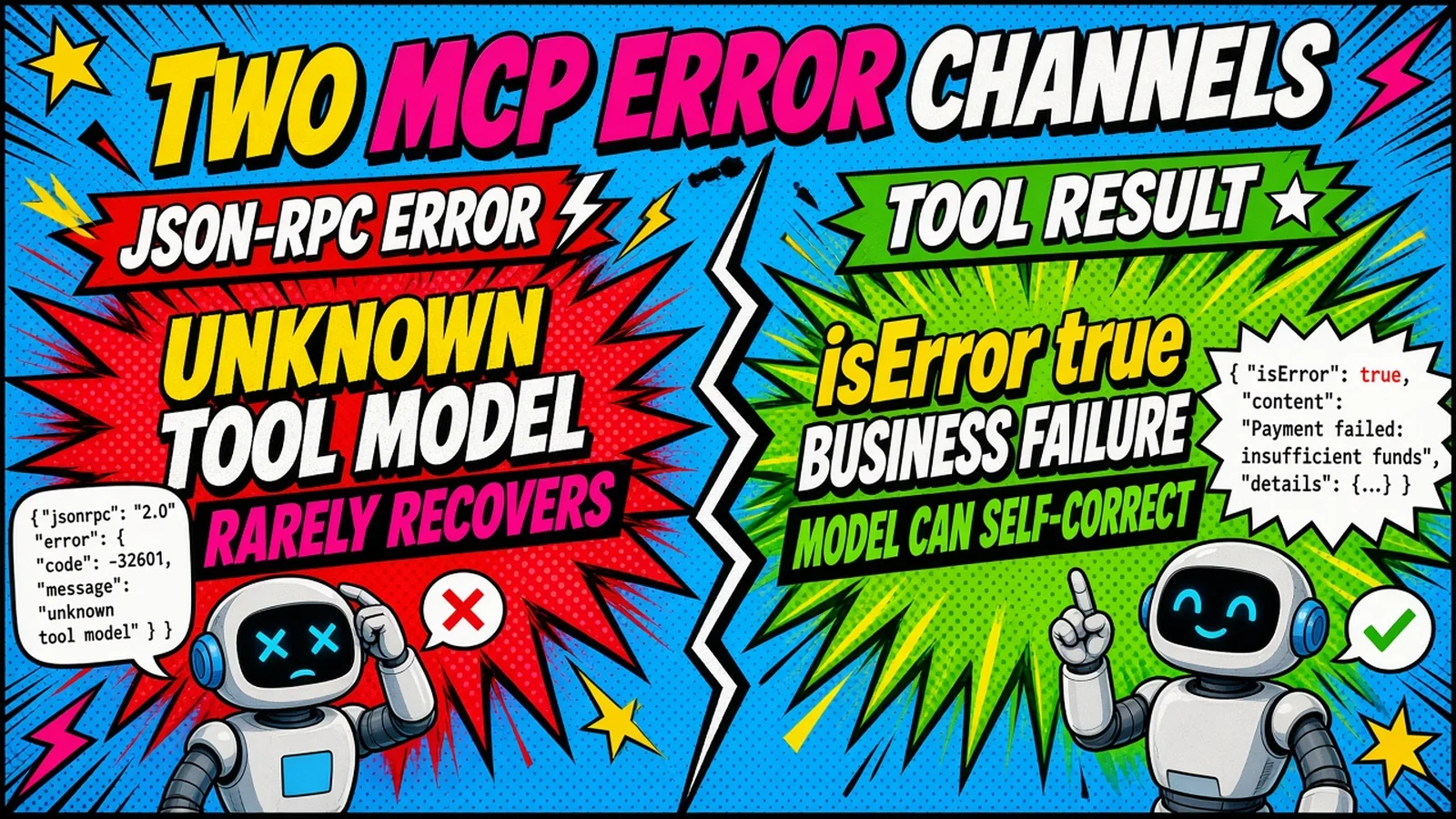
The Model Context Protocol draws a hard line:
- Protocol / request errors: unknown tool name, malformed arguments at the RPC layer. JSON-RPC
errorobject. The client may surface these; models rarely recover well. - Tool execution errors: business failure, missing row, permission denial you already decided to explain, upstream timeout. Reported as a successful
tools/callresult withisError: trueand actionable text incontent.
That second path is how the MCP tools specification expects language models to self-correct. Hide the failure in a protocol error and you train the agent to flail.
Return isError. Do not throw across the wire.
Every tool handler ends in one of three shapes:
final class McpToolResult
{
    public static function ok(array $payload): array
    {
        $json = json_encode($payload, JSON_THROW_ON_ERROR);

        return [
            'content' => [['type' => 'text', 'text' => $json]],
            'structuredContent' => $payload, // optional; keep in sync with outputSchema if you declare one
            'isError' => false,
        ];
    }

    public static function fail(
        string $code,
        string $message,
        bool $retryable = false,
        ?string $hint = null,
    ): array {
        $body = array_filter([
            'error' => [
                'code' => $code,
                'message' => $message,
                'retryable' => $retryable,
                'hint' => $hint,
            ],
        ]);

        $text = $hint
            ? "{$message} Hint: {$hint}"
            : $message;

        return [
            'content' => [['type' => 'text', 'text' => $text]],
            // Prefer omitting structuredContent on errors unless your clients
            // are known to skip outputSchema validation when isError is true.
            'isError' => true,
        ];
    }
}
Notes that bite in production:
isError: trueis still a successful RPC result. The call happened; the business outcome failed. That is the whole point.- Put the recovery text in
content. Models read the text blocks. A code alone is not enough. - Be careful with
structuredContenton errors if the tool declaresoutputSchema. Some clients still validate error payloads against the success schema. The safe default today: actionable text incontent, no structured error object, unless you have verified your client stack. - Never put secrets, stack traces, SQL, or other tenants’ identifiers in the text the model sees. Audit can keep a redacted internal reason; the agent gets a public message.
Map Laravel domain failures to a small code set
Do not invent a new error dialect per tool. Use one mapper, shared with the auth gate denial reasons and the idempotency conflict codes:
| Code | When | Retry? | Hint |
|---|---|---|---|
not_found | Missing in this tenant | no | List first; check the ID |
forbidden | Actor lacks scope | no | Elevate or pick another resource |
validation_failed | Args fail domain rules | no | Name the bad field and expected shape |
conflict | Same key, different args | no | New key for a new intent |
in_flight | Idempotency claim held | yes | Retry the same key shortly |
rate_limited | Tool budget exhausted | yes | Back off; include Retry-After |
upstream_unavailable | Provider blip | yes | Retry once; no second refund |
internal | Truly unexpected | no | Stop; send the user to support |
final class McpErrorMapper
{
    public function fromThrowable(\Throwable $e, McpActor $actor): array
    {
        return match (true) {
            $e instanceof ModelNotFoundException => McpToolResult::fail(
                code: 'not_found',
                message: 'Resource not found in your workspace.',
                hint: 'List resources first, then retry with an ID from that list.',
            ),
            $e instanceof AuthorizationException => McpToolResult::fail(
                code: 'forbidden',
                message: 'You are not allowed to run this tool on that resource.',
                hint: 'Ask the account owner for the required permission.',
            ),
            $e instanceof ValidationException => McpToolResult::fail(
                code: 'validation_failed',
                message: $e->validator->errors()->first() ?: 'Invalid arguments.',
                hint: 'Fix the field named in the message and call again.',
            ),
            $e instanceof IdempotencyConflict => McpToolResult::fail(
                code: 'conflict',
                message: 'Idempotency key was reused with different arguments.',
                hint: 'Generate a new idempotency_key for a new intent.',
            ),
            $e instanceof IdempotencyInFlight => McpToolResult::fail(
                code: 'in_flight',
                message: 'A request with this idempotency key is still running.',
                retryable: true,
                hint: 'Wait a few seconds and retry with the same idempotency_key.',
            ),
            default => McpToolResult::fail(
                code: 'internal',
                message: 'The tool failed unexpectedly. Do not retry with new side effects.',
                hint: 'Tell the user support needs the session id '.$actor->sessionId.'.',
            ),
        };
    }
}
Catch once, at the adapter
Catch at the MCP adapter boundary, once, not inside every tool with a different string. Tools throw domain exceptions. The adapter decides what the model is allowed to see.
public function invoke(string $tool, array $args, McpActor $actor): array
{
    try {
        $this->auth->assertAllowed($actor, $tool, $args);
        $result = $this->tools->run($tool, $args, $actor);
        $this->audit->allowed($tool, $args, $result);

        return McpToolResult::ok($result);
    } catch (\Throwable $e) {
        $error = $this->errors->fromThrowable($e, $actor);
        $this->audit->denied($tool, $args, $this->errors->codeOf($e));

        return $error;
    }
}
not_found must mean “not in this tenant,” the same rule as your global scopes from Laravel multi-tenancy. A row that exists for another customer is still not_found to this actor.
Never return forbidden with the other tenant’s ID in the message. That is an enumeration leak dressed as honesty.
Hints beat apologies
Bad tool error
Better
list_invoices for this customer, then retry get_invoice with an ID from that list.The first one is useless. The model will guess.
The hint should name another tool the agent already has, or a field to fix, not a URL to your internal runbook.
For retryable: true, say what to reuse. Idempotency taught us that “retry” without “same key” creates double refunds. Encode that in the hint every time:
A refund with this idempotency key is still in flight.
Hint: wait ~30s and call refund_order again with the SAME idempotency_key and arguments.Audit the code the model saw
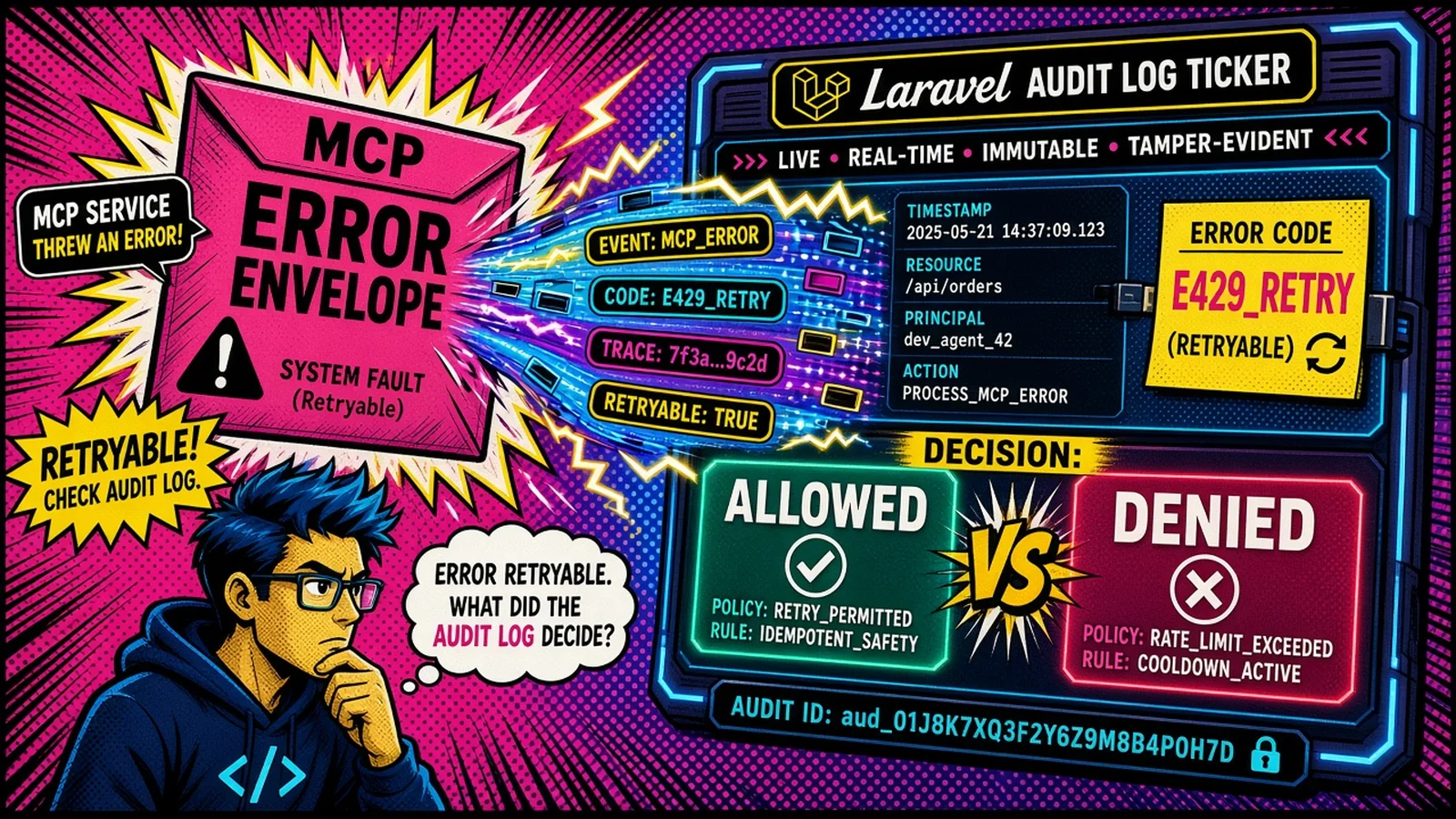
Your audit stream already records allowed | denied | replayed. Store the public error code on denials.
When an agent loops on not_found fifty times, you want a query, not a vibes-based log scroll.
McpAuditEvent::query()->create([
    'tenant_id' => $actor->tenantId,
    'user_id' => $actor->userId,
    'session_id' => $actor->sessionId,
    'tool' => $tool,
    'decision' => 'denied',
    'reason' => $code, // not_found | forbidden | …
    'args_hash' => hash('sha256', json_encode($redactedArgs)),
    'args' => $redactedArgs,
    'result_summary' => ['isError' => true, 'code' => $code],
    'idempotency_key' => $args['idempotency_key'] ?? null,
    'duration_ms' => $ms,
]);
Ops dashboard: top denied codes per tool, per tenant, last 24h. Product signal: a spike in validation_failed usually means your tool schema description is lying to the model.
What I refuse to ship
firstOrFail()/ uncaught exceptions escaping the MCP adapter- JSON-RPC errors for “invoice missing” or “seat already reset”
- Stack traces, SQLSTATE, or filesystem paths in
contenttext - Different error shapes per tool (
errvserrorvsmessageonly) forbiddenmessages that confirm another tenant’s resource exists- Swallowing idempotency
conflict/in_flightinto a genericinternal - Marking money-moving failures
retryable: truewithout a key
If a human API would return 404/409/422 with a problem+json body, the agent path needs isError with a code and a hint, not a thrown Exception.
Wiring it into the series
This sits on top of MCP auth and audit logging and idempotency keys for mutations. Same McpActor, same audit table, same claim codes, now visible to the model instead of only to your pager.
Tenancy rules stay the Laravel multi-tenancy ones; do not invent a parallel “agent ACL.”
For wallet-level token budgets at the LLM edge, that is a different layer. See rate limiting your AI wallet. Tool errors are what happen after the model is already allowed to call you.
If your MCP tools still throw through to the client and you want the error surface reviewed before agents hold live keys, start with an AI Integration Sprint. We will inventory which failures are recoverable, which must stop the loop, and how the audit trail proves it after a bad night.
Key takeaways
- Use MCP tool-result errors (
isError: true) for business failures. Reserve JSON-RPC errors for protocol problems. - Catch once at the adapter. Map domain exceptions to a small, stable code set.
- Write for the model: message + hint that names the next tool or field; set
retryablehonestly. - Omit or carefully handle
structuredContenton errors ifoutputSchemais in play. - Audit the same codes the agent saw. Spikes are product bugs, not just noise.
- Never leak cross-tenant existence through clever error text.
When your agent hits a missing invoice today, does it get a hint it can act on, or a crash it can only apologize for?