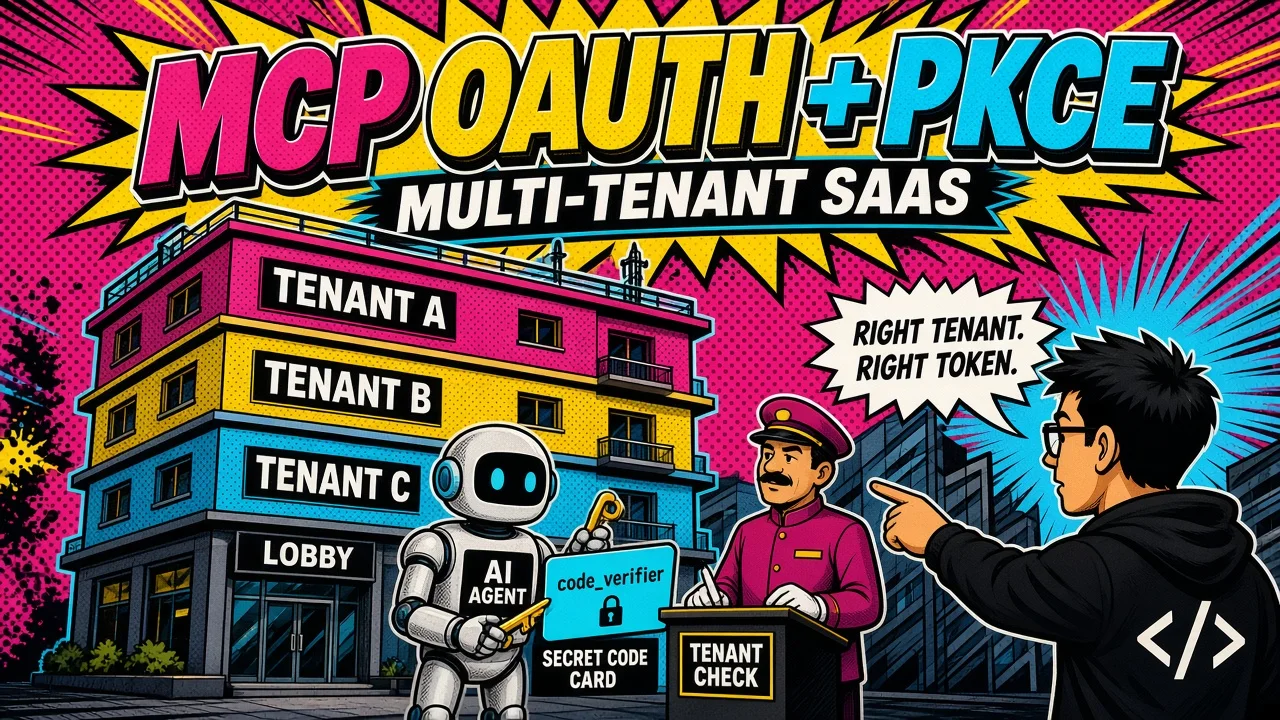
Giving Claude a tool that can read tickets and billing is useful. Giving it the same credentials your admin panel uses is how you invent a new incident class.
I have been wiring MCP servers into real Laravel SaaS surfaces, the same domain that powers the MCP SaaS case study.
The hard part is not JSON-RPC. The hard part is making sure every tool call is tenant-scoped, attributable, and auditable, without teaching the model a parallel permission system.
This post is the pattern I keep shipping: actor context on the request, tools that refuse to invent a tenant, and an audit log that survives a prompt injection attempt.
The failure mode
Most first MCP demos look like this:
- Boot a Laravel app.
- Register
list_tickets,get_invoice,refund_order. - Hand the MCP client a service-account token that can do all three for every tenant.
- Call it a day.
That works in a sandbox. In production it fails the moment:
- Two tenants share a deployment and the agent “helpfully” looks up the wrong invoice ID.
- A prompt-injected ticket description asks the agent to dump another customer’s billing.
- A retry doubles a refund because nobody recorded the tool call idempotency key.
- You get paged and the logs say
tool=refund_order ok=truewith no actor, no tenant, and no arguments.
MCP does not invent tenancy for you. Laravel already has it. The job is to force every tool through that gate.
One actor per request
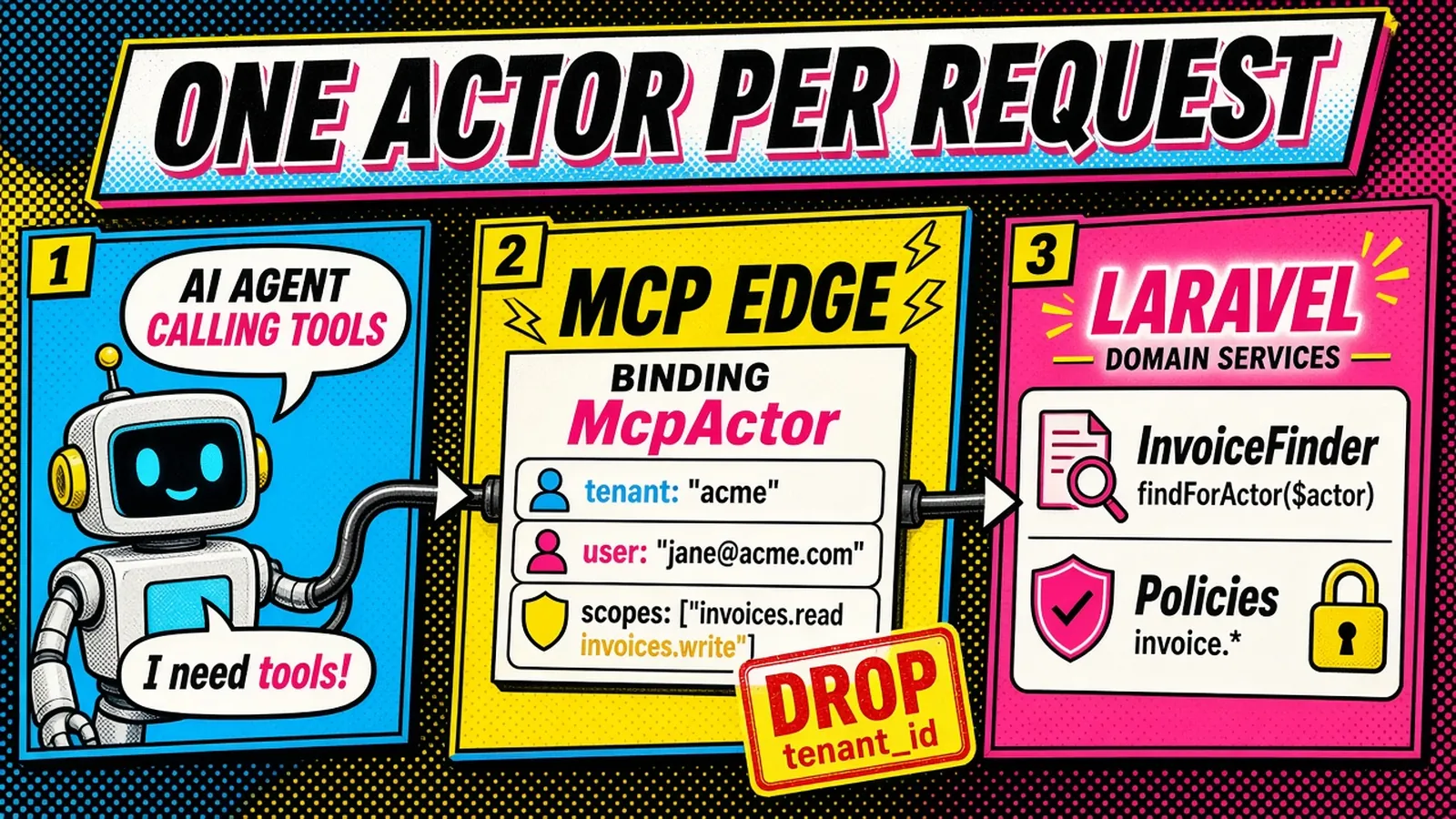
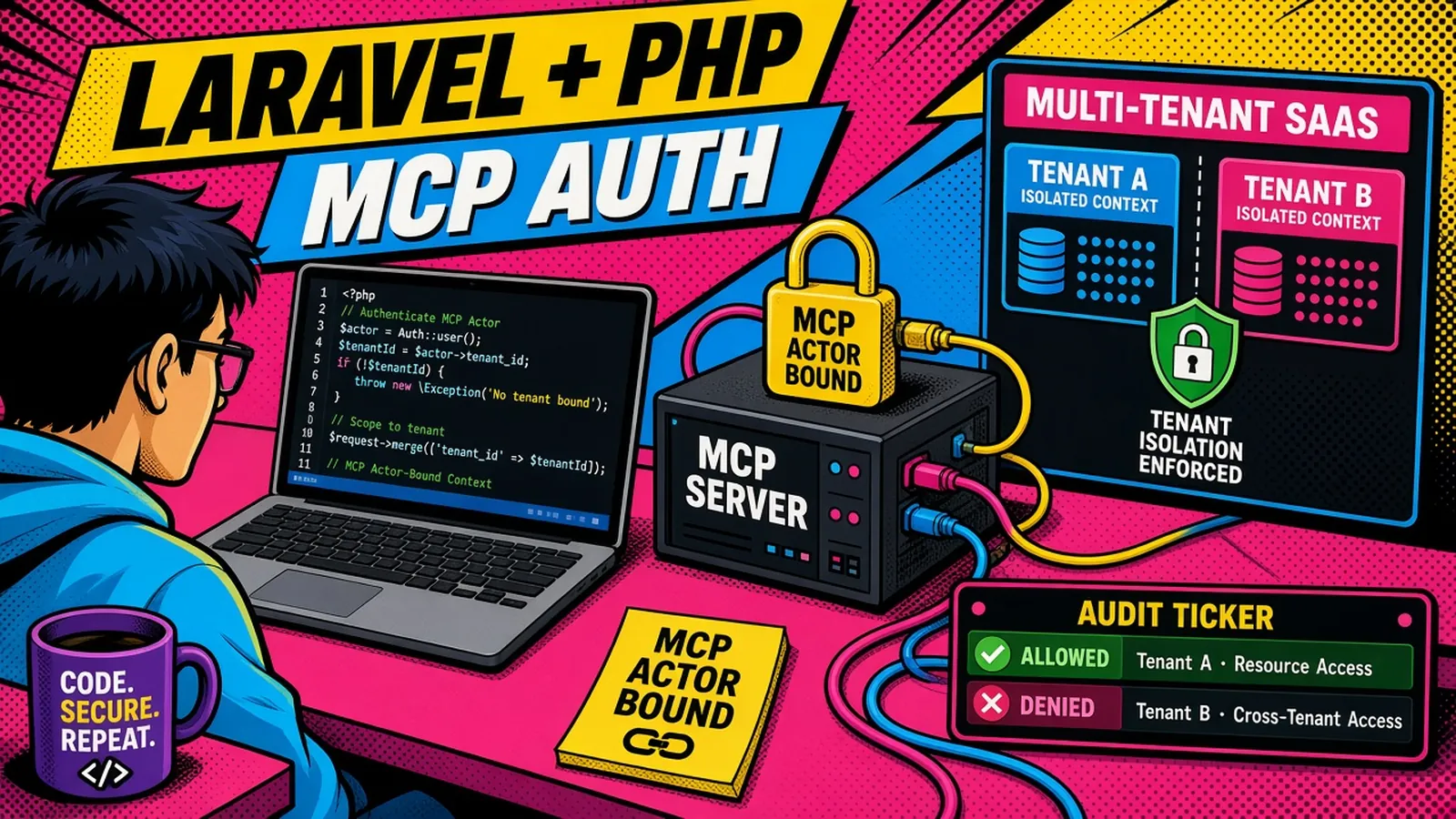
Treat an MCP tool invocation like an HTTP request that happens to arrive over JSON-RPC. Bind an actor before any tool runs:
final class McpActor
{
    public function __construct(
        public readonly string $tenantId,
        public readonly string $userId,
        public readonly string $sessionId,
        /** @var list<string> */
        public readonly array $scopes,
    ) {}
}
Resolve it once at the transport edge (API token, signed agent session, or OAuth subject) and stash it on the container for the lifetime of that call:
app()->instance(McpActor::class, $actor);Tools never accept tenant_id from the model. If the model passes one, drop it. The only tenant that exists is the one on McpActor.
That single rule kills the most common cross-tenant footgun: an LLM that “found” an ID in context and used it.
Tools are thin. Domain services stay thick.
Keep MCP handlers boring. Authorize, call the same service the Filament admin would call, return a shaped DTO:
final class GetInvoiceTool
{
    public function __construct(
        private readonly McpActor $actor,
        private readonly InvoiceFinder $invoices,
        private readonly McpAuditLogger $audit,
    ) {}

    public function __invoke(array $args): array
    {
        $invoiceId = (string) ($args['invoice_id'] ?? '');

        $invoice = $this->invoices->findForTenant(
            tenantId: $this->actor->tenantId,
            invoiceId: $invoiceId,
        );

        if ($invoice === null) {
            $this->audit->denied('get_invoice', $args, 'not_found_or_foreign');
            return ['error' => 'invoice_not_found'];
        }

        if (! in_array('billing:read', $this->actor->scopes, true)) {
            $this->audit->denied('get_invoice', $args, 'missing_scope');
            return ['error' => 'forbidden'];
        }

        $payload = $invoice->toMcpArray();
        $this->audit->allowed('get_invoice', $args, $payload);

        return $payload;
    }
}
Notice what is missing: a raw GraphQL passthrough, a DB::table query that forgets tenant_id, and any path where “not found” and “wrong tenant” diverge. Same response. Same audit reason code you can filter later.
If you already enforce tenancy in Eloquent global scopes, keep them. MCP is not a reason to bypass them “just this once.”
Audit log shape that survives an incident
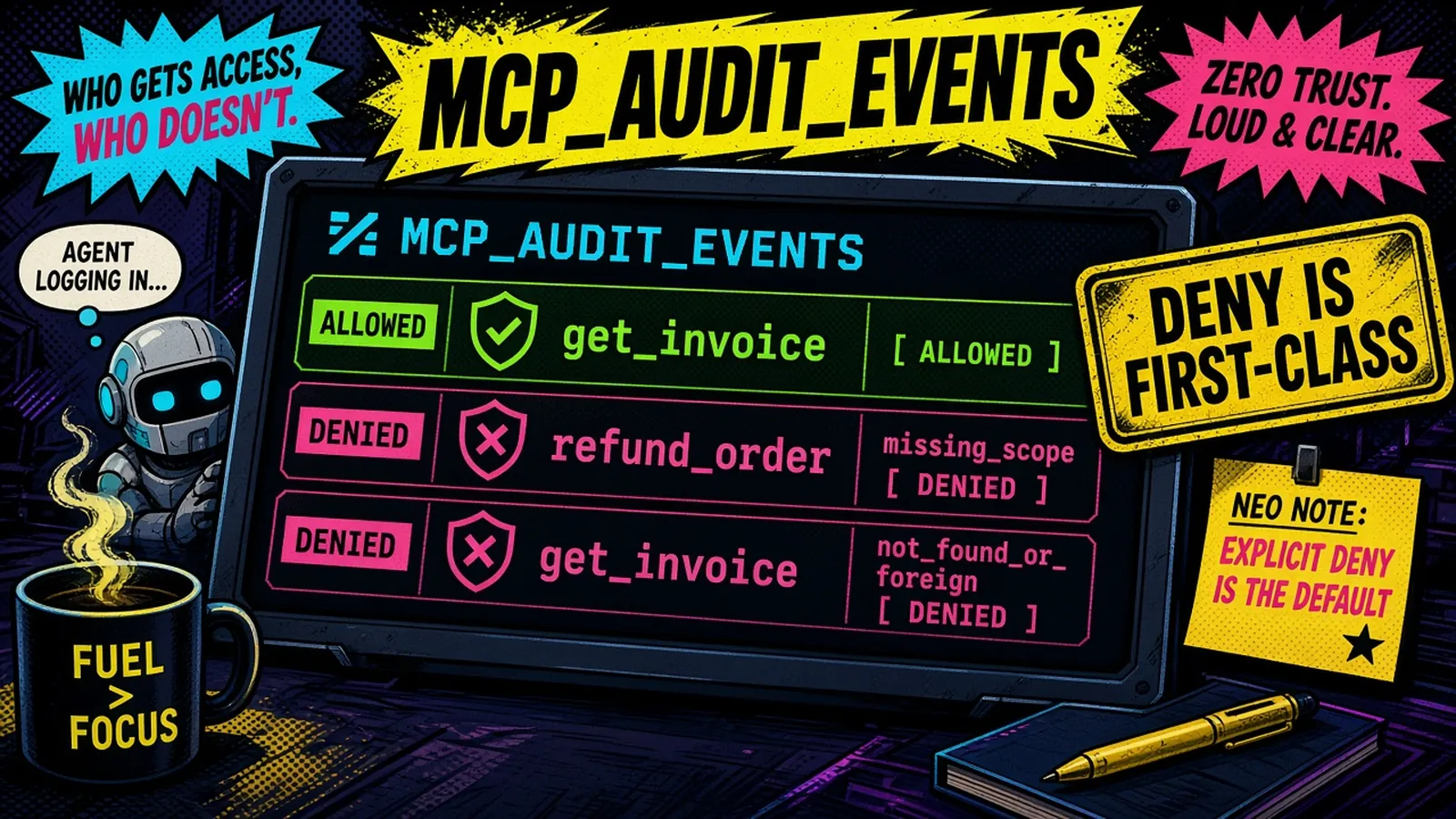
I log one row per tool attempt, allowed or denied, with enough to reconstruct the call without storing secrets:
McpAuditEvent::query()->create([
    'tenant_id' => $actor->tenantId,
    'user_id' => $actor->userId,
    'session_id' => $actor->sessionId,
    'tool' => $tool,
    'decision' => $decision, // allowed | denied
    'reason' => $reason,
    'args_hash' => hash('sha256', json_encode($redactedArgs)),
    'args' => $redactedArgs,
    'result_summary' => $summary, // counts / IDs, never card data
    'idempotency_key' => $idempotencyKey,
    'duration_ms' => $ms,
]);
Rules that have paid for themselves:
- Redact before write. Tokens, raw card PANs, and full email bodies do not belong in
args. - Hash + store. The hash lets you prove two calls carried the same payload without dumping PII into every analytics export.
- Deny is a first-class event. Most teams only log successes. The interesting story is usually a denied
refund_orderright before a successful one from a different session. - Idempotency keys for mutations. Refunds, seat resets, and password emails must key on something the client retries with. Store it on the audit row and short-circuit duplicates.
This is the same discipline I want on agentic commerce checkouts. Money-moving tools are just the obvious version of the rule.
Typical log
tool=refund_order ok=true, with no actor, no tenant and no arguments.Audit row
Scopes beat role names
is_admin is a product concept. MCP wants capabilities:
tickets:read
tickets:write
billing:read
billing:refund
docs:search
Map your SaaS roles onto scopes at session mint time. The tool checks scopes.
When a customer upgrades from “support viewer” to “billing ops,” you change the session mint, not every tool.
Also expire sessions aggressively. An MCP session that lives for a week is a stolen-laptop story waiting to happen.
What I refuse to expose
A short deny-list that has saved me more than any middleware:
- Arbitrary Eloquent / Query Builder execution
- Raw GraphQL or “run this SQL” tools
- Cross-tenant search “for convenience”
- Tools that return full PII when a masked summary would do
- Mutations without an idempotency key
- Anything that bypasses the same policy class the HTTP API uses
Wiring it into the series
This sits next to Laravel multi-tenancy and Octane under load on the framework side, and next to MCP vs A2A on the protocol side.
The tenancy model is Laravel. The tool surface is MCP. The trust boundary is yours.
If you are putting Claude on top of a multi-tenant Laravel app and want a second pair of eyes on the boundary, start with an AI Integration Sprint. We will map the tools, the scopes, and the audit trail before any agent sees production data.
Key takeaways
- Never let the model choose the tenant. Bind
McpActorat the edge; tools read it, they do not accept it. - Thin tools, thick domain. Reuse the same finders and policies as your admin UI.
- Audit allows and denies. Include tool, actor, redacted args, reason, and idempotency key.
- Scopes over roles at the MCP boundary. Mint short-lived sessions.
- No parallel API. If it is dangerous in HTTP, it is dangerous in JSON-RPC.
If you got paged tonight about a strange refund, could your audit log tell you which actor, tenant and session asked for it?