
If your shopping agent still calls get_cart and update_cart on https://{shop}.myshopify.com/api/mcp, you are running on deprecated tools.
Shopify announced the deprecation on June 24, 2026. Maintenance for those Storefront MCP cart tools ended on August 31, 2026.
Agents that have not moved are now on unmaintained tools, and they can fail mid-conversation while buyers still expect a cart.
The replacement is UCP Cart MCP at https://{shop-domain}/api/ucp/mcp. Same commerce job. Different endpoint, tool set, and request shape.
This post is the migration map: what breaks, what replaces it, and a checklist you can run against any agent still wired to /api/mcp.
For the broader agent-ready storefront story, start with the Shopify UCP quick-start and secure agentic commerce on Shopify.
What is being deprecated
On Storefront MCP (/api/mcp), cart support was essentially two tools:
get_cartupdate_cart
Those tools mixed “create if missing” behavior into update, patched line items like a classic AJAX cart, and lived next to policy search on the legacy storefront MCP surface.
UCP Cart MCP implements the UCP cart capability (dev.ucp.shopping.cart, version 2026-08-25 in current Shopify docs) and exposes four tools on /api/ucp/mcp:
| Tool | Job |
|---|---|
create_cart | Start a cart with line items and optional buyer context |
get_cart | Read current cart state and estimated totals |
update_cart | Replace the full cart state (PUT semantics) |
cancel_cart | Delete the cart; requires an idempotency key |
Catalog discovery (search_catalog, lookup_catalog, get_product) already moved toward the UCP endpoint. Cart is catching up. Treat /api/mcp cart calls as a compatibility shim, not a long-term contract.
Official references: deprecation changelog and Cart MCP docs.
Endpoint and request shape
Point every cart tools/call at:
POST https://{shop-domain}/api/ucp/mcpCart tools accept unauthenticated requests. That lets an agent estimate totals and share a continue_url before the buyer signs in.
Checkout is a different server with stricter auth and rate limits; keep exploratory work on Cart MCP.
The meta block
Every cart call must include meta in arguments:
{
  "meta": {
    "ucp-agent": {
      "profile": "https://your-agent.example/.well-known/ucp"
    }
  }
}
That profile URI is how the merchant negotiates capabilities. Skipping it is not a soft warning; it is a failed request.
Hosting that profile is the agent equivalent of registering an OAuth app. Pair this post with the secure agentic commerce guidance when you harden trust tiers.
Ids and responses
For get_cart, update_cart, and cancel_cart, pass the cart id as a top-level id in arguments. Do not nest id inside the cart object on write.
Responses land in result.structuredContent. Read the cart object there.
Business problems (expired cart, quantity adjusted) often arrive as a successful JSON-RPC result with entries in cart.messages, not as a protocol error. If your client only checks JSON-RPC errors, you will miss quantity adjustments and not_found.
create_cart is not optional
Legacy update_cart often created a cart when no id was sent. UCP splits that out.
Use create_cart when the buyer has selected variants and you want estimated totals, multi-turn edits, or a shareable continue_url without starting checkout. Include:
cart.line_items[]withquantityanditem.id(variant GID, which my Shopify GID decoder can unpack)- optional
context(address_country, region, postal code) for pricing and availability hints - optional
attribution(UTM / click ids) if you will later convert to checkout - optional
buyerfor personalized estimates
If you plan to call Checkout MCP create_checkout with this cart, set attribution on the cart before conversion. The merchant uses the cart’s line items, context, buyer, and attribution when creating checkout and ignores overlapping fields in the checkout payload.
When the buyer is ready to pay, pass the cart id as cart_id into create_checkout. Conversion is idempotent for the same cart id.
PUT semantics will break naive agents
This is the sharp edge of the migration.
update_cart on UCP Cart MCP replaces the cart. Omit line_items, context, or attribution and those fields are removed. There is no server-side merge.
That differs from Storefront API and AJAX cart mutations, and from the old Storefront MCP patch-style mental model.
Patch habit
UCP PUT
attribution and context, on every update.
Practical rules for agent tool wrappers:
- Keep the last known full cart snapshot in your session store.
- Apply the buyer’s delta in your code (qty change, remove line, new postal code).
- Send the entire desired
cartobject on everyupdate_cart. - Resend
attributionandcontextif you still want them.
Put that rule in the tool description and in your skill playbook, not only in a human README.
cancel_cart needs an idempotency key
cancel_cart requires meta["idempotency-key"] as a UUID in addition to ucp-agent.profile. Cancel removes the cart from storage. Later get_cart returns a business not_found outcome.
Use cancel when the buyer abandons, or when you need to clear a stale cart before starting clean.
Retries without a stable idempotency key are how you get confusing double-cancel paths. The same discipline shows up in MCP idempotency for Laravel mutations even when the server is Shopify’s, not yours.
Cart vs checkout: keep exploration cheap
Carts are long-lived browsing containers. Checkouts are short-lived purchase sessions with stricter freshness and rate limits.
| Use case | Prefer |
|---|---|
| Multi-turn browsing and total estimates | Cart MCP |
| Share a link with the buyer | Cart MCP continue_url |
| Buyer ready to purchase | Checkout MCP |
| Complete payment in your app | Checkout MCP |
Rate limits scale with how the agent identifies itself (Bearer, signed, anonymous). Anonymous Cart MCP works for exploration; Checkout MCP does not. Keep chatty quantity tweaks off checkout tools.
This split matches the MCP vs A2A vs ACP idea: pick the protocol surface that matches the job, not the one your first tutorial used.
Migration checklist for agents on /api/mcp
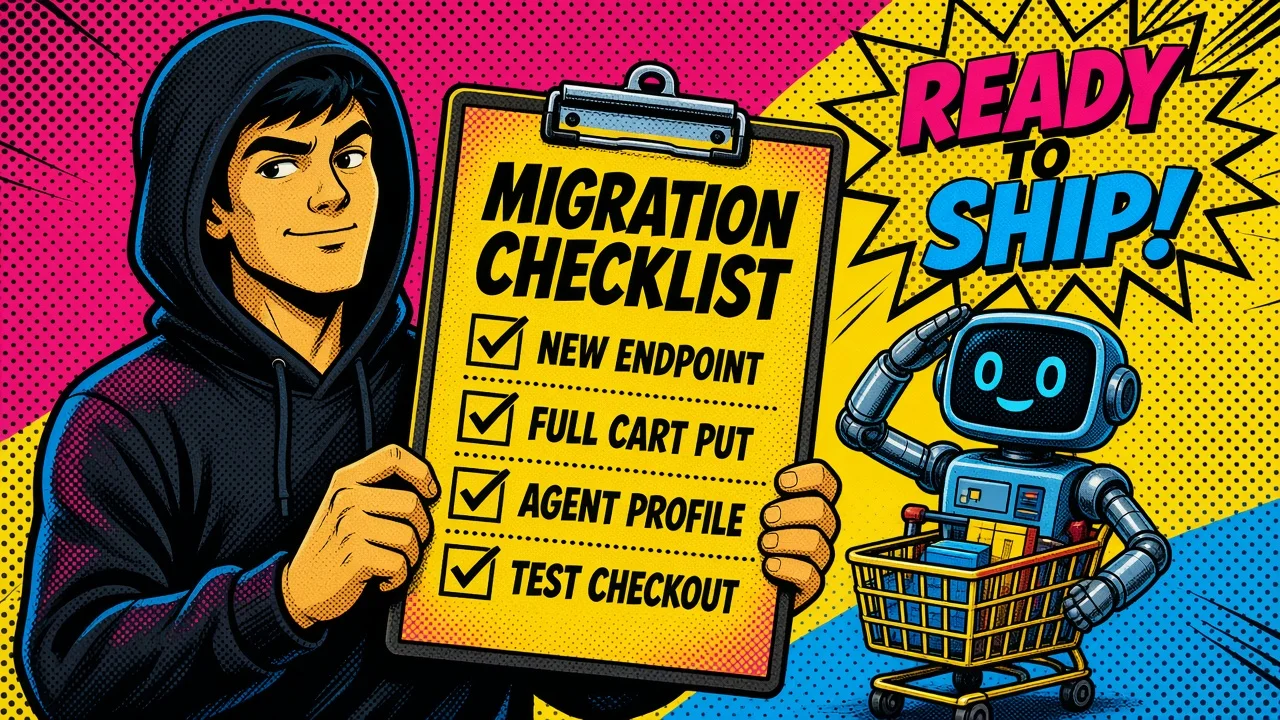
Run this against every agent, skill, and integration that still mentions Storefront MCP carts:
- Find callers. Search for
/api/mcp,get_cart, andupdate_cartin agent configs, MCP client URLs, and tool wrappers. - Retarget the endpoint to
/api/ucp/mcpfor cart tools. - Add
create_cartas an explicit step; stop inventing carts inside update. - Require
meta.ucp-agent.profileon every cart call. - Store and resend full cart state on
update_cart(PUT semantics). - Pass cart id as top-level
idfor get, update, and cancel. - Add UUID
idempotency-keyforcancel_cart. - Parse
structuredContent.cart.messagesfor business outcomes (not_found,quantity_adjusted, and friends). - Wire checkout separately: cart id into
create_checkoutonly when the buyer commits. - Dogfood on staging before you cut over. Hit a staging shop with create → update (full replace) → get → cancel → create_checkout.
If you are still designing the product around agents rather than bolting MCP onto a human-only flow, the MCP first framing helps: ship the cart tools and skills as the capability contract, then let the chat UI sit on top.
Key takeaways
- Storefront MCP
get_cart/update_carton/api/mcpare deprecated; maintenance ended August 31, 2026. Migrate now. - Migrate cart traffic to UCP Cart MCP at
/api/ucp/mcpwithcreate_cart,get_cart,update_cart, andcancel_cart. - Every request needs
meta.ucp-agent.profile; cancel also needs a UUID idempotency key. update_cartis full replacement. Partial payloads wipe omitted fields.- Keep browsing on Cart MCP; move to Checkout MCP only when the buyer is ready to pay.
- Treat
cart.messagesas first-class outcomes, not optional log noise.
If your agent still hard-codes /api/mcp for carts, which step fails first in staging: missing agent profile, empty cart after a partial update, or a checkout call that never saw a real cart id?