
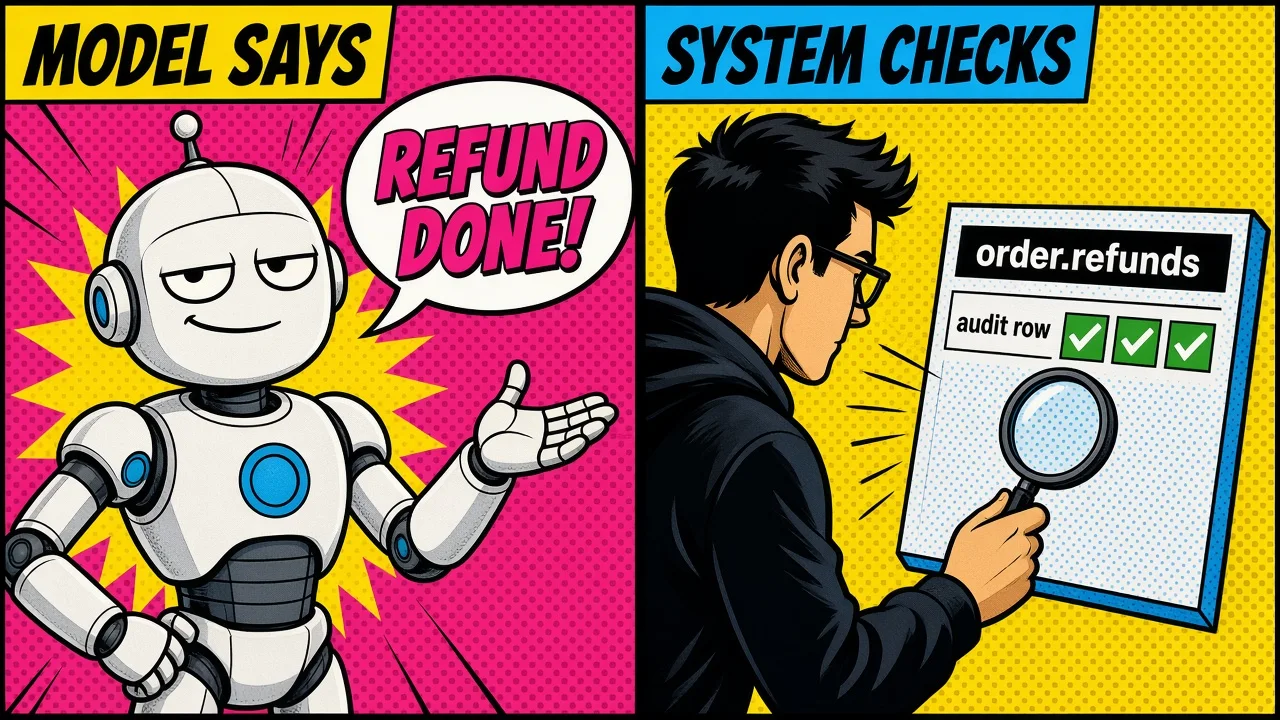
Agents are optimistic. They call a tool, see a JSON blob that looks success-shaped, and tell the user “refund sent.”
Sometimes the refund is pending. Sometimes the tool returned a structured error the model ignored. Sometimes the write never happened.
Human-in-the-loop (HITL) gates and post-mutation verification are how you stop early victory. The model can propose. Policy decides. The system checks reality before anyone celebrates.
This is the mutation half of MCP first: tools without judgment burn money.
Pair with idempotency, structured tool errors, auth and audit, and commerce paths in secure agentic commerce.
Which mutations need a gate
Not every tool needs a human. Read-only lookups should be fast. Mutations that move money, stock, or trust should slow down.

| Risk class | Examples | Default gate |
|---|---|---|
| Money out | Refunds, payouts, store credit | Approve above threshold; auto only inside policy |
| Inventory | Force adjust, unpublish, bulk price | Approve or dual-control for large deltas |
| Spend / buy | Agent checkout complete, ad spend | Buyer confirm or spend ceiling |
| Credentials | Rotate keys, invite admins | Always human for production |
| Irreversible comms | Mass email, legal notices | Approve + preview |
Thresholds are product decisions. A small shipping adjustment is not the same as a large refund. Encode ceilings in policy config, not prompt text.
For Shopify-style claims and refunds, the same idea shows up as queue triage with human resolution (claims pipeline). Auto-clear the easy half; keep edge cases for people.
Gate shapes that work
There are four shapes that hold up in production:
- Pre-tool approval: agent prepares a
proposed_actionpayload; UI or Slack asks a human to approve; only then doesexecute_refundrun with the approval id. - Two-step tools:
draft_refund(safe) thencommit_refund(requiresapproval_token). - Async review queue: mutation creates a
pendingrecord; worker waits for approve/deny; agent polls status. - Policy auto-approve: small, low-risk, fully validated cases skip the human but still write audit + verification.
Bind every approval
Always bind approvals to:
- Actor (who asked)
- Tenant
- Exact action hash / idempotency key
- Expiry (stale approvals must not run tomorrow)
Do not let the model invent an approval_id. Issue it from your system after a real human (or policy engine) decision.
Anti early-victory: verify after tools
The failure mode is consistent across stacks:
- Tool returns something the model interprets as success.
- Model narrates completion to the user.
- Downstream system never applied the change (validation, partial write, wrong environment).
Early victory
Verified
What a second read looks like
Verification is a second read (or event) that proves the world moved:
- After refund: fetch order transactions / refund set; confirm amount and status.
- After inventory adjust: read InventoryLevel (or your source of truth); confirm quantity.
- After spend: read ledger entry or checkout status; confirm
completednotopen. - After key rotate: confirm old key rejected and new key works in a dry probe.
Put verification in code the agent must call (or that your tool runner calls automatically), not only in a skill paragraph.
Pattern for a tool runner:
authorize -> idempotency begin -> mutate -> verify -> audit -> respondIf verify fails, return a recoverable structured error (verification_failed) with what was expected vs observed. Do not return a soft “ok” with a warning buried in prose.
Where HITL sits in MCP / UCP
- Your SaaS MCP: gate inside the tool or a preceding approval tool; never expose bare Admin credentials to the model (secure agentic commerce for the commerce variant).
- Shopify UCP checkout:
complete_checkoutalready sits behind trust tiers and permissions (agent profiles, buyer-linked tokens). Still verify order state before telling the buyer “paid.” - Laravel MCP: combine gates with idempotency so a double-approved click cannot double-refund.
Stateless servers (stateless MCP) make this cleaner: approval records live in your DB, not in a vanished MCP session.
Implementation checklist
- Classify tools: read / low-risk mutate / high-risk mutate.
- Define numeric ceilings per tenant for auto-approve.
- Require
approval_id(system-issued) on high-risk commits. - Expire approvals; bind them to idempotency keys.
- Auto-verify after mutate; fail closed on mismatch.
- Audit propose, approve, execute, verify as separate events.
- Teach skills: “never claim success without verify tool result.”
- UX: show the human the exact payload (amount, SKU, customer) before approve.
Key takeaways
- HITL gates belong on refunds, inventory writes, spend, and credential changes.
- Issue approval ids from your system; never trust model-invented tokens.
- Verify mutations with a second read before user-facing success copy.
- Encode ceilings and dual-control in policy config, not only prompts.
- Audit propose, approve, execute and verify as distinct events.
- Early victory is a product bug, not a charming agent quirk.
When your agent last said “all done,” did the ledger agree within a second, or did a human discover the gap in a support ticket two days later?