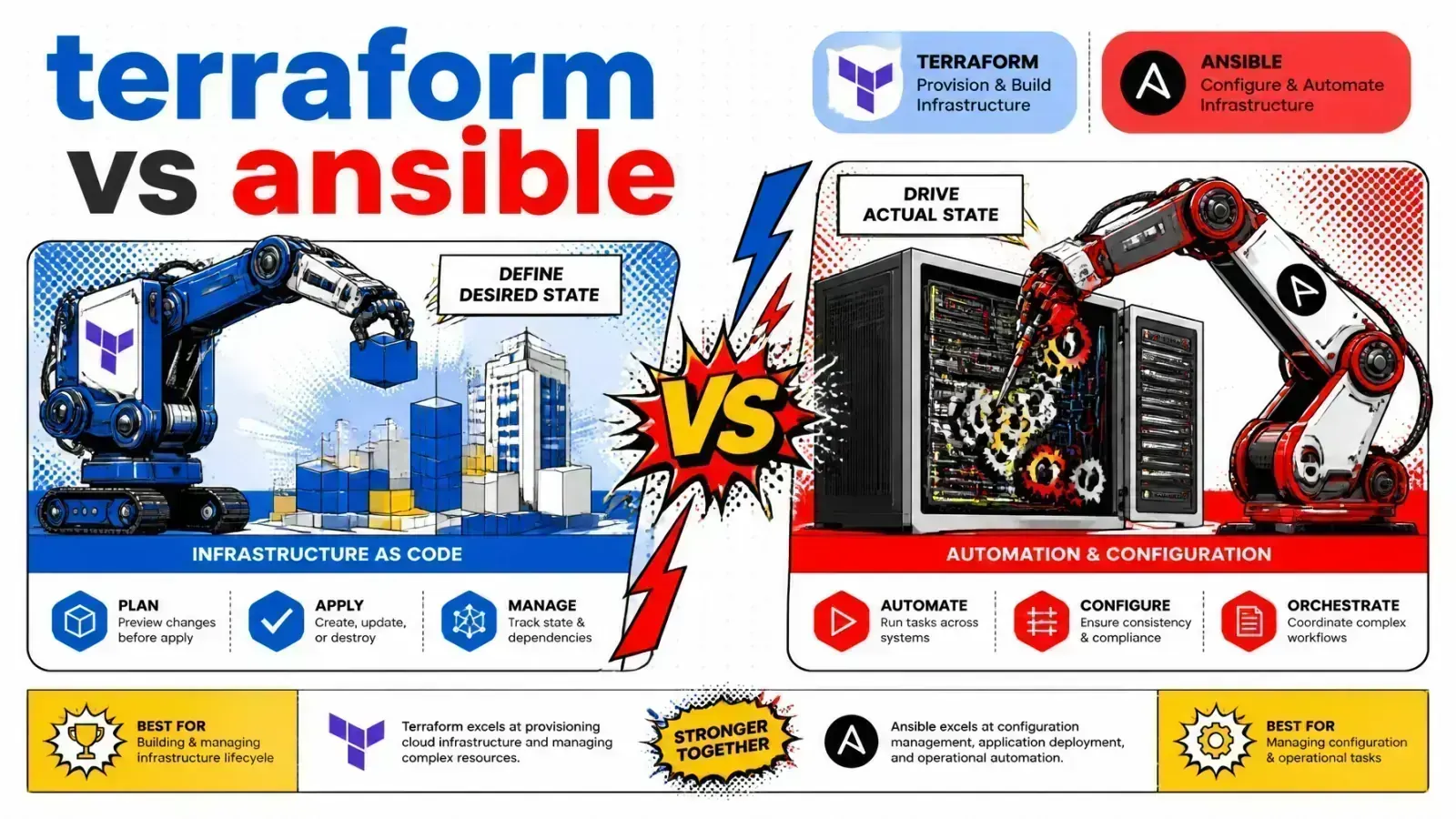
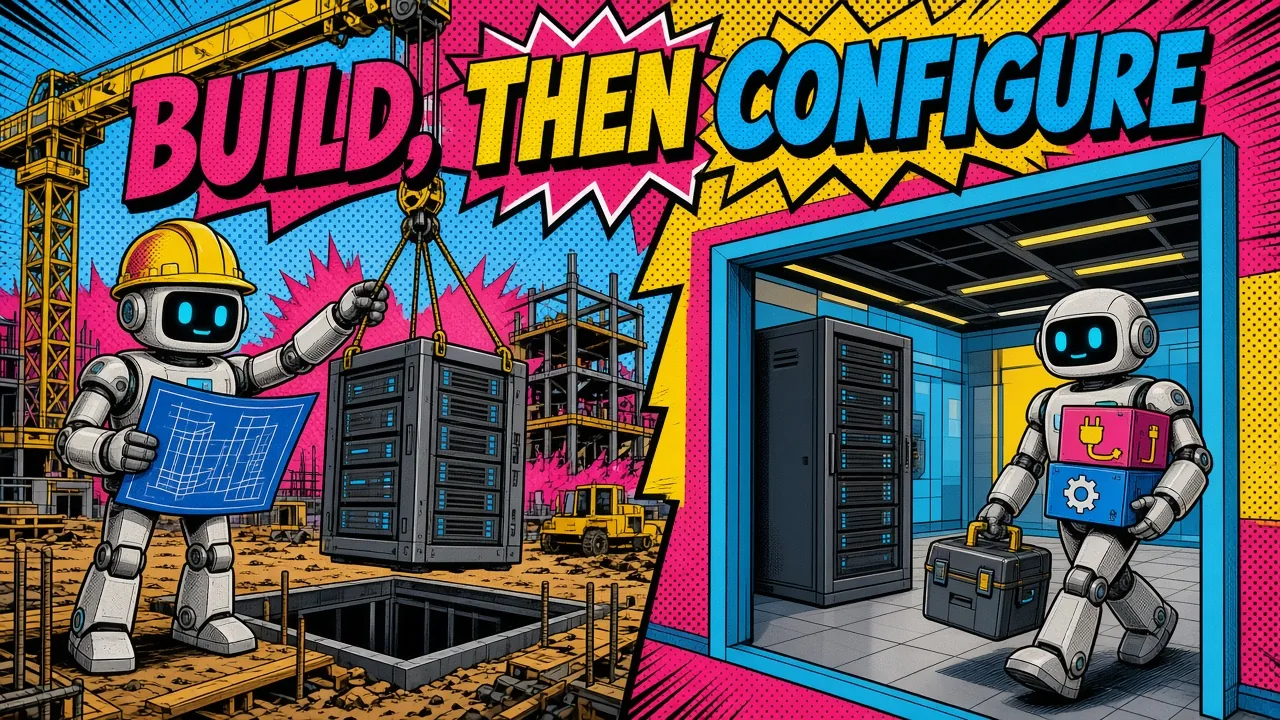
Terraform builds the servers. Ansible sets up what runs on them. Most pipeline pain comes from asking one to do the other’s job.
You spend six hours clicking through the AWS console to set up a VPC, three subnets, and a load balancer. Then you realize you missed a single security group rule that breaks the entire staging environment.
Then you have to do it all over again for production. This manual toil is a ticking time bomb for technical debt and human error.
Infrastructure as Code (IaC) is the industry standard solution, but the market is split between two titans: Terraform and Ansible. Choosing the wrong one for the task leads to fragile pipelines and “snowflake” servers that no one dares to touch.
Terraform vs Ansible: provisioning vs configuration
The most common misunderstanding in DevOps is treating Terraform and Ansible as interchangeable tools. They are not. At their core, they solve two distinct stages of the infrastructure lifecycle.
Terraform provisions
Terraform is a provisioning tool. Its main job is to talk to cloud providers like AWS, Google Cloud, or Azure to create the virtualized “hardware” of your stack: VPCs, subnets, IAM roles, and managed databases.
It builds the foundation your software will live on.
Ansible configures
Ansible is a configuration management tool. Once the server exists, Ansible takes over to install Nginx, configure the PHP-FPM pool, or deploy your latest Laravel build.
It is designed to manage the internal state of the operating system and the applications running on it.
| Feature | Terraform | Ansible |
|---|---|---|
| Primary Goal | Provisioning infrastructure | Configuration management |
| Language | HCL (declarative) | YAML (procedural/imperative) |
| State | Managed (state file) | Stateless |
| Architecture | Client-only (API-based) | Agentless (SSH/WinRM) |
| Best For | VPCs, clusters, databases | Installing apps, OS hardening |
Declarative vs procedural logic
The way you talk to these tools defines how you manage your stack. Terraform is strictly declarative. You describe the “end state” you want.
If you tell Terraform you want five EC2 instances, it compares that with the instances it already manages. If it manages three, it adds two. If it manages seven, it destroys two.
You don’t tell it how to do it; you tell it what you want the result to be. Instances created by hand outside Terraform are invisible to it until you import them.
Ansible runs steps in order
Ansible is mainly procedural (or imperative), though it uses declarative modules. You write playbooks that list a series of steps:
- Update apt-get.
- Install Docker.
- Copy the config file.
- Restart the service.
Ansible modules are idempotent (they won’t re-install Docker if it’s already there), but the workflow follows a specific sequence of commands. This makes Ansible very good at complex application deployments where the order of operations matters.
Terraform (declarative)
Ansible (procedural)
Immutable vs mutable infrastructure
The choice between Terraform vs Ansible often shapes your architectural philosophy.
Terraform leans immutable
Terraform leans heavily toward immutable infrastructure. In an immutable world, you don’t “fix” a server. If you need to update the base OS image, you destroy the old server and provision a new one from a fresh image.
This is the same philosophy behind containers and orchestration. It removes “configuration drift,” where servers that started identical become different over time because of manual patches.
Ansible is the king of mutable
Ansible is the king of mutable infrastructure. It is designed to go into existing, long-lived servers and modify them.
This is often necessary for legacy systems or complex environments where spinning up a fresh cluster for every minor config change is too slow or expensive.
For teams using self-hosted solutions like Coolify for SaaS hosting, Ansible is a good fit for managing the underlying VPS environment.
State management: the source of truth
Terraform’s superpower (and its greatest complexity) is the state file. This JSON file is a map of your real-world infrastructure.
When you run a command, Terraform compares your HCL code against this state file and the real resources to work out what needs to change.
Drift detection
This lets Terraform detect “drift”: when someone manually changes a setting in the AWS console, Terraform sees the difference and offers to revert it.
Ansible keeps no record
Ansible is stateless. It doesn’t keep a record of what it did yesterday. It simply connects to the IP addresses in your inventory and runs the playbook.
If a server is down, Ansible reports a failure, but it has no “global view” of your infrastructure the way Terraform does. This makes Ansible easier to start with but harder to use for tracking the full lifecycle of high-level cloud resources.

Better together: the hybrid workflow
In a professional DevOps pipeline, you rarely choose just one. Most strong teams use both.
A typical workflow
- Terraform provisions the network (VPC), the security groups, and the base EC2 instances using a clean Ubuntu AMI.
- Terraform outputs the IP addresses of those new instances.
- Ansible picks up those IPs and runs a playbook to install the LEMP stack, configure SSL certificates, and tune the firewall.
Why the split works
By separating the cloud fabric (Terraform) from the software layer (Ansible), you create a modular system that is easy to debug and scale.
If you move from AWS to Google Cloud, you rewrite your Terraform code for the new provider’s resources but keep your Ansible playbooks largely the same.
Wiring both stages into a single CI/CD pipeline turns this into a one-command, reproducible build.
The licensing caveat
One 2026 caveat worth flagging: HashiCorp moved Terraform to the Business Source License in August 2023, and the community forked it into OpenTofu (now a CNCF project under the Linux Foundation).
OpenTofu is a near drop-in replacement using the same HCL syntax and state format, so “Terraform” in this article applies equally to it. IBM completed its acquisition of HashiCorp in February 2025, which has only sharpened that licensing question for teams.
Key takeaways
- Terraform is for building the house (infrastructure). It is declarative, immutable, and stateful.
- Ansible is for decorating and maintaining the house (software configuration). It is procedural, mutable, and stateless.
- Use Terraform to manage resources with a clear lifecycle, like databases and load balancers.
- Use Ansible to manage the “inside” of a VM, such as package updates and application deployments.
- Avoid using Ansible to provision cloud resources; while possible, it lacks the state management and dependency graphing of Terraform.
- Combine both tools in a CI/CD pipeline for a fully automated, reproducible environment.
If you had to rebuild your entire production environment from scratch in 30 minutes, would your current automation tools be enough to restore both the infrastructure and the application state?