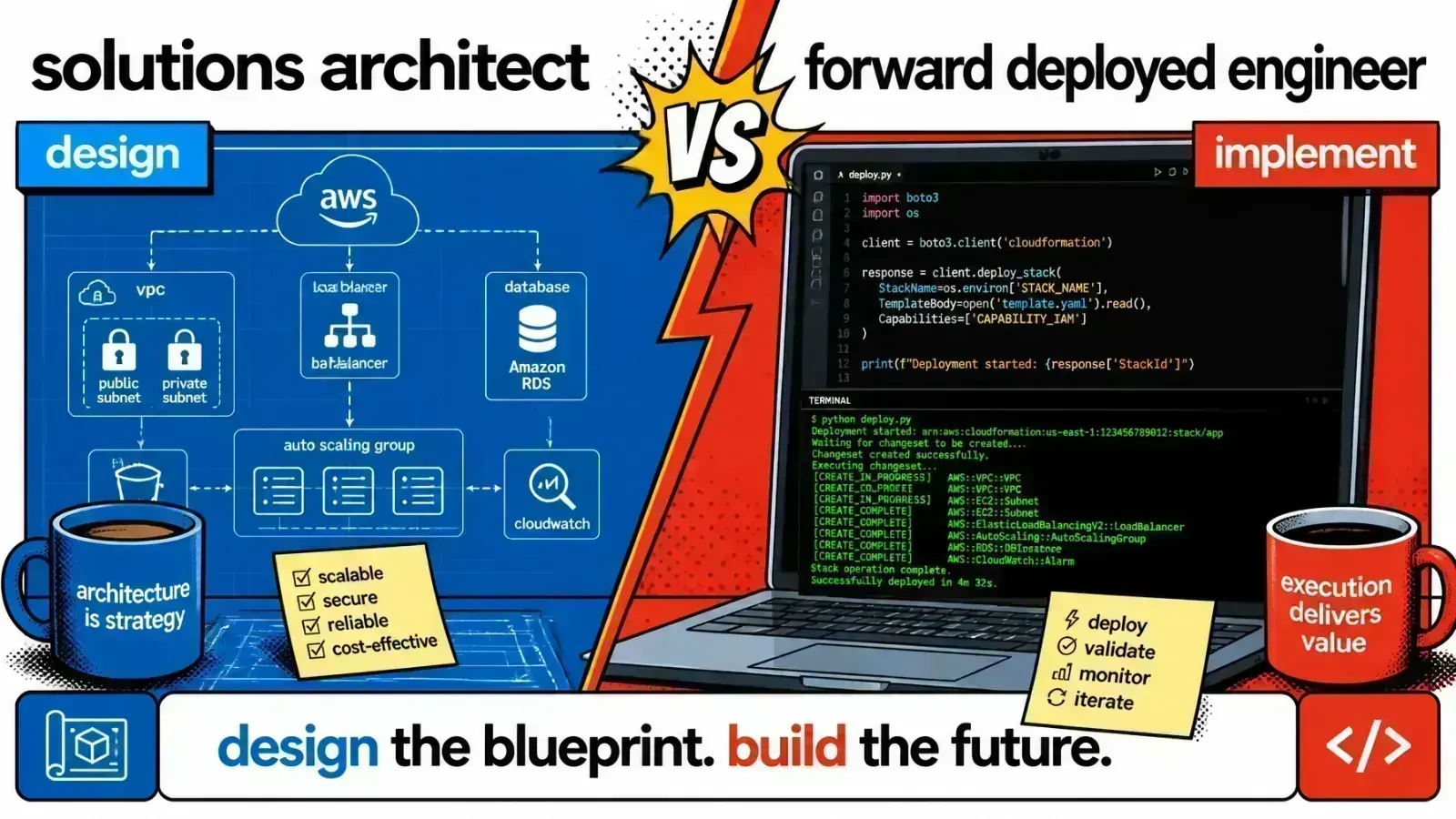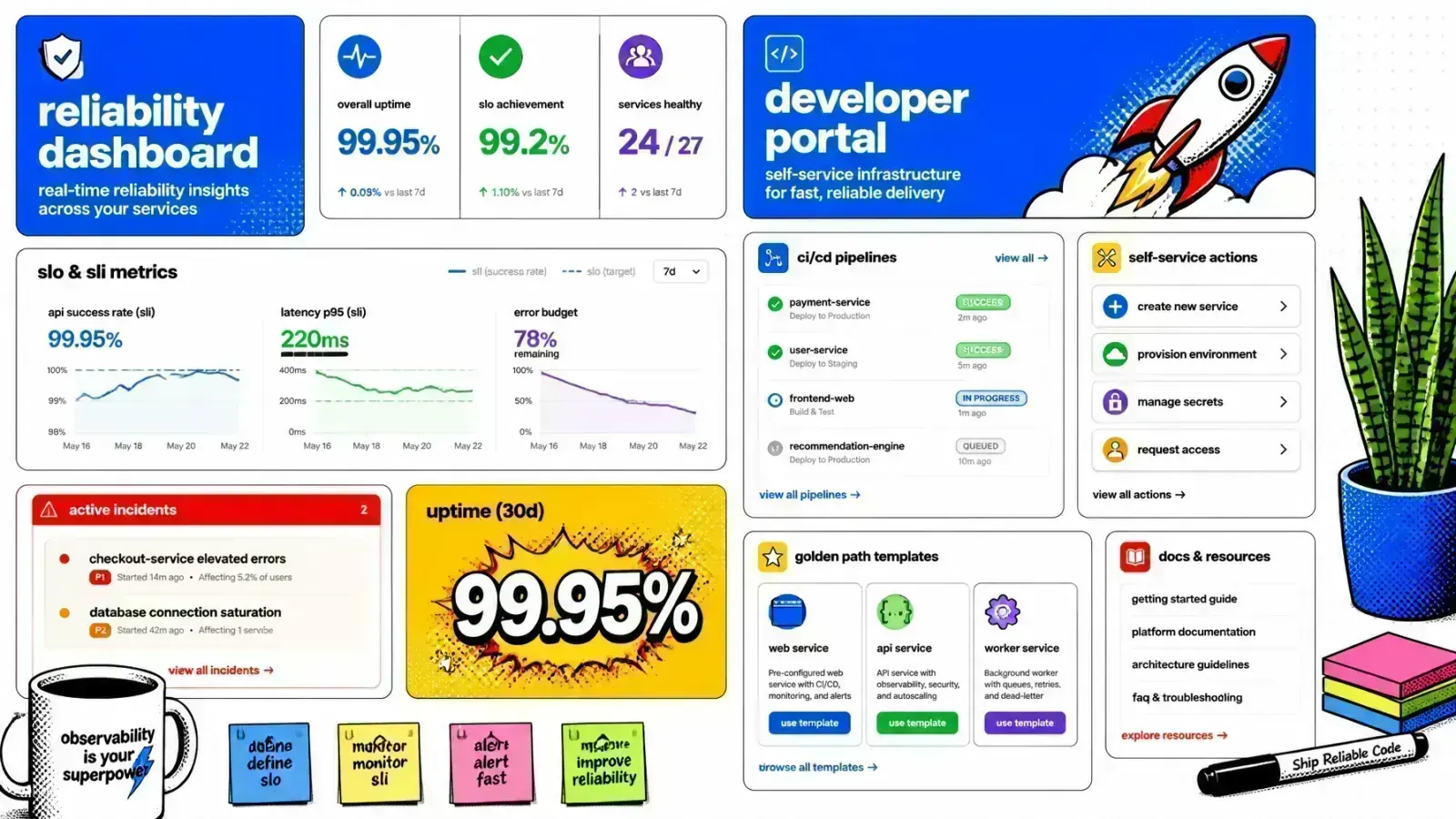
An SRE keeps production up for your users. A platform engineer makes shipping easy for your developers. Hire for the bottleneck you have today.
Your production environment is down and the error budget is burning. You have two choices.
You can hire someone to fix the immediate fire and make sure it never happens again. Or you can hire someone to build the tools that keep your developers from starting that fire in the first place.
This is the core tension between Site Reliability Engineering (SRE) and Platform Engineering.
For years, “DevOps” was the catch-all term for anyone who touched a server. As systems grew more complex, the roles split into specialized disciplines. SRE and Platform Engineering are the two most visible results.
They often share tools like Kubernetes, Terraform, and Docker, but their missions are worlds apart. One focuses on the runtime reality of the user. The other focuses on the internal experience of the developer.
The SRE: the guardian of production
Site Reliability Engineering is what happens when you ask a software engineer to design an operations function. Originally pioneered by Google, SRE treats operations as a software problem.
The mission of an SRE is simple but difficult: make sure production services are reliable, scalable, and performant.
SLOs and error budgets
SREs live and breathe metrics. They define Service Level Indicators (SLIs) and Service Level Objectives (SLOs) to put a number on what “up” actually means.
If a service has a 99.9% availability target, the SRE manages the “error budget.” This is the remaining 0.1% of downtime allowed before the team must stop shipping features and focus on stability.
Killing toil
The daily life of an SRE involves on-call rotations, incident response, and post-mortem analysis. Beyond fixing bugs, they build automation to eliminate “toil.”
Toil is the manual, repetitive work, like scaling clusters or rotating certificates, that grows linearly with the size of the system.
By writing code to automate these tasks, an SRE lets the infrastructure grow without a matching increase in headcount.

The Platform Engineer: architect of the golden path
Platform Engineering is the practice of building and running internal developer platforms (IDPs). If the SRE focuses on the end user, the Platform Engineer focuses on the internal developer.
Their goal is to improve Developer Experience (DX) by hiding the complexity of the underlying infrastructure.
Golden Paths
A Platform Engineer builds “Golden Paths.” These are standardized, self-service workflows that let a developer go from “code on my laptop” to “running in production” without opening a ticket for the infrastructure team.
Instead of every developer learning the details of AWS IAM roles or Kubernetes ingress controllers, they use a platform that handles these details automatically.
The platform is a product
Platform Engineers are measured by lead time to production and developer satisfaction. They treat the platform as a product and run user research with their internal developers to find friction points.
They build CI/CD pipelines, environment provisioning tools, and internal portals that make shipping software feel effortless. You can see similar patterns in how tools like Coolify simplify SaaS hosting by providing one management layer.
The core divergence: metrics and customers
The easiest way to tell these roles apart is to look at who they serve and how they are measured.
| Feature | SRE | Platform Engineer |
|---|---|---|
| Primary Customer | End users & product teams | Internal developers |
| Success Metric | SLOs, latency, MTTR | Lead time, deployment frequency |
| Key Focus | Production reliability | Developer productivity |
| Artifacts | Alerting rules, runbooks, SLOs | IDPs, CLI tools, CI/CD templates |
The “now” and the “how”
An SRE cares about the “now.” Is the site up? Is the latency within limits? If a database query takes 500ms instead of the usual 50ms, the SRE is the first person to notice. They are the front line for the business’s reputation.
A Platform Engineer cares about the “how.” How long does it take a new hire to ship their first line of code? How many manual steps are in the deployment process?
They are the industrial engineers of the software factory. They optimize the assembly line so everyone else can move faster.
This role matters more as we move toward agentic commerce and automated Shopify workflows, where the speed of iteration is a competitive advantage.
A Formula 1 metaphor
Imagine a Formula 1 team.
SRE: the race engineer
Platform Engineer: the factory engineer
The tools of the trade
Both roles use similar technologies, but they apply them differently.
SRE tooling:
- Observability: Prometheus, Grafana, Datadog, Honeycomb.
- Incident management: PagerDuty, Jira Service Management (Atlassian stopped selling Opsgenie in June 2025 and shuts it down in April 2027).
- Resilience: Chaos Mesh, Gremlin.
- Automation: Python, Go, Ansible.
Platform engineering tooling:
- Internal portals: Backstage, Port, Cortex.
- Infrastructure as Code: Terraform, Pulumi, Crossplane.
- CI/CD: GitHub Actions, GitLab CI, ArgoCD.
- Developer environments: Loft, DevPod, Docker.
Same tools, different jobs
The SRE uses observability tools to find “unknown unknowns” in production. The Platform Engineer uses those same tools to bake monitoring defaults into the platform.
If you want to dig deeper into the technical stack for modern applications, check our guide on the API gateway for the AI stack.
Better together: the feedback loop
In a high-performing organization, these two roles form a tight feedback loop.
The SRE discovers a recurring failure mode during an incident. Perhaps developers forget to set proper resource limits on their containers, and nodes run out of memory.
From incident to default
Instead of telling developers to “be more careful,” the SRE brings this feedback to the Platform Engineer. The Platform Engineer updates the “Golden Path” templates to include sensible default resource limits automatically.
Now every new service created on the platform is “reliable by design.”
Everyone wins
This loop reduces the SRE’s operational load. They spend less time fighting fires and more time on high-level architecture.
At the same time, developers are happier because the platform keeps them from making common mistakes. This is what mature DevOps looks like.

Which one do you need?
The choice depends on your current pain points.
Hire a Platform Engineer if…
Your developers keep struggling to set up environments, fighting CI/CD pipelines, or waiting weeks for infrastructure tickets. You have a productivity bottleneck. You need to productize your infrastructure so your team can scale.
Hire an SRE if…
Your site is frequently down, your performance is unpredictable, and your developers are terrified of shipping on a Friday. You have a reliability bottleneck. You need someone to bring the discipline of SLOs and incident management into your culture.
The split comes with growth
In many startups, a single “DevOps Engineer” handles both. As you grow, the split is inevitable, because specialized roles allow deeper expertise.
An SRE who doesn’t have to build CI/CD pipelines can focus on making the system hard to break. A Platform Engineer who isn’t on call for every production blip can focus on making the developer experience excellent.
Key takeaways
- SRE focuses on the reliability of production systems for end users.
- Platform Engineering focuses on the developer experience and internal tooling.
- SRE uses SLOs and error budgets to balance speed and stability.
- Platform Engineering uses “Golden Paths” to provide self-service infrastructure.
- The two roles are complementary. SRE provides the feedback, and Platform Engineering provides the abstractions.
- Both roles are essential for scaling modern, complex software organizations.
How does your team handle the balance between shipping fast and staying up?