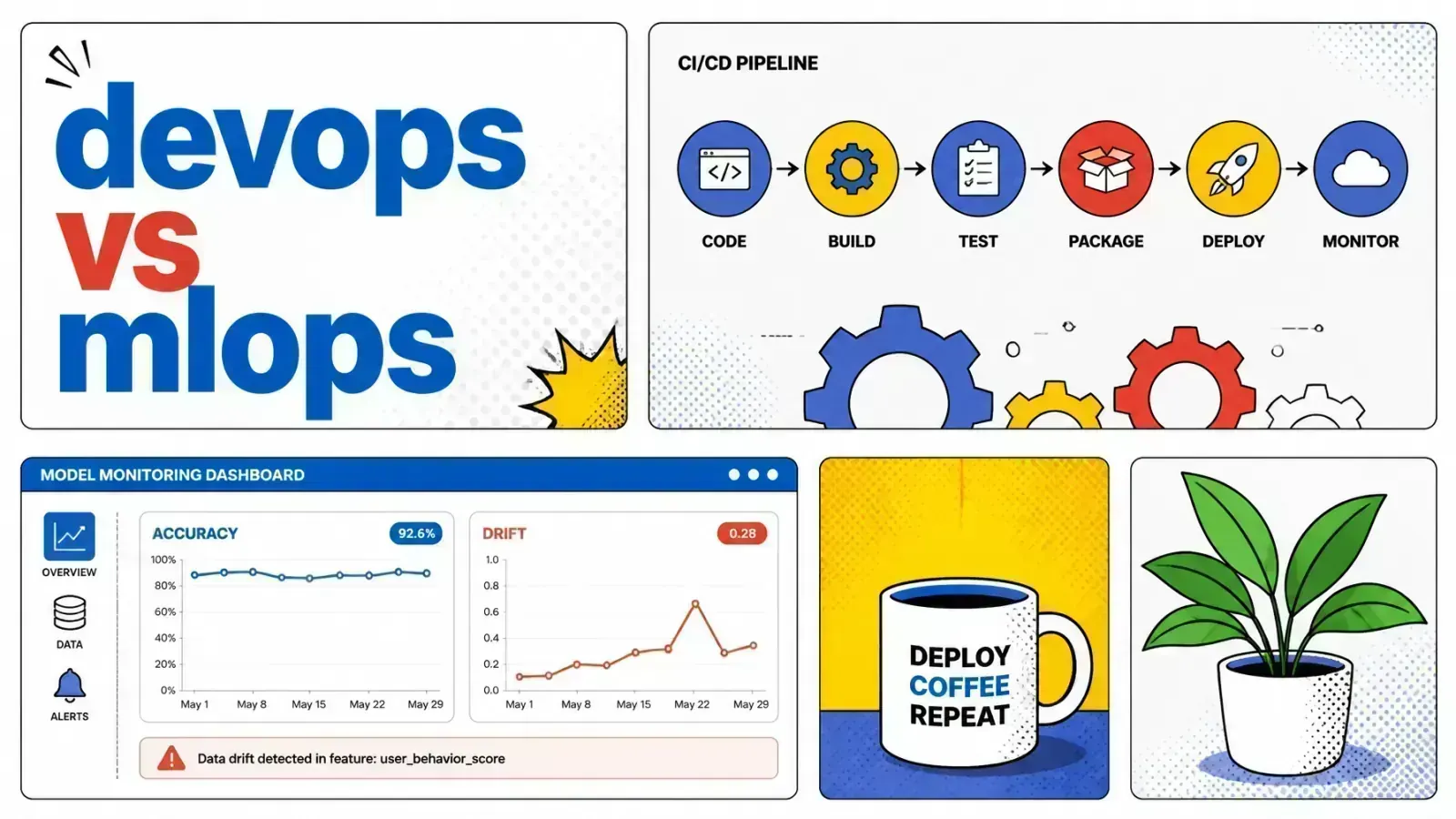
DevOps ships code that behaves the same every day. MLOps ships models that quietly get worse as the world changes.
Shipping application code to production is difficult. Shipping a machine learning model that keeps performing accurately over time is much harder.
You might have a perfectly automated pipeline that builds your Docker images and deploys them to a cluster in seconds.
Correct code, broken product
If your model starts making wrong predictions because consumer behavior changed, your automated deployment of “correct” code is shipping a broken product. That is the core friction between traditional software operations and machine learning operations.
What the comparison is really about
DevOps focuses on the reliability and speed of software delivery. It treats code as the primary artifact.
MLOps takes the same principles and adds two volatile new variables: data and models. DevOps solves “it works on my machine.” MLOps solves “it worked on last month’s training data.”
Understanding this divide is essential for any team moving beyond simple heuristic-based software and into AI engineering.
The core philosophy of DevOps
DevOps is built on the continuous integration and continuous delivery (CI/CD) pipeline. The goal is to shorten the development life cycle and ship changes continuously with high software quality.
A deterministic process
In a standard DevOps environment, like one running a Laravel application on Docker, the process is fairly deterministic.
If the source code passes its unit tests, the integration tests succeed and the environment configuration is correct, the application should behave predictably in production.
Static artifacts
The artifacts are static. Once a binary or a container image is built, its internal logic does not change based on the data flowing through it.
Technical teams use DevOps to manage:
- Source code: versioning application logic in Git.
- Build automation: compiling code and packaging it into artifacts.
- Infrastructure as Code (IaC): using tools like Terraform or Pulumi to define servers and networks.
- Testing: running automated suites to catch regressions in logic.
The emergence of MLOps
MLOps, or Machine Learning Operations, is a set of practices for deploying and maintaining machine learning models in production reliably and efficiently.
Calling it “DevOps for AI” misses the point. It borrows the automation mindset, but the artifacts in MLOps are fundamentally different.
Three moving parts
A machine learning system has three distinct components: code, data and the model. In DevOps, you mostly care about the code.
In MLOps, a change in the data can break the system even if the code is untouched. That brings a level of non-determinism traditional CI/CD pipelines are not designed to handle.
Data drift in the real world
If you are building agentic commerce solutions on Shopify, your recommendation engine might fail without any bug in the Python script. The cause could be a shift in the distribution of customer purchases during a holiday sale.
This is known as data drift, and it requires a lifecycle with continuous monitoring and retraining.
Key technical differences at a glance
Here are the main technical distinctions between the two methodologies.
| Feature | DevOps | MLOps |
|---|---|---|
| Primary artifact | Source code and binaries | Code, datasets, and model weights |
| Lifecycle | Build, test, deploy | Data prep, train, evaluate, deploy, monitor |
| Testing | Unit and integration tests | Model validation, accuracy metrics, bias checks |
| Deployment | Static (service/binary) | Dynamic (model endpoint or batch job) |
| Monitoring | Latency, CPU, error rates | Data drift, model decay, precision, recall |
| Feedback loop | Code bug fixes | Continuous retraining (CT) |
The CI/CD/CT pipeline
The main architectural difference is a third loop. DevOps relies on CI (Continuous Integration) and CD (Continuous Delivery). MLOps adds CT (Continuous Training).
Continuous Integration (CI) in MLOps
CI here tests the data as well as the code. You must validate the schema of incoming datasets and make sure feature engineering logic is the same in the training environment and in production.
A mismatch leads to training-serving skew, a common reason for model failure.
Continuous Delivery (CD) in MLOps
CD covers the automated deployment of the model service. This often means deploying a prediction API or updating a weights file in a running inference engine.
Because models are large and expensive to run, MLOps pipelines often use canary deployments or shadow testing to check performance on live data before a full rollout.
Continuous Training (CT)
This is the signature of MLOps. A CT pipeline triggers a retraining job when certain conditions are met, either on a schedule or when performance degrades.
The pipeline pulls new data, runs the training script, evaluates the new model version against a benchmark and registers it in a model registry if it passes.
DevOps pipeline
MLOps pipeline
Monitoring and the problem of drift
In traditional DevOps, monitoring centers on system health. You watch memory usage, response times and HTTP 500 errors. If the server is up and the code runs, the system is usually considered “healthy.”
Healthy server, failing model
In MLOps, system health is only half the story. You also need to monitor statistical health.
A model might return a “200 OK” status code with 50ms latency, but if its predictions are nonsensical, the system is failing.
Two kinds of drift
There are two main types of drift that MLOps engineers must track:
- Data drift: the input data distribution changes. For example, a model trained on high-end fashion data might struggle if the store expands into budget streetwear.
- Concept drift: the relationship between input and output changes. For instance, what counted as a “normal” credit card transaction in 2019 might look very different during a global supply chain crisis.
Close the feedback loop
Detecting drift requires careful logging of every prediction and its eventual outcome. That creates a feedback loop that informs the next training cycle, a step often missed in early-stage AI development.
Tooling and infrastructure
The toolsets for these two fields are moving apart. Docker and Kubernetes are shared, but the special needs of machine learning have created a new stack.
Standard DevOps tools
- GitHub Actions / GitLab CI: pipeline orchestration.
- Docker: containerization.
- Terraform: infrastructure provisioning.
- Prometheus / Grafana: system monitoring.
What MLOps adds
- MLflow / Weights & Biases: experiment tracking and model versioning.
- Kubeflow / Vertex AI: ML-specific orchestration.
- Feature stores: central repositories for pre-processed data features.
- Evidently AI / Arize: statistical monitoring and drift detection.
Building a bridge between these tools is the mark of a mature technical organization. You need the stability of DevOps to host the infrastructure and the flexibility of MLOps to manage the intelligence layer.
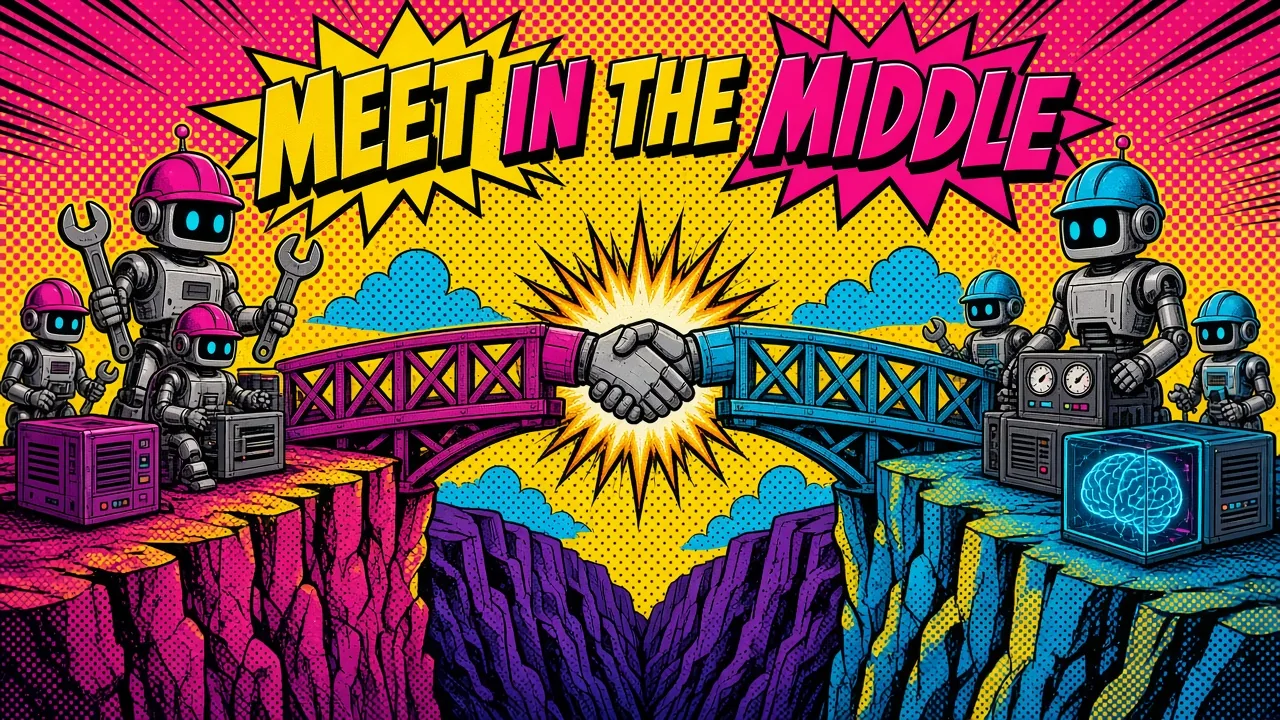
Bridging the gap in production
For teams running complex web applications, the goal is integration, not picking one side.
A modern stack might use a Laravel backend for user management, hosted on a Coolify-managed VPS, while calling an MLOps-managed inference endpoint for personalized content.
Version your data
One practical way to start is versioning your datasets. You would never deploy code without a commit hash, so never train a model without knowing exactly which version of the data was used.
This makes results reproducible, which is the first step toward a working MLOps workflow.
Treat retrieval as infrastructure
The same rigor applies to retrieval systems. Treat vector databases and retrieval pipelines as managed infrastructure inside your DevOps workflow, not as ad-hoc scripts.
That discipline alone heads off many of the RAG failures teams hit in production.
Key takeaways
- DevOps is about code reliability: CI/CD pipelines, automated testing and deterministic deployments.
- MLOps is about model reliability: data validation, experiment tracking and statistical monitoring.
- The CT loop is essential: continuous training keeps models from going stale as real-world data changes.
- Monitoring must cover two layers: system metrics (latency, errors) and model metrics (drift, accuracy).
- Tooling is specialized: standard DevOps tools for hosting, MLOps tools for training and the registry.
- Data is an artifact: version your training data with the same rigor you apply to source code.
If you’re adding models to a product that already ships with CI/CD, here’s how I help teams build MLOps pipelines with drift monitoring and retraining.
How do you plan to handle the statistical monitoring of your models once they move from a static environment into the unpredictable flow of production data?