An ML engineer builds the model. An AI engineer builds the product around a model someone else trained. Hire the wrong one and nothing ships.
You are ready to ship AI features, but your hiring roadmap is a mess of overlapping buzzwords and conflicting job descriptions.
Hiring a researcher to build a production chatbot often means a month of experiments with zero shipped code. Asking a standard full-stack developer to optimize a vector search index usually ends in a high-latency disaster.
A wider gap than it looks
The gap between training a model and orchestrating a system is wider than most founders realize.
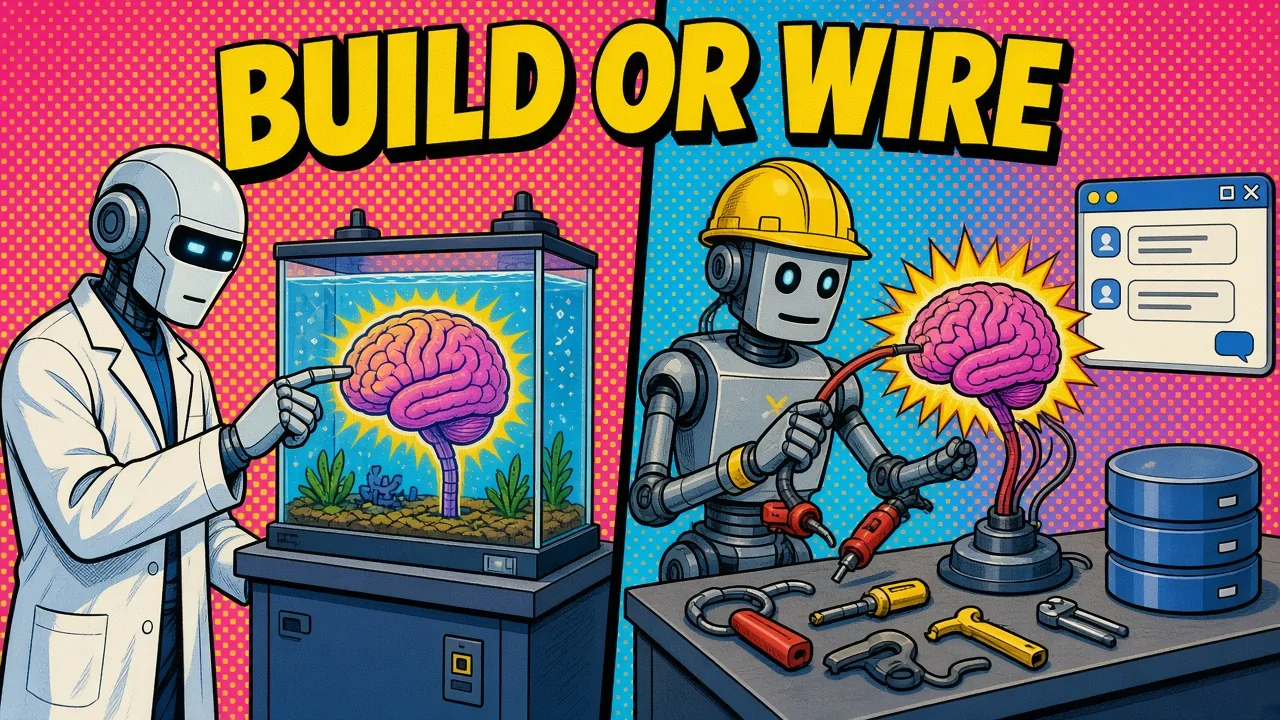
The choice between an ML engineer and an AI engineer decides whether you build a proprietary brain or a fast application powered by existing intelligence.
The model scientist: defining the ML engineer
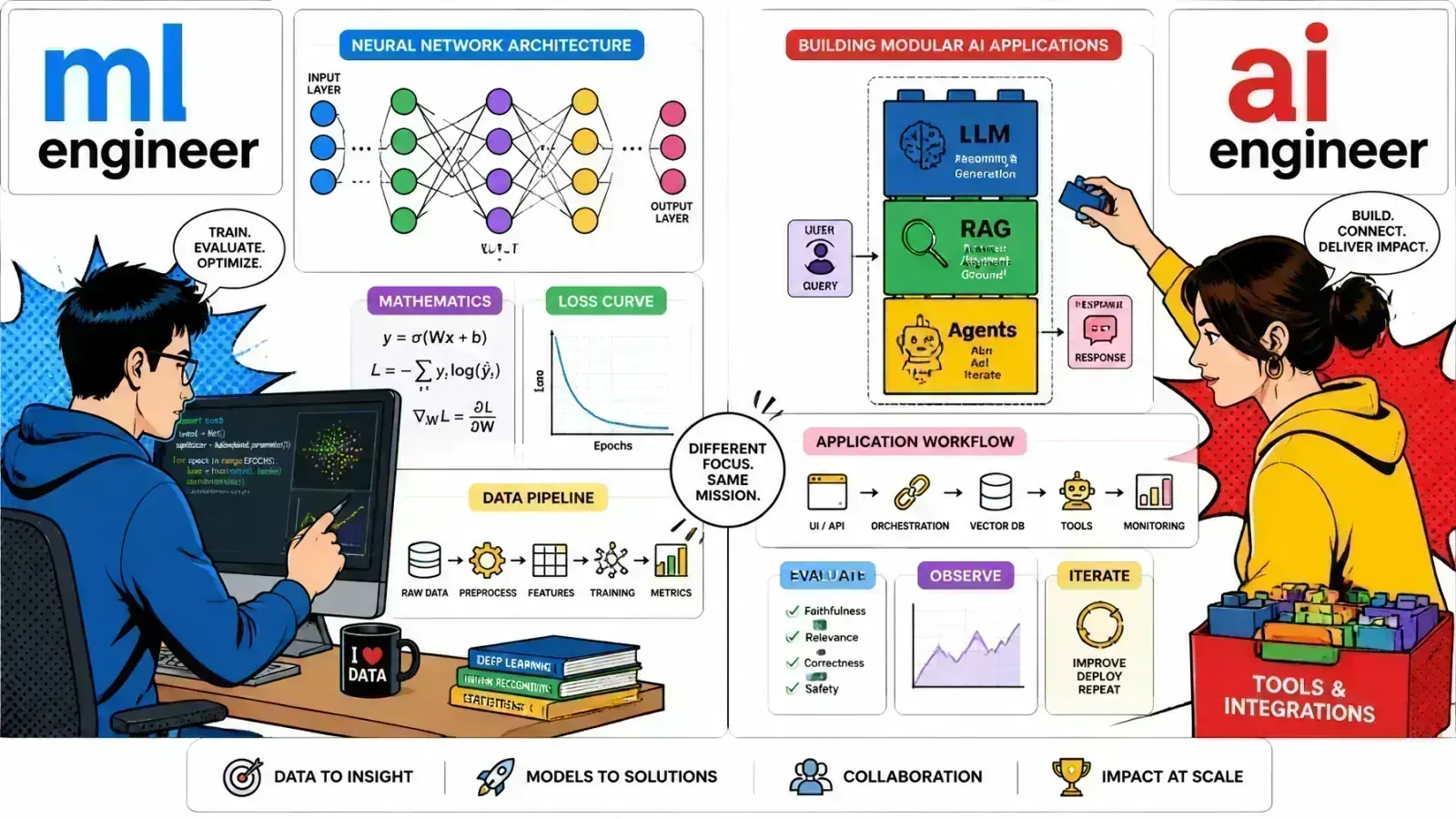
The machine learning engineer lives in the world of weights, biases and data distributions. Their main goal is to create, train or fine-tune models that solve specific predictive or generative tasks.
They build the logic that lives inside the API, instead of calling someone else’s.
A day in the life
An ML engineer might spend the day in PyTorch or TensorFlow designing a custom architecture. They handle the “dirty work” of data: cleaning large datasets, managing feature stores and dealing with data drift.
Their mental model is rooted in applied statistics and experimental iteration. If you need a model that predicts fraudulent transactions from proprietary financial data, you need an ML engineer. They make sure the model generalizes well and doesn’t overfit the training set.
Their stack
Their stack sits at the heavy end of the data world: Spark for data processing, Weights & Biases for experiment tracking and NVIDIA GPUs for heavy lifting.
The output is a serialized model file or a dedicated inference service that other systems call. This is a deep-tech role focused on the “how” of intelligence, and the split between training and inference shapes most of their day.
The systems architect: defining the AI engineer
The AI engineer is a fairly new kind of developer. They treat the model as a black-box service.
Their focus is the infrastructure around the LLM that makes it useful for users, rather than training it. They are the bridge between raw intelligence and a working product.
A day in the life
An AI engineer spends their time on system design and software engineering. They work with foundation models like Claude, GPT and Gemini through APIs, and focus on RAG (retrieval-augmented generation) and agentic workflows.
Instead of tweaking hyperparameters, they tweak system prompts and design tool-use schemas.
Owners of the AI user experience
The AI engineer owns the user experience of AI. That includes managing latency, adding guardrails and making sure the output is structured correctly for the frontend.
If you are building a custom support bot on Shopify, you want an AI engineer. They know how to connect the store’s data to the LLM and handle multi-turn conversations.
Technical stack: a side-by-side comparison
To see the differences, look at the tools used in 2026. There is overlap, but the main focus areas are distinct.
| Feature | ML Engineer | AI Engineer |
|---|---|---|
| Core Models | Custom PyTorch/TensorFlow, XGBoost | Claude, GPT, Llama, Gemini APIs |
| Primary Task | Training, Fine-tuning, Evaluation | Prompt Engineering, RAG, Agents |
| Data Focus | Feature engineering, labeling, drift | Chunking, indexing, retrieval quality |
| Programming | Python (heavy), C++, CUDA | Python, TypeScript, PHP |
| Infrastructure | Kubernetes, GPUs, Feature Stores | Vector DBs (pgvector), MCP, Serverless |
| Success Metric | F1 Score, Accuracy, Loss curves | Latency, Hallucination rate, User NPS |
Two pipelines
The ML engineer owns the pipeline from raw data to a deployed model. The AI engineer owns the pipeline from a user query to a relevant, cited response.
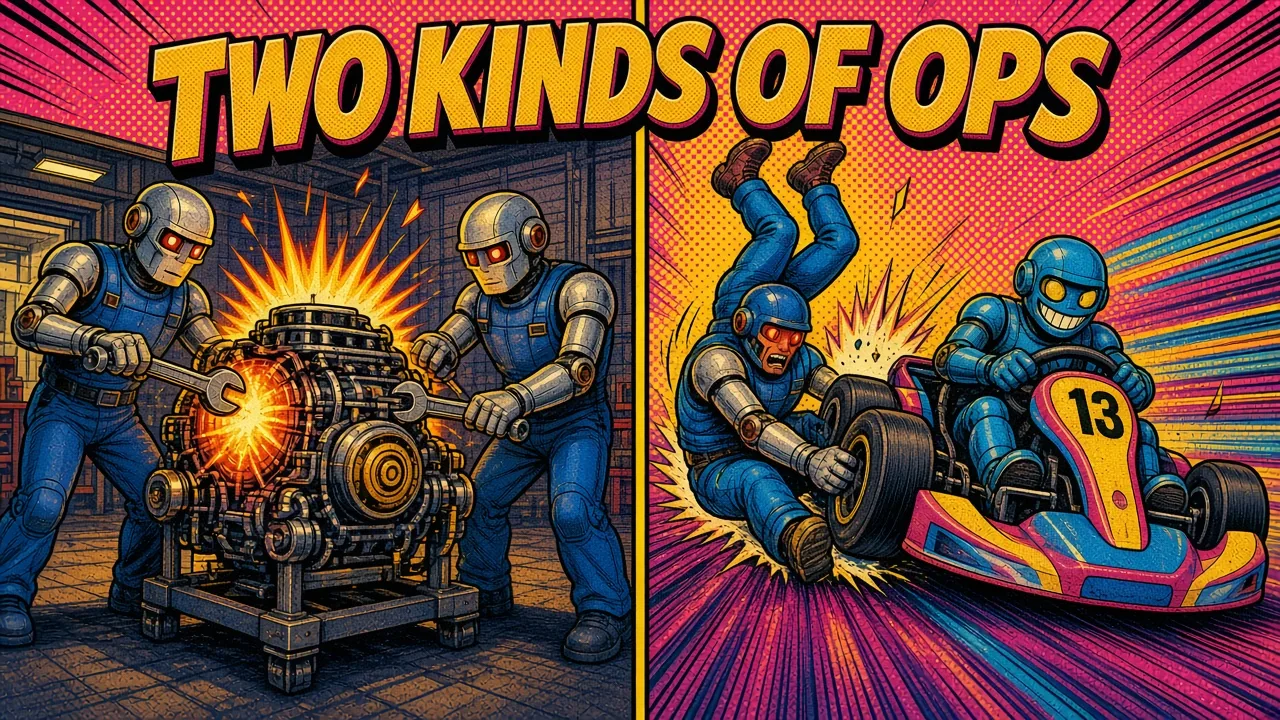
One builds the engine; the other builds the car and picks the right fuel.
The RAG bridge: where the roles meet
Retrieval-augmented generation (RAG) is the most common meeting point for these two roles. A solid RAG system needs high-quality embeddings and a fast, scalable vector database.
The ML side
An ML engineer might train a domain-specific embedding model or a custom reranker to improve search relevance. They look at the mathematical similarity between vectors and tune the distance functions.
The AI side
The AI engineer usually builds the end-to-end RAG system. They decide how to chunk documents, how to manage metadata and how to run hybrid search with tools like pgvector or Pinecone.
They also handle context management: making sure the LLM gets exactly what it needs without exceeding its context window or blowing the budget. If you are just starting, avoid common RAG mistakes in production by focusing on retrieval quality before model size.
Agentic systems: the new frontier
In 2026, the focus has shifted from simple chatbots to agentic systems: AI agents that use tools, browse the web and run code to finish complex tasks.
AI engineers drive it
AI engineers are the main drivers of this shift. They use frameworks like LangGraph or the Claude Agent SDK to build multi-step workflows.
They implement the Model Context Protocol (MCP) to give agents access to internal databases, local files and external APIs. That takes deep software engineering skills, because agents need reliable error handling and human-in-the-loop checkpoints to be useful in a business.
ML engineers supply the specialists
ML engineers support this by building the specialized tools agents call. An agent might call a custom fraud-detection model built by an ML engineer as part of its reasoning loop.
The AI engineer orchestrates the logic, while the ML engineer provides the specialized predictions.
ML engineer's loop
AI engineer's loop
DevOps and deployment: from MLOps to LLMOps
The deployment cycle looks very different for each role.
MLOps
ML engineers deal with MLOps. See DevOps vs MLOps for how that discipline differs from classic ops.
It means specialized infrastructure for model training, managing GPU clusters and watching for model drift over time. They often use Docker and Kubernetes so their models can scale to millions of inference requests.
LLMOps
AI engineers focus on LLMOps, or “AI DevOps.” Their concerns are API reliability, cost management and caching.
They need their AI apps to stay fast and to swap a model version (for example, moving a Claude or GPT model to a newer release) without breaking the system. Tools like Coolify or cloud setups on Google Cloud are common here for hosting the middleware that connects the LLM to the world.
How to choose the right path for your project
The decision depends on the “intelligence” you need.
When you need an ML engineer
If your problem is unique and no pre-trained model can solve it, you need an ML engineer. That is true for niche medical imaging, high-frequency trading or specialized sensor data analysis.
When you need an AI engineer
If a very smart assistant with access to your company data can solve it, you need an AI engineer. Most modern software falls into this group.
You don’t need to train a new model to build an AI-powered project management tool. You need a great system around a foundation model. This often comes down to a RAG vs fine-tuning decision, and the answer is usually RAG.
The new full-stack
AI vs traditional development is becoming less about the code and more about data orchestration. The AI engineer is a full-stack developer who has learned to manage non-deterministic outputs.
Key takeaways
- ML engineers are model builders focused on training, data science and applied statistics.
- AI engineers are system builders focused on app development, RAG, agents and model orchestration.
- The overlap is Python and data basics, but the daily toolsets are moving apart.
- RAG is the main point where both roles add to one production feature.
- Agents are where AI engineering is heading, and they need strong backend logic and API integration skills.
- Choosing the right role avoids wasted budget and gets your AI features into production.
If you need the AI engineering side (RAG, agents and MCP wired into your product), here’s how I help teams ship production AI features.
When you look at your roadmap, is the main bottleneck the lack of a custom model, or making an existing model work reliably with your data?