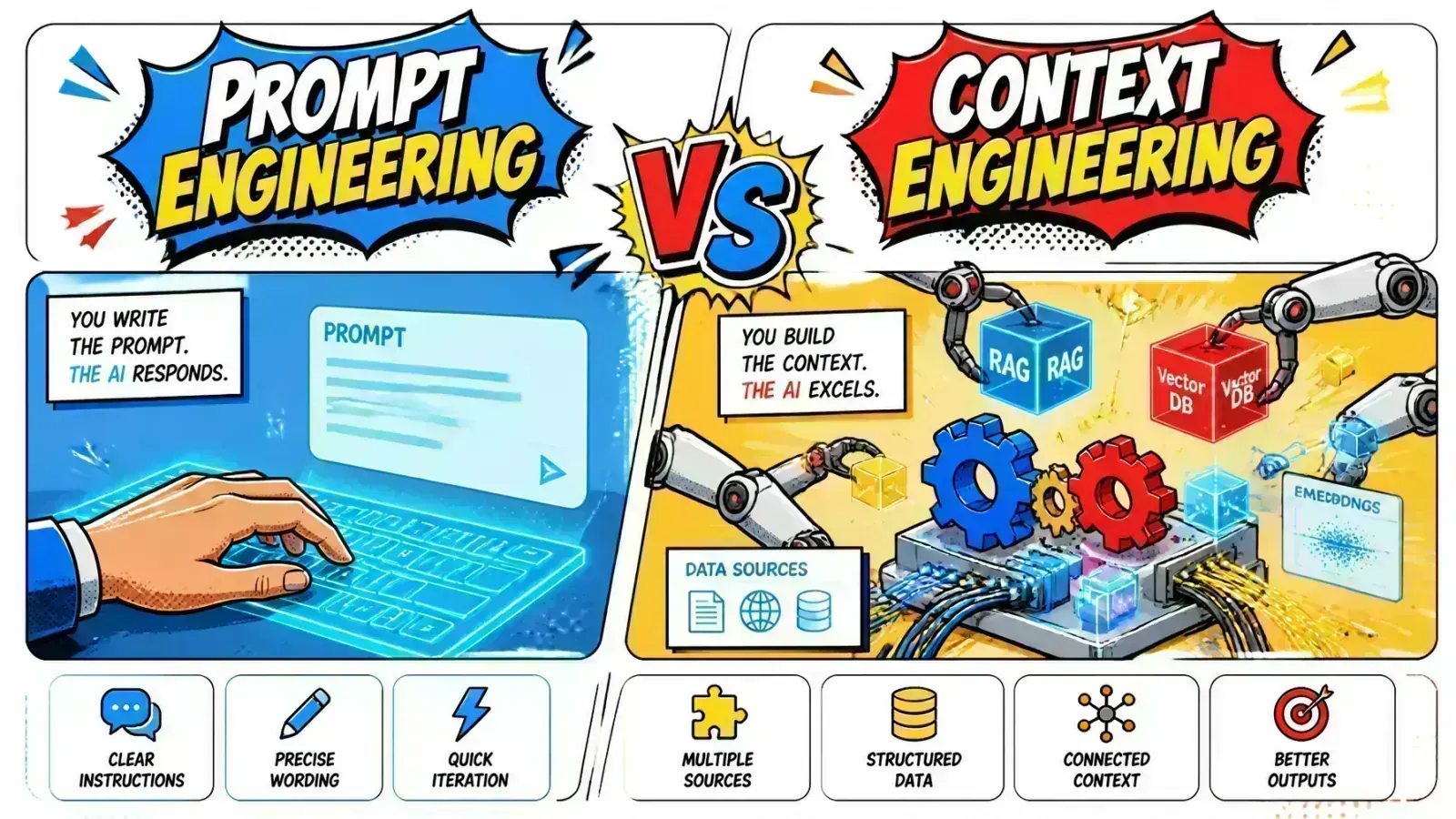
Prompt engineering is about how you ask. Context engineering is about what the model can see when you ask. Past a certain point, only the second one moves accuracy.
You spent three hours tweaking a system prompt so your LLM would stop inventing details about customer orders. It worked for ten minutes.
Then a user asked about a return policy from 2024, and the model confidently described a 90-day cash-back guarantee that doesn’t exist.
The instruction ceiling
You’ve hit the instruction ceiling. No amount of “You are a helpful assistant” or “Think step by step” lets a model reason its way out of missing data.
You’re treating a data problem as a language problem. As we move from simple chatbots to agentic systems, the focus shifts from how we talk to models to how we feed them.
Where prompts stop working
Prompt engineering was the first discipline of the AI era. You craft instructions, examples and formatting rules to steer a Large Language Model (LLM), and you might spend days testing phrasing or adding few-shot examples.
That works well for creative writing and basic text transformation.
Stateless and crowded
Prompts are stateless and limited. You squeeze logic, data and constraints into a finite context window, and when it gets crowded the model loses track of details.
Researchers call this “lost in the middle”: models use information at the start and end of a long context better than information buried in the middle. Relying only on prompts also means relying on training data, which is static and often outdated.
Static instructions in production
In production, especially in Shopify development or custom enterprise software, static instructions are dangerous. If the model doesn’t know real-time stock levels or the specs of a new product, clever phrasing won’t prevent a made-up answer.
What is context engineering?
Context engineering is the programmatic management of everything around the model. It covers the text you send, and also the architecture that decides which data, tools and memories the model can reach at any moment.
If prompt engineering is writing a script for an actor, context engineering is building the stage, supplying the props and hiring the research team that feeds facts into the actor’s earpiece.
The moving parts
- Retrieval pipelines: fetch relevant data from external sources on demand.
- Tool governance: decide which APIs or functions the model can call.
- Memory management: store and retrieve past interactions for continuity.
- State orchestration: track where the user is in a workflow or business process.
Moving from “telling” to “showing” lowers the load on the model. Instead of asking it to remember every policy, you build a system that finds the one relevant policy and puts it in front of the model.

RAG: the context delivery engine
Retrieval-augmented generation (RAG) is the most common form of context engineering. It closes the knowledge gap by connecting your LLM to a vector store: Postgres with the pgvector extension, or a dedicated database like Pinecone, Weaviate or Qdrant.
When a user asks a question, the system first converts it into an embedding (a numeric representation of meaning). It searches for the most similar documents, then injects those snippets into the prompt.
Prompt engineering
Context engineering
That change cuts the chance of the model making things up. RAG has its own pitfalls, though, and it’s worth knowing the common RAG mistakes in production.
MCP: the shared data plumbing
The Model Context Protocol (MCP) is one of the most useful pieces of context engineering. Anthropic introduced it in November 2024 and donated it in December 2025 to the Agentic AI Foundation, a Linux Foundation fund co-founded by Anthropic, Block and OpenAI.
Say you’re building an agent that checks GitHub issues, looks up a customer in a CRM and writes a technical summary. Traditionally you’d write custom integration code for each source. With MCP, servers expose those sources in a standard format any MCP client can discover and call.
Pull, don’t push
MCP lets the model pull context when it needs it, so it explores your data instead of passively receiving one big prompt. It turns context from a static block of text into a queryable interface, and it’s a core part of a modern API gateway for AI stacks.
| Feature | Prompt engineering | Context engineering |
|---|---|---|
| Focus | Phrasing and tone | Data and tools |
| Tooling | Text editors, prompt playgrounds | Vector DBs, MCP, RAG pipelines |
| State | Mostly stateless | Stateful and persistent |
| Scalability | Hard to maintain as docs grow | Built for large document sets |
| Primary goal | Better behavior | Better accuracy |
Memory and state
Prompting focuses on the “now.” Context engineering also handles the “always”: long-term memory.
In a Laravel application, you might keep user preferences or past interactions in a database or Redis. When the user returns, the context layer retrieves those fragments and summarizes them for the model.
More than the last five messages
- Summarization: condense long histories into short summaries. My token counter shows how much a summary saves.
- Metadata filtering: pull only memories relevant to the current topic.
- Hierarchy: decide which memories are “core” and which are “ephemeral.”
Agents vs chatbots
Context is what separates a basic chatbot from an AI agent. A chatbot waits for a prompt and responds. An agent works inside a context: tools (via MCP), knowledge (via RAG) and history (via memory stores).
With a context-first mindset, you spend less time in a prompt playground and more time building reliable data connectors. You care about the quality of your data more than the cleverness of your adjectives.
A context layer in Laravel
For Laravel and Vue.js stacks, this means a context layer in your backend that gathers everything the AI needs before it sees the user’s input.
// A simple context orchestrator in Laravel
class AIContextManager
{
    public function buildContext(User $user, string $query): array
    {
        $knowledge = $this->vectorStore->search($query);
        $history = $this->memory->getRecent($user->id);
        $tools = $this->mcp->getAvailableTools(['inventory', 'shipping']);

        return [
            'system_prompt' => view('prompts.system')->render(),
            'retrieved_docs' => $knowledge,
            'user_history' => $history,
            'available_tools' => $tools,
            'user_query' => $query,
        ];
    }
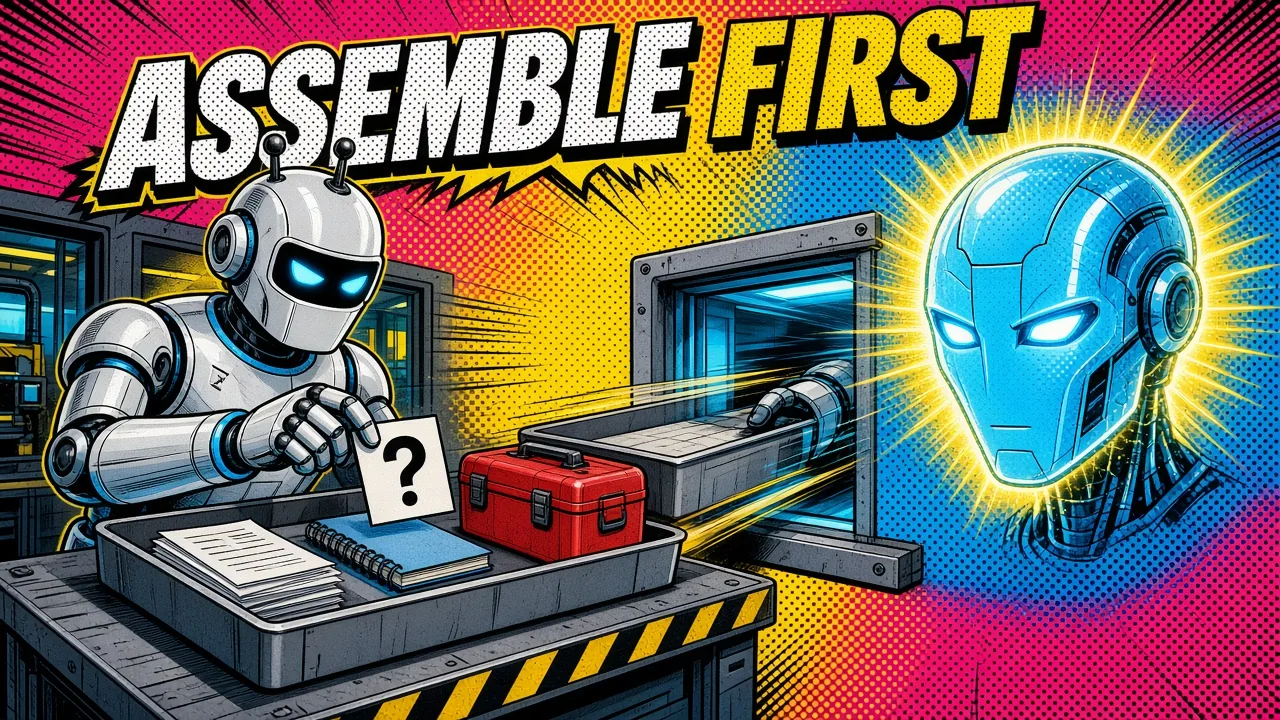
}
Key takeaways
- Prompts are instructions; context is knowledge. Stop trying to teach the model your whole business inside a system prompt.
- Invest in RAG early. Postgres with pgvector gives you a scalable way to handle growing documentation.
- Adopt MCP for tool calling. It standardizes how your AI reaches your APIs and databases.
- Manage state outside the prompt. Let your backend (Laravel, Node or similar) handle memory and session state.
- Focus on data quality. A perfect RAG system with bad data still gives bad answers. Context engineering is data engineering at heart.
If you’re building that context layer for production, here’s how I help teams design RAG, MCP and memory for their AI features.
How are you balancing long system prompts against external retrieval in your current AI work?