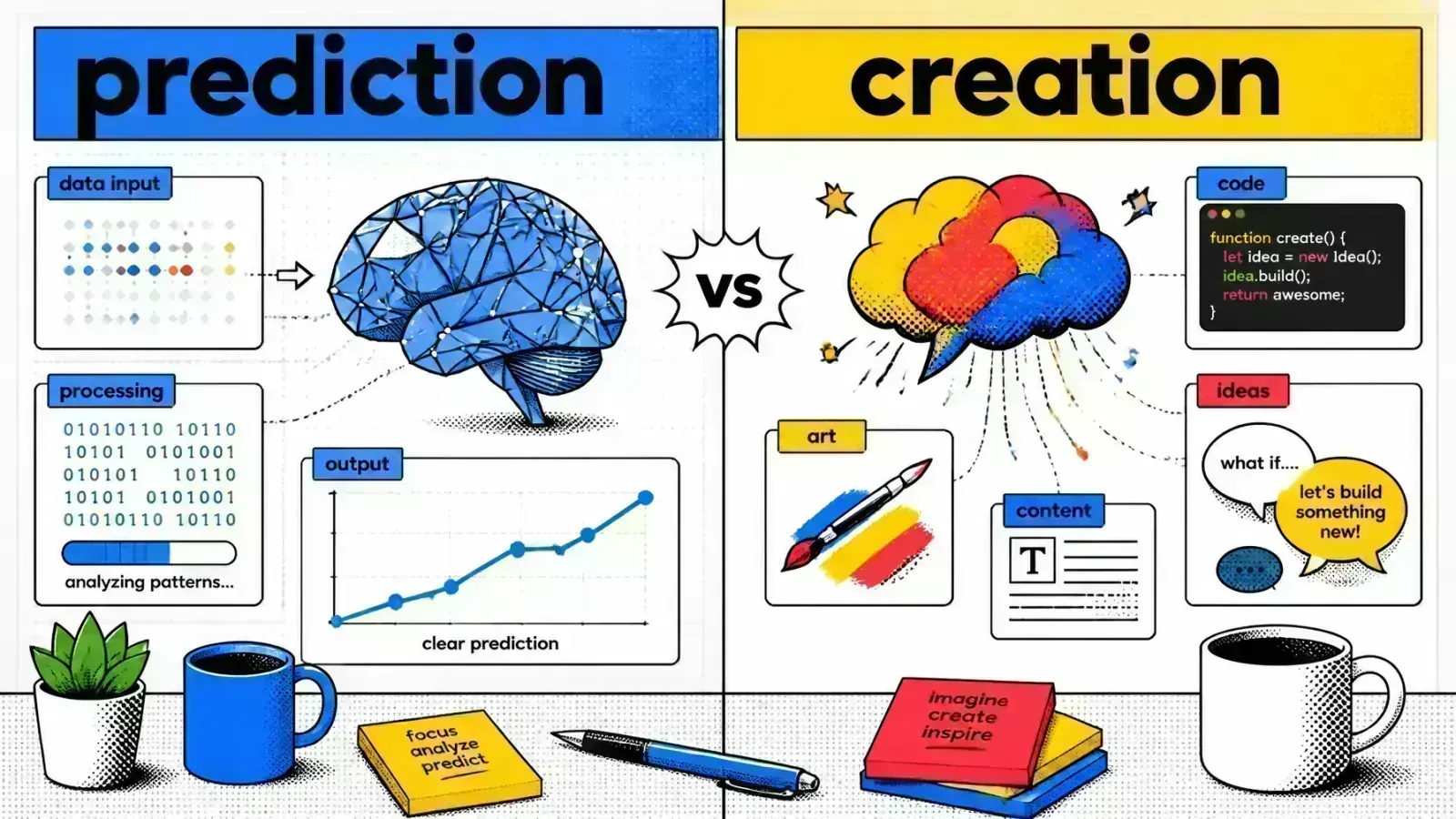
Machine learning predicts. Generative AI creates. Pick the wrong one and you burn GPU credits on a model that hallucinates when it should be calculating.
Your data may be sitting idle in a warehouse while competitors ship agentic systems that write code and predict churn in the same stack.
Hype blurs the line
Marketing hype blurs the line between these two technologies, and stakeholders use the terms interchangeably. That mismatch breeds technical debt.
Build a generative model for a task that demands strict mathematical precision and you set yourself up for failure. Rely on traditional models for creative automation and your product feels rigid and outdated.
Know the engineering difference
The fix is understanding the engineering differences between predictive and creative systems. If you want to zoom out first, my breakdown of AI vs machine learning shows where both sit in the broader AI hierarchy.
Machine learning: the logic of prediction
Traditional Machine Learning (ML) is the backbone of modern data science. It is mainly a discriminative technology.
Its job is to tell different types of data apart or to predict a number from historical patterns. You ask it to categorize an input or forecast a trend.
Built for structured data
ML models thrive on structured data. They look at rows and columns in a database to find correlations.
For instance, a regression model might analyze thousands of Shopify transactions to predict next month’s revenue. A classification model might look at server logs to spot a potential DDoS attack.
One model, one job
Traditional ML is often task-specific. If you want to detect fraud, you train a fraud detection model, and that model cannot suddenly start recommending products.
It is a precision tool built for a single objective. That focus makes ML very efficient in high-stakes settings where accuracy and predictability are what matter.
Generative AI: the architecture of creation
Traditional ML analyzes data to make a choice; GenAI uses data to create something new.
It is built on deep learning architectures, mainly Transformers and Diffusion models. Instead of only classifying data, these systems learn the probability distribution of their training set so they can generate new outputs.
Next-token prediction, coherent results
When you prompt a frontier Large Language Model (LLM) like Claude or GPT, you are using a generative system. It predicts the next most likely token in a sequence, and the result is coherent text or a code snippet.
That creative ability is what makes GenAI so useful for building agentic commerce solutions on Shopify.
Foundation models
GenAI models are often foundation models, trained on huge unstructured datasets with billions of parameters. They handle a wide range of tasks without being retrained from scratch.
One model can summarize a legal document, write a Python script and brainstorm marketing copy. That flexibility is its main strength, and it also brings the risk of hallucinations.
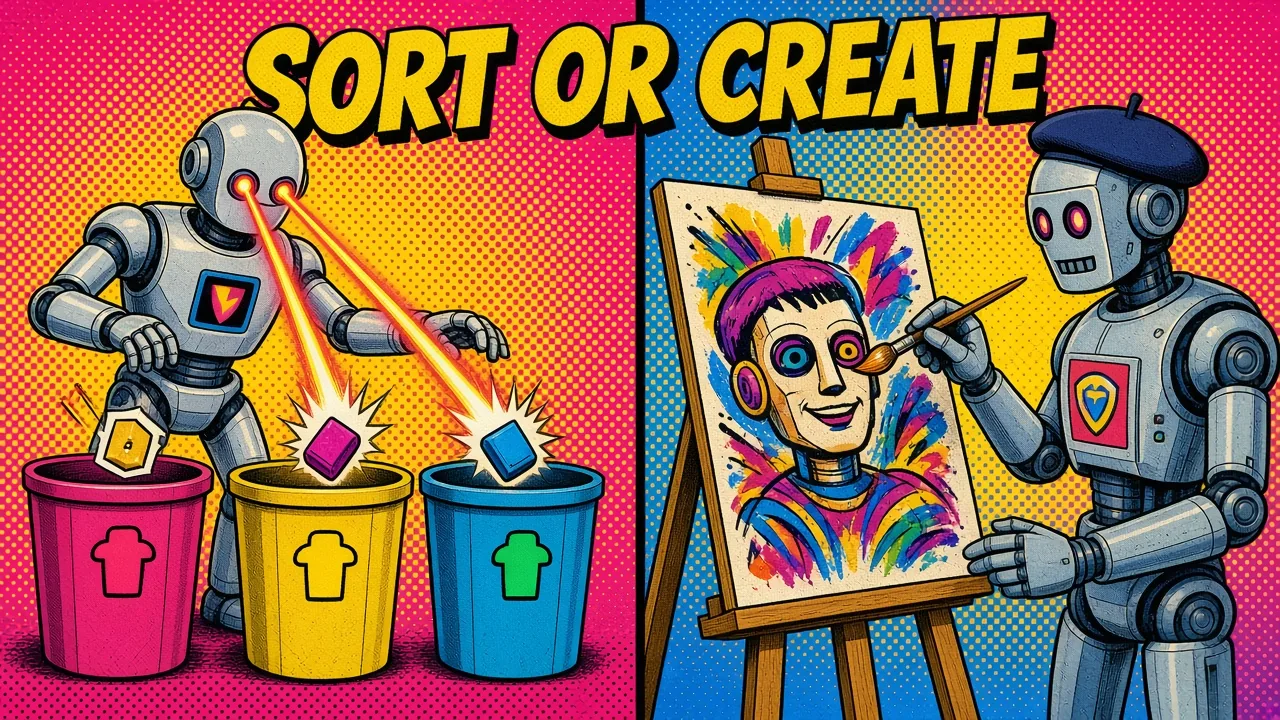
Machine learning vs generative AI: discriminative vs generative models
The core technical difference lies in their mathematical objectives. To know which one to deploy, look at how each processes information.
Discriminative models (traditional ML)
Discriminative models learn the boundary between classes. Mathematically, they model the conditional probability P(y | x): “given the input x, what is the probability of the label y?”
- Focus: telling data points apart.
- Output: a discrete label (Spam/Not Spam) or a continuous value (Price).
- Efficiency: usually needs less compute for inference.
- Example: a Random Forest algorithm flagging fraudulent credit card transactions.
Generative models (GenAI)
Generative models learn how the data itself is distributed. They model the joint probability P(x, y) or the probability of the input itself P(x): “what does a typical example of this data look like?”
- Focus: understanding the structure of the data to reproduce it.
- Output: new data samples (text, image, audio).
- Efficiency: very resource-intensive, needing specialized GPUs.
- Example: a Transformer model generating a new Laravel controller from a prompt.
| Feature | Machine Learning (Discriminative) | Generative AI (Generative) |
|---|---|---|
| Primary Goal | Classify or Predict | Create New Content |
| Data Type | Structured (Tables, Logs) | Unstructured (Text, Images) |
| Output Type | Numbers, Labels, Scores | Content, Code, Media |
| Model Complexity | Low to Medium | Very High |
| Training Data | Task-Specific, Labeled | Massive, Unlabeled/Self-Supervised |
Use cases: when to choose one over the other
The right tool depends on your business goals and your data. Using an LLM to predict a stock price is an expensive mistake. Using a linear regression model to write a blog post is impossible.
When to use machine learning
ML is the better fit for tasks that need high precision and deterministic logic. If you are working through complex technical challenges in a real product, ML is often the right choice for the “back-office” logic.
- Fraud detection: spotting anomalies in financial transactions where false positives must be kept low.
- Inventory forecasting: predicting stock levels for an e-commerce store from seasonal trends.
- Recommendation engines: ranking products for a user based on their browsing history.
- Medical diagnostics: analyzing lab results to flag specific health markers.
When to use generative AI
GenAI shines when you need to bridge human language and machine logic. It is a strong fit for intuitive interfaces and creative automation.
- Code generation: automating boilerplate or converting legacy code to frameworks like Laravel and Vue.js.
- Content personalization: generating unique product descriptions or email subject lines for thousands of customers.
- Search and retrieval: using Retrieval-Augmented Generation (RAG) so users can “chat” with their own documentation. Learn more in my guide on common RAG mistakes.
- Prototyping: quickly generating UI mockups or synthetic data to test a new application.
The hybrid future: combining ML and GenAI in production
In 2026, strong engineering teams don’t choose one over the other. They build hybrid architectures, using traditional ML for the heavy data processing and GenAI for the user-facing interaction layer.
Support tickets
Consider a modern customer support system. An ML model runs sentiment analysis and routes the ticket to the right department based on urgency.
Once routed, a GenAI agent drafts a response using internal knowledge bases. The system ends up both efficient and empathetic.
Churn prevention
Another example comes from AI vs traditional development. An ML model predicts which users are likely to churn.
A GenAI model then creates a custom discount offer and a personalized email tailored to that user’s interests to keep them engaged.
One model for everything
Hybrid

DevOps and deployment considerations
The two need different infrastructure strategies.
Traditional ML
Traditional ML models are often small enough to run on standard CPUs or even edge devices. They are easy to containerize with Docker and cheap to host on platforms like Coolify or AWS.
Generative AI
GenAI models are a different beast. Even “small” LLMs need significant VRAM, and the cost profile of training vs inference shapes every hardware decision.
If you self-host, you need solid GPU orchestration. Many businesses use API-based options like Claude or OpenAI to avoid managing hardware. For teams concerned with data privacy or high volume, deploying open-weights models on Google Cloud or AWS with specialized inference servers is the standard approach.
Monitor the right failure mode
Whichever you choose, keep the architecture clean. Containerize for environment consistency and monitor the right failure mode: model drift in ML, hallucination rates in GenAI.
That rigor keeps your AI solutions scalable and maintainable over time.
Key takeaways
- Define your goal first: use ML for prediction and classification, GenAI for content creation and reasoning.
- Data type matters: ML excels with structured, tabular data. GenAI is built for unstructured data like text, images and code.
- Cost and latency: traditional ML is usually cheaper and faster to run. GenAI needs much more compute and has higher latency.
- Hybrid works best: combine the precision of ML with the flexibility of GenAI.
- Plan infrastructure early: use containers and cloud-native services for each technology’s hardware needs.
- Avoid the hype: don’t use an LLM because it is trending. Pick the model that solves the engineering problem most efficiently.
If you’re deciding where ML ends and GenAI begins in your product, here’s how I help teams design and ship hybrid AI features.
Is your current data strategy focused on predicting what will happen next, or are you ready to start creating the outcomes you want to see?