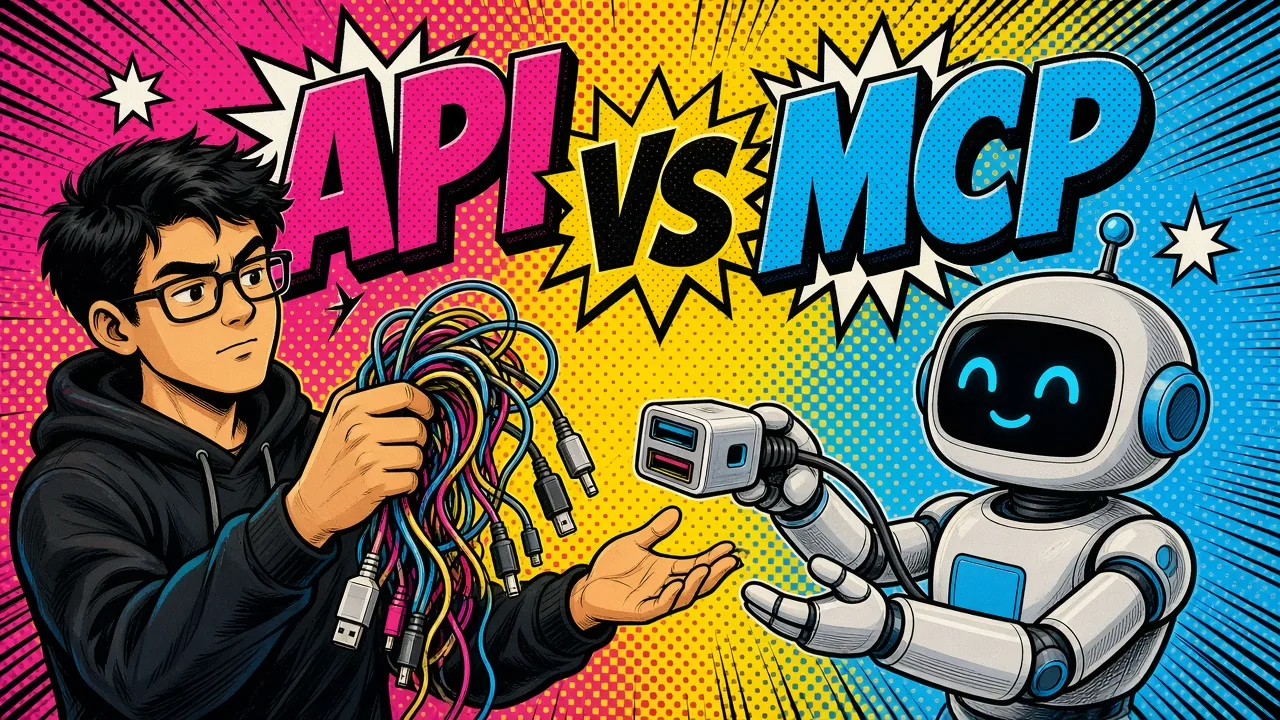
APIs connect software to software. MCP connects AI agents to software. Mix them up and you spend weeks writing glue code that breaks on the next schema change.
Your AI agents are trapped in a silo of brittle, custom-coded API integrations that break the moment you update a schema.
You spend weeks writing boilerplate glue code just to give a Large Language Model (LLM) access to a single database or a CRM.
This manual mapping of endpoints to prompts is the hidden tax of modern AI engineering. Every new tool needs a fresh round of documentation reading and prompt tuning.
Why APIs alone struggle with agents
APIs have powered the internet for decades, but they were never designed for the non-deterministic, reasoning-heavy nature of AI agents.
We are moving from hard-coded connections to dynamic capability discovery. This is where the Model Context Protocol (MCP) comes in.
The API era: the power grid of the web
Traditional APIs (Application Programming Interfaces) are the foundation of modern software. Whether it is a RESTful endpoint, a GraphQL query or a gRPC stream, the core idea is the same.
It is a defined contract for software-to-software communication. You know exactly what input to send, and you get a predictable output back.
Rigid by design
In AI development, APIs are like the power grid. They provide the raw energy and data your application needs.
If you are building a Shopify application, you use the Shopify Admin API to fetch orders or update inventory. The logic is rigid, the schemas are fixed, and the developer must know exactly which endpoint to call and when.
The translation tax
The problem starts when you want an LLM to use these tools. You have to write “tool definitions” or “function schemas” that describe the API to the model.
You are translating the API documentation into a format the model can understand. This works for one or two tools. It does not scale to an entire ecosystem of internal data sources and external services.
What is Model Context Protocol?
The Model Context Protocol (MCP) is an open standard introduced by Anthropic to solve the “M x N” integration problem. Anthropic donated it to the Agentic AI Foundation, a Linux Foundation fund, in December 2025.
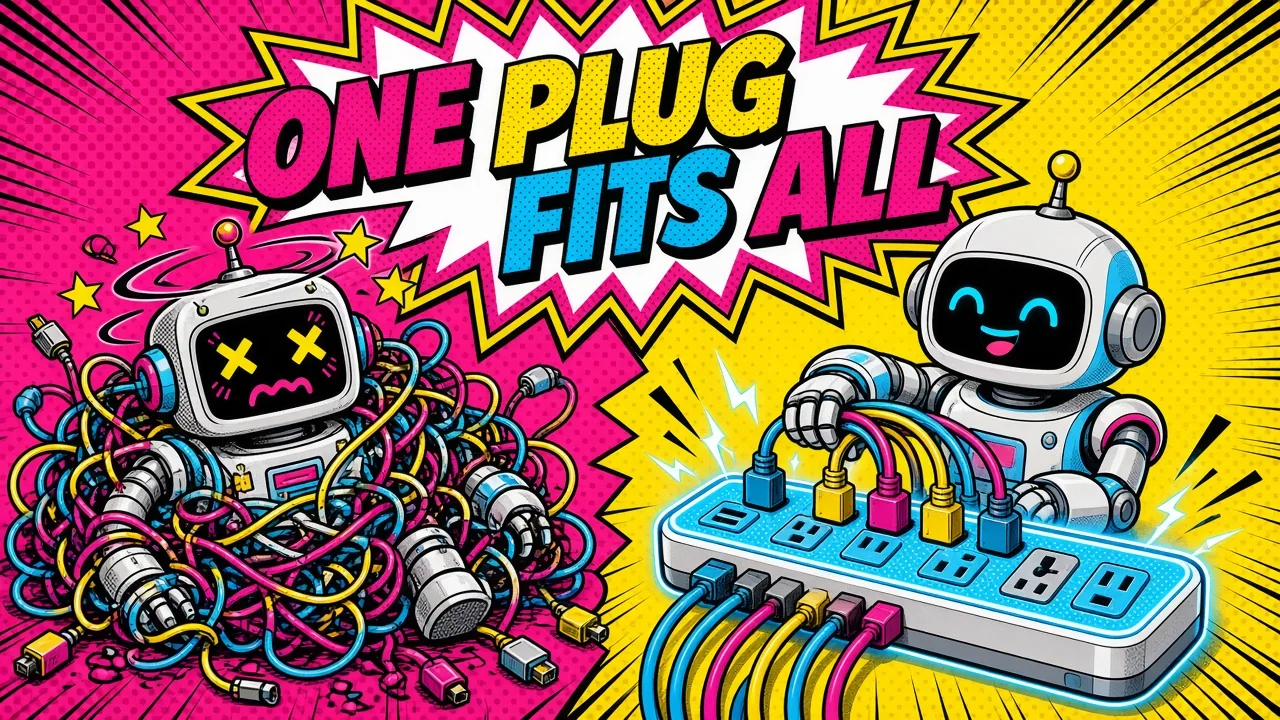
In a traditional setup, if you have M AI clients (like Claude, ChatGPT and an internal agent) and N tools (like GitHub, Slack and your internal DB), you build M x N individual integrations.
From M x N to M + N
MCP changes this to an M + N problem. With a standard “universal plug,” any MCP-compatible AI client can connect to any MCP-compliant server. Think of it as the USB-C of the AI world.
Instead of writing custom code to explain how to search your database, you host an MCP server that describes its own capabilities. When the agent connects, it “discovers” what the server can do without you hard-coding the instructions.
What runs under the hood
MCP uses JSON-RPC 2.0. A server can offer tools, resources (like files or data) and prompt templates to the model.
Since the 2026-07-28 spec, the protocol core is stateless request and response. The connection handshake and session IDs are gone, and each request carries its own protocol version and client capabilities.
If your app needs state across calls, the server hands the model an explicit handle to pass back. I cover what that means in practice in stateless MCP servers on Laravel.
Structural differences: discovery and consumers
The core difference between API and MCP lies in who consumes the interface and how they find what they need.
| Feature | Traditional API | Model Context Protocol (MCP) |
|---|---|---|
| Primary Consumer | Human Developers | AI Agents & LLMs |
| Discovery | Manual (Reading Docs) | Automatic (Self-describing) |
| Interface | Heterogeneous (REST/GraphQL) | Standardized (JSON-RPC) |
| State | Mostly Stateless | Stateless core since 2026-07-28; explicit handles for app state |
| Flexibility | Rigid / Pre-scripted | Dynamic / Reasoning-based |
Docs for humans, descriptions for models
APIs are built for humans to read and implement. You look at a Swagger UI, understand the authentication and write a fetch request.
MCP is built for models to navigate. An MCP server lists its tools and resources along with natural language descriptions. The model reasons about which tool to call based on the user’s intent.
If you are comparing AI vs traditional development, this is a prime example of the shift. Traditional development builds the pipes. AI engineering with MCP builds the connectors that let the model choose its own pipes.
Why AI agents need MCP for scale
Agentic systems need a level of autonomy that traditional APIs struggle to provide efficiently.
An agent asked to “research a company and draft a proposal” might need a search tool, a CRM, a file system and a PDF generator.
Less context, fewer wrong choices
With standard APIs, you feed the descriptions of all those endpoints into the model’s context window. This eats tokens and raises the risk of the model getting confused.
With MCP, the client asks the server what it offers (and can cache that list), and the agent calls tools on demand. You can surface only the tools relevant to the task instead of pre-loading every schema.
The result is less wasted context and fewer irrelevant choices for the model to wade through.
Resources that can notify you
MCP also defines a “resource” primitive. An API endpoint returns data on request. An MCP resource can be subscribed to, so the server sends a notification when the underlying file or record changes.
Lightweight RAG, not a vector store
For lightweight retrieval-augmented generation (RAG) cases, an MCP server can expose your local files or database to the model in a standard way. That spares you a custom ingestion layer for every experiment.
It does not replace a vector store for large-scale semantic search. Get that wrong and you hit the usual production RAG mistakes.
Implementation: how they work together
MCP does not replace APIs. In fact, MCP usually wraps existing APIs. Your business logic, security constraints and data persistence still live in your core services.
A Laravel example
Say you have a Laravel backend with REST endpoints for managing customer orders.
To make them accessible to an AI agent, you build a small MCP server (perhaps in Node.js or Python) that sits between the agent and your Laravel API.
The translation layer
The MCP server describes the get_order_history tool in a way an LLM understands.
When the LLM calls that tool through MCP, the server makes the actual REST call to your Laravel backend, receives the JSON and passes the relevant context back to the model.
This separation lets your core engineering team focus on solid, well-tested APIs while your AI team builds the MCP wrappers that enable agentic behavior.
Direct API wiring
MCP wrapper
Choosing the right tool for the job
When should you stick to direct API calls, and when should you implement MCP? It depends on the complexity of your integrations and the role of the LLM.
Use direct APIs when
- You have a simple request-response flow with no AI reasoning involved.
- You need absolute minimum latency for high-throughput systems.
- You are performing deterministic tasks like processing payments or bulk data migrations.
- You only have one or two integrations that rarely change.
Use MCP when
- You are building complex agents that need three or more tools.
- Your tools and data sources change frequently.
- You want your tools reusable across different AI clients (e.g., Claude Desktop and custom IDE tools).
- You need to expose local data or specialized resources to an LLM without building a custom backend for every experiment.
Where MCP stops
One boundary worth drawing early: MCP covers the agent-to-tool axis only. The moment two agents need to delegate work to each other, you are in a different protocol’s territory.
See MCP vs A2A vs ACP for how the two layers stack.
Key takeaways
- APIs are the “what” (the data and logic), while MCP is the “how” (how the AI interacts with that data).
- MCP removes the M x N integration problem with a universal protocol for AI tool discovery.
- Traditional APIs suit deterministic software-to-software paths; MCP suits non-deterministic AI-to-tool reasoning.
- Implementing MCP often means wrapping existing REST or GraphQL APIs to make them self-describing for LLMs.
- MCP cuts token waste and prompt complexity by standardizing how context is shared with the model.
- For modern AI engineering, MCP is becoming the standard layer for building agentic workflows that scale.
If you’re wrapping your existing APIs in MCP so agents can use them safely, here’s how I help teams ship it.
What is the biggest friction point you face when giving your AI agents access to your internal production databases?