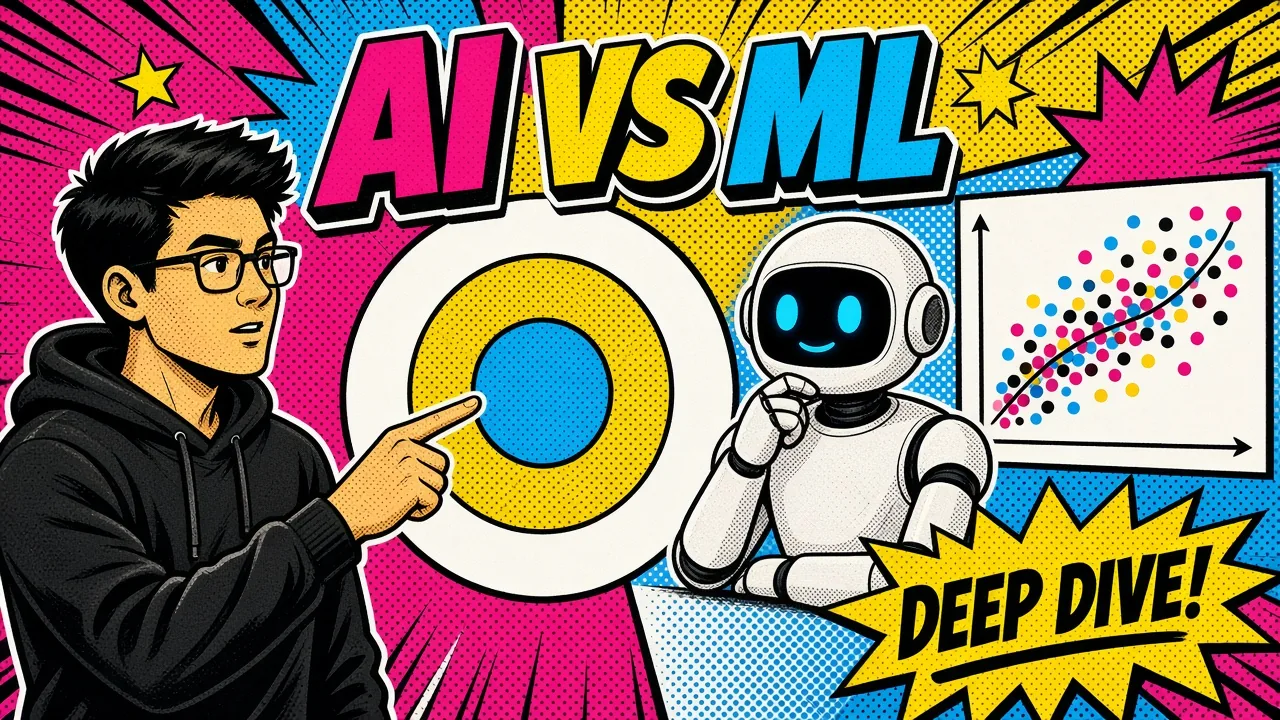
Rules you write by hand can be AI. Patterns a model learns from data are machine learning. Mix them up and you build the wrong system.
The tech industry often treats “AI” and “machine learning” as interchangeable. This confusion leads to real architectural debt when teams build intelligent features without understanding the underlying mechanics.
You end up trying to build a predictive engine out of static rule-based systems or, the other way around, over-engineering a simple decision tree with a neural network.
Picking the wrong tool produces bloated cloud bills, slow performance, and systems that fail to generalize to real-world data. When you mix up the umbrella field of artificial intelligence with the specific mechanics of machine learning, you lose the ability to choose the most efficient path for your product.
This guide draws the line between the two concepts and shows how they show up in modern stacks like Laravel and Shopify, with a focus on RAG and agentic systems. The goal: a clear framework for deciding when to reach for rule-based logic and when to deploy a learned model.
The AI umbrella: broad intelligent systems
Artificial Intelligence (AI) is the broad field of creating systems that can perform tasks that usually require human intelligence. This is the “umbrella” term.
It covers everything from simple “if-then” logic to the most complex large language models (LLMs).
AI does not have to learn
In engineering terms, AI is about the system’s behavior. If a software system can reason, plan, or solve problems, it is an AI system. This does not mean it has to “learn.”
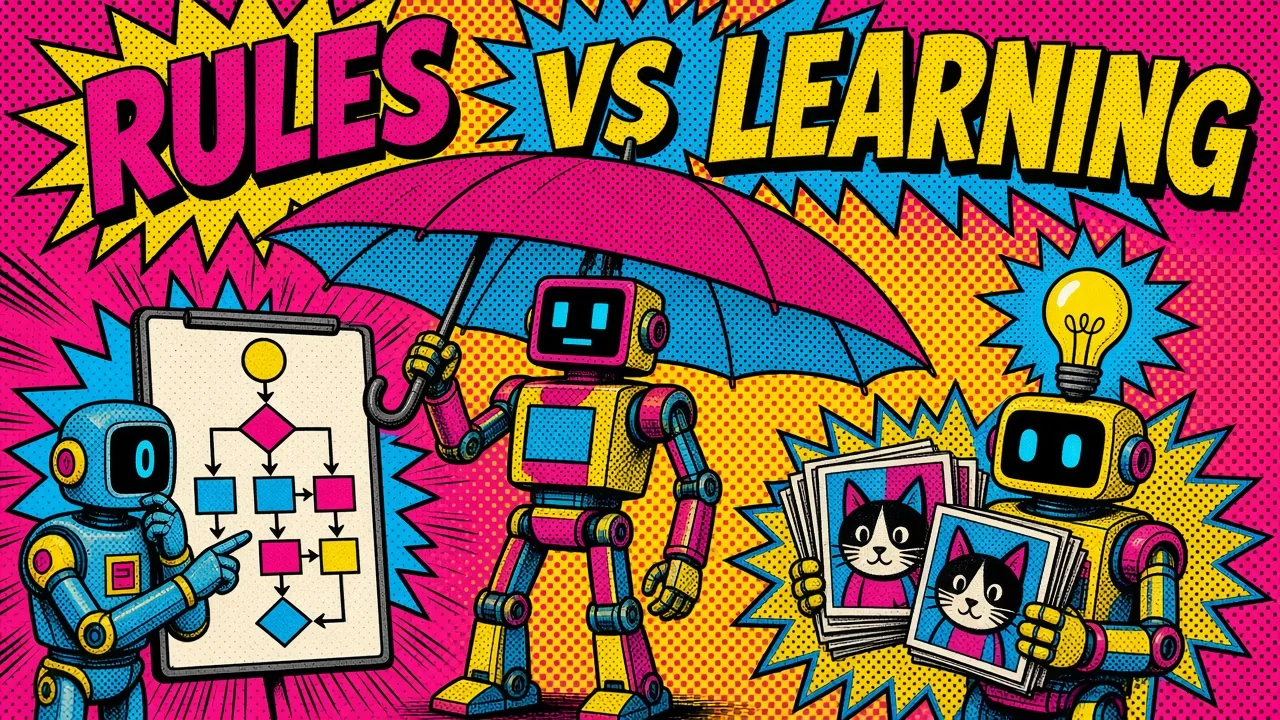
Early AI systems, often called symbolic AI or expert systems, relied on hardcoded rules and logic. These systems are very predictable and easy to debug because every decision path is written out explicitly.
A rule-based example
Take a sophisticated shipping calculator in a Shopify Plus store that adjusts prices based on complex regional taxes and carrier API responses. It mimics human decision-making from a set of logical parameters, which puts it at the simple, rule-based end of AI.
It is not machine learning, because it does not improve its performance based on past data unless a developer updates the code.
Machine learning: the engine of pattern recognition
Machine Learning (ML) is a subset of AI focused on algorithms that let computers learn from data and make predictions. Instead of being explicitly programmed for a task, an ML model is “trained” on a dataset to find patterns and hidden structures.
When rules run out
When your product needs to handle high-dimensional data where rules are too complex to write by hand, ML is the solution. Think about image recognition or fraud detection.
You cannot write enough “if” statements to account for every possible pixel arrangement in a photo of a cat. Instead, you feed an ML model thousands of images, and it learns the statistical representation of a “cat.”
Rule-based AI
Machine learning
A different lifecycle
In production, ML involves a lifecycle that is distinct from traditional software development. It requires data collection, cleaning, feature engineering, model training, and evaluation.
You can read more about how this differs from standard workflows in our post on AI vs traditional development. For the deeper discriminative-vs-generative comparison inside ML itself, see machine learning vs generative AI.
AI vs machine learning in RAG systems
The distinction becomes critical when you move into modern AI engineering, particularly with Retrieval-Augmented Generation (RAG). A RAG system is a clear example of an AI system that uses several ML components to reach a goal.
In a RAG pipeline, the system behavior is the AI part. How a user query is received, how a search runs against a vector database, and how the results go into a prompt is a design problem. The components doing the heavy lifting, however, are ML models.
Embedding models and vector databases
The “retrieval” part of RAG relies on embedding models. These are ML models (specifically deep learning models) that turn text into high-dimensional vectors.
When you store these vectors in a tool like pgvector or a dedicated vector database, you are using the output of a machine learning process.
The generator (LLM)
The “generation” part is handled by a large language model. This is a massive ML model trained on trillions of tokens of text.
Whether you call it through an API or a local deployment, the model itself is a static file of weights learned through intensive training.
Which job are you doing?
When you refine your RAG system by changing the chunking strategy or the system prompt, you are doing AI engineering.
You are only doing ML engineering if you decide to fine-tune the embedding model or the LLM itself on your domain data, a trade-off covered in RAG vs fine-tuning. Understanding these layers helps prevent common RAG mistakes in production.
Agentic systems and autonomous workflows
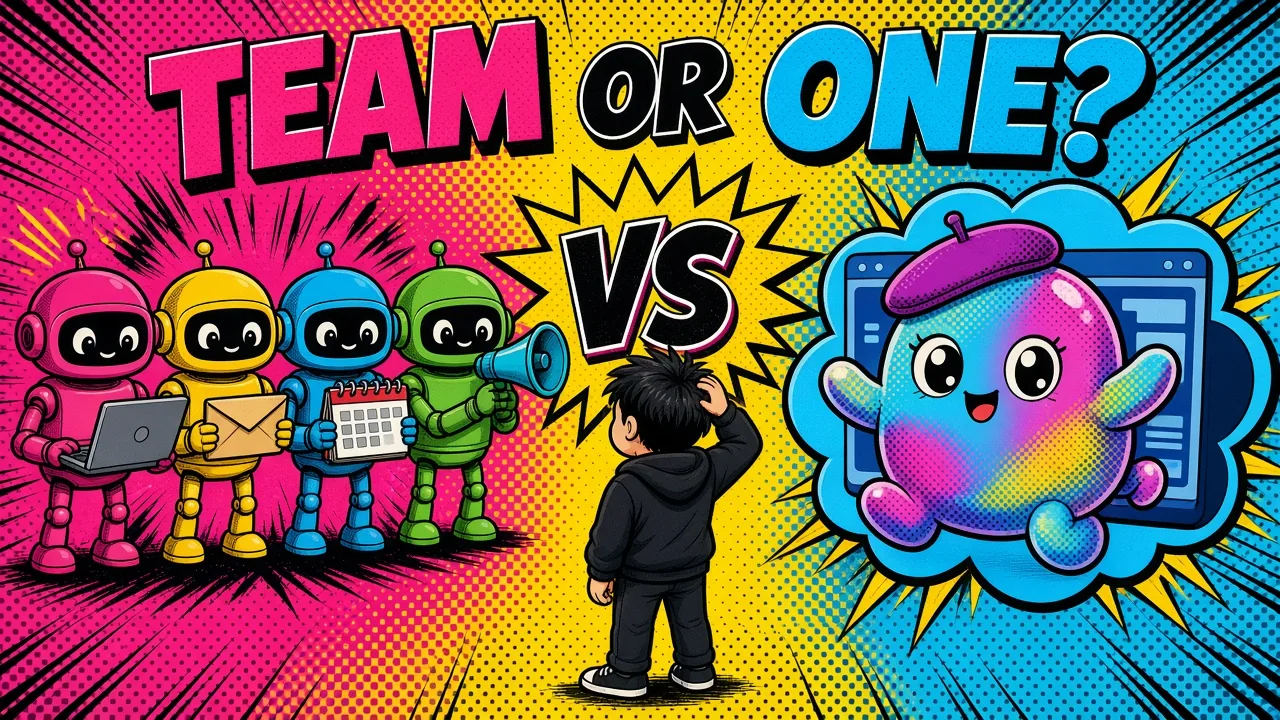
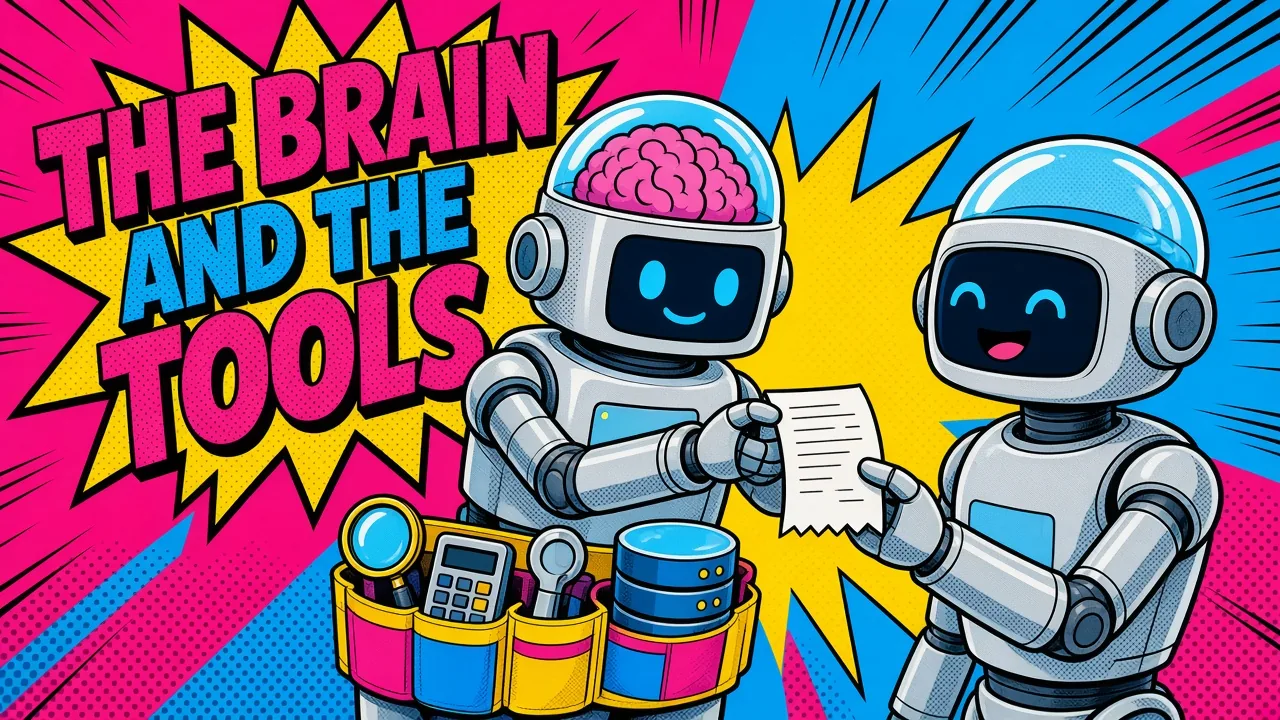
Agentic systems take the AI vs machine learning comparison a step further. An “agent” is an AI system that uses an ML model as its “brain” to decide a sequence of actions toward a goal. The jump from a static model to an autonomous one is the focus of LLM vs AI agent.
In an agentic workflow, the ML model (the LLM) is just one tool in the agent’s belt. The agent might also have access to a search engine, a calculator, or a database. The logic that handles the “loop” (Observe -> Think -> Act) is the AI system design.
Agents in commerce
For developers working with Shopify, agentic commerce allows for autonomous customer service or inventory management.
The agent uses machine learning to understand the customer’s intent (NLP) but uses traditional software APIs to execute a refund or check stock levels.
// A conceptual example of an AI Agent 'thought' process in a Laravel controller
public function handleAgentRequest(Request $request)
{
    $userInput = $request->input('query');

    // ML Component: Identify intent using an LLM
    $intent = $this->llmService->identifyIntent($userInput);

    // AI System Logic: Choose the tool based on intent
    if ($intent === 'check_order_status') {
        return $this->orderService->getStatus($request->user());
    }

    // AI System Logic: Fallback to RAG if intent is informational
    return $this->ragService->queryKnowledgeBase($userInput);
}
Practical implementation: Laravel and Shopify contexts
Integrating AI and ML into existing frameworks like Laravel or Shopify requires a clear understanding of where the data lives and how the models are served.
Laravel and ML orchestration
Laravel is an excellent framework for building the “AI system” around an ML model. You can use Laravel’s queue system to handle long-running ML tasks, or its HTTP client to talk to Python-based ML microservices.
Many developers use Laravel to manage the “human-in-the-loop” side of AI, such as reviewing model outputs before they are published.
Shopify and AI
Shopify has built AI features directly into its platform through Shopify Magic. For custom Shopify Plus builds, you might implement your own ML-driven product recommendation engine.
This involves capturing user behavior data, training a model (likely off-platform on Google Cloud or AWS), and serving those recommendations through a custom app or a Liquid block.
Cloud infrastructure for AI and machine learning
Deploying these systems requires different infrastructure strategies. AI systems (the orchestration code) can usually run on standard web servers or serverless functions.
Machine learning models, especially for training or high-throughput inference, often require GPUs or specialized hardware.
Separate containers
Docker and tools like Coolify make it simpler to deploy these modular systems. You might host your Laravel application on a standard VPS while your vector database and ML inference server run in separate containers. For more on this, check out our guide on Coolify and Docker for SaaS hosting.
Monitor different things
Monitoring is also different. For an AI system, you monitor latency and error rates. For an ML model, you monitor “drift” (when the real-world data starts to look different from the training data) and accuracy.
| What you run | Where it runs | What you monitor |
|---|---|---|
| AI system (orchestration code) | Standard web servers or serverless | Latency and error rates |
| ML model | GPUs or specialized hardware | Drift and accuracy |
Key takeaways
Telling AI and machine learning apart is about choosing the right architecture and team skill sets for your project, not about vocabulary.
- AI is the “what”: It describes the goal of creating intelligent behavior. It includes both hardcoded logic and learned models.
- Machine Learning is the “how”: It is a specific method for achieving AI by training models on data.
- RAG and agents are hybrid systems: They use ML components (LLMs, embeddings) inside an AI system designed with code and prompts.
- Framework integration matters: Laravel is great for AI orchestration, while Shopify Plus provides a solid environment for ML-driven commerce.
- Infrastructure needs differ: AI code is lightweight. ML models require specialized environments for training and inference.
Are you building a system that needs to follow strict regulatory rules, or one that needs to adapt to unpredictable user behavior?