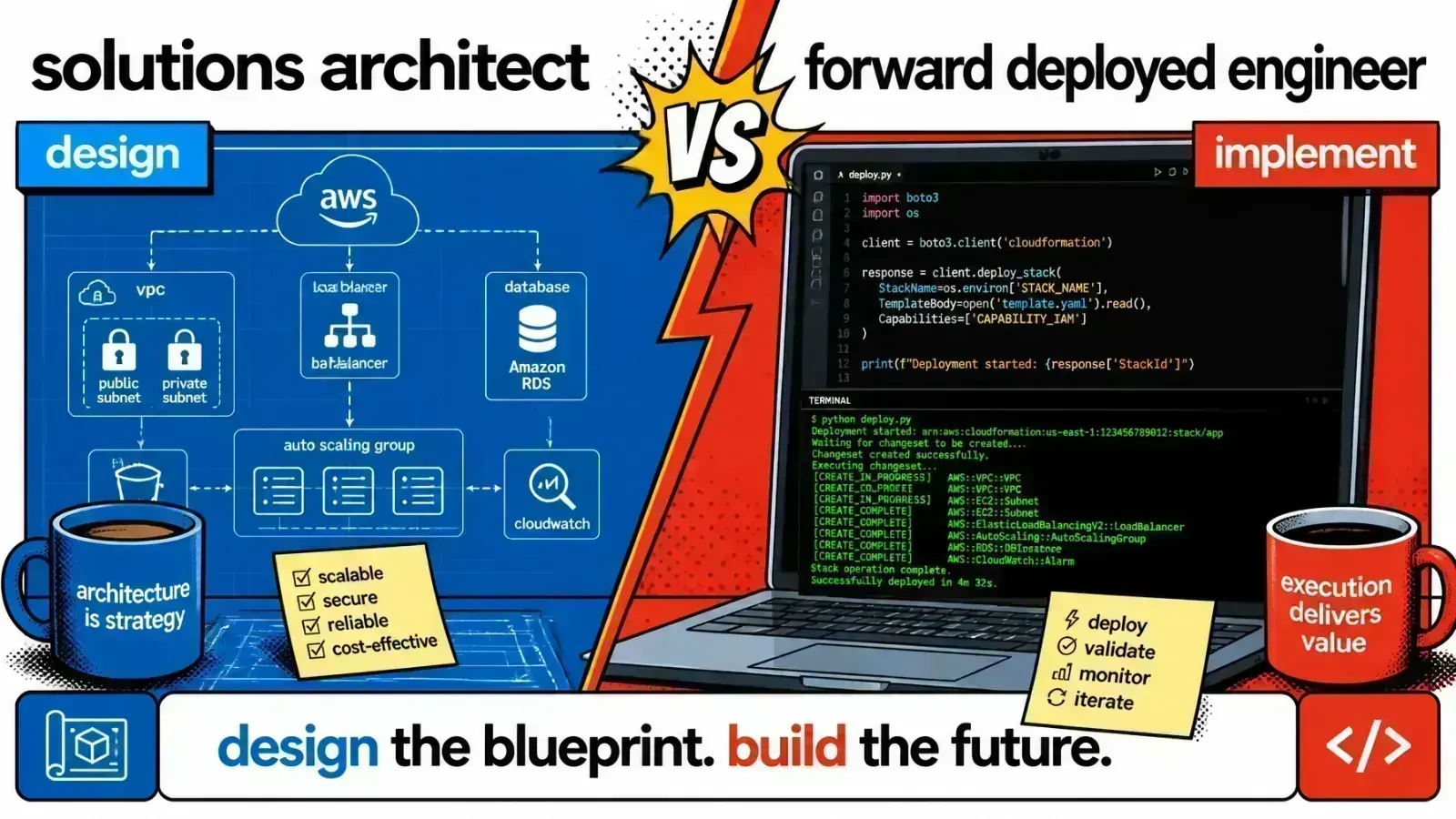
A solutions architect owns the blueprint. A forward deployed engineer owns the outcome. When a project fails, it usually fails in the gap between them.
Writing code is only part of the job. Where that code sits in the customer’s value chain matters just as much, and the difference between a solutions architect and a forward deployed engineer decides who is accountable when it lands there.
Many organizations invest millions in complex software platforms like Shopify Plus or custom Laravel ecosystems, only to realize they cannot bridge the gap between a sales demo and a running production system.
The implementation phase becomes a graveyard of missed requirements and technical debt. Sales cycles stall because the “how” is missing. This is exactly where the two roles diverge.
Both roles sit where engineering meets customer success, but they solve different problems. One builds the blueprint so the house will stand. The other moves onto the construction site to make sure the pipes actually connect to the city main.
The design blueprint: defining the Solutions Architect
The Solutions Architect is the strategic engine of a technical engagement. Their main goal is to design a scalable, low-risk implementation architecture that maps customer business requirements to technical capabilities.
They operate in the space between a “yes” from the buyer and a “go-live” from the developers.
Working at the macro level
An architect focuses on the big picture. They evaluate how a new Laravel development project will integrate with existing legacy databases, or how a Shopify app will interact with a third-party ERP.
Their deliverables are not usually production pull requests. Instead, they produce sequence diagrams, entity-relationship diagrams (ERDs), and security compliance documents.
Owning the design
They spend their days in design workshops and advisory conversations. They must convince a CTO that the proposed cloud infrastructure is secure, while proving to the marketing manager that the data flow will support their holiday campaigns.
The Solutions Architect owns the design. They make sure that if the plan is followed, the system will be stable, secure, and performant.
Once the blueprint is approved, though, they often move on to the next challenge and hand the execution to a delivery team.

The boots on the ground: defining the Forward Deployed Engineer
The Forward Deployed Engineer is a hybrid role born in high-stakes enterprise software. Pioneered by Palantir to embed engineers in messy, sensitive customer data environments, the FDE is a full-stack engineer who works directly inside the customer’s environment.
They write the production code that makes the system real.
Engineer and diplomat
If a Solutions Architect is a designer, the FDE is a lead engineer who is also a specialized diplomat. They inherit the “messy” reality of customer data, undocumented APIs, and internal politics.
When a RAG pipeline fails because the customer’s vector database has inconsistent metadata, the FDE is the one debugging the ingestion script at 2:00 AM.
Owning the outcome
The FDE owns the outcome. They are measured by whether the system actually works in production and delivers business value.
This role needs a high tolerance for ambiguity and the ability to pivot when a design meets the harsh reality of production.
They are also the company’s best feedback loop. They find the bugs and missing features in the core product and push those requirements back to the internal product teams.
Core differences: strategic design vs production ownership
The divide between these roles comes down to where they sit in the software development lifecycle (SDLC) and who owns the risk.
| Feature | Solutions Architect | Forward Deployed Engineer |
|---|---|---|
| Primary output | Blueprints, PoCs, design docs | Production code, integrations, live systems |
| Lifecycle stage | Pre-sales and discovery | Implementation and post-launch |
| Code ownership | Reference implementations only | Direct commits to customer repos |
| Main stakeholder | CTOs and architects | Engineering managers and devs |
| Goal | Risk reduction and scalability | Successful deployment and value delivery |
One design, two jobs
A Solutions Architect might design a multi-region deployment strategy on Google Cloud Platform (GCP) for a global e-commerce brand. They specify the load balancers, the database replication strategy, and the caching layers.
A Forward Deployed Engineer then takes that design and writes the Terraform scripts, configures the Docker containers, and debugs the latency issues that appear when the first 10,000 users hit the site.
This is why FDEs are often found in companies selling complex, horizontal platforms that need significant customization to be useful.
Real-world scenarios: from Laravel to AI agents
To see how these roles interact, picture the deployment of an agentic AI system for a large retailer. The stack is complex: a Laravel backend, a Shopify frontend, and an AI orchestration layer using Claude and MCP.
The architect goes first
The Solutions Architect starts the project. They define how the Claude MCP dev tools will interface with the retailer’s private product catalog.
They map out the authentication flow so the AI agent cannot access sensitive customer financial data. They produce a high-level technical document that the retailer’s security team signs off on.
The FDE moves in
Once the “paperwork” is done, the Forward Deployed Engineer moves in. They realize the product catalog API is much slower than promised, so they write a custom Redis caching layer in the Laravel middleware.
They spend three days pairing with the retailer’s frontend team to integrate the AI chat widget into a bespoke Shopify theme.
They are also the ones who notice the RAG system needs a different chunking strategy for the type of PDF manuals the retailer uses. They fix it in the code.
What the architect ensured
What the FDE ensured
Hiring the right talent: which one do you need?
Choosing between a Solutions Architect and a Forward Deployed Engineer depends on your product’s complexity and your business model.
When an architect is enough
If you are a consultancy or software vendor with a product that is “plug-and-play” but needs significant integration planning, a Solutions Architect is your best bet.
They can handle five or six customers at once, giving the high-level guidance that keeps projects moving without getting stuck in any single code repository.
When you need FDEs
If you are building “deep tech” or complex platforms like AI-driven supply chain tools or custom enterprise ERPs, you need Forward Deployed Engineers.
These products are never truly “plug-and-play.” They need an engineer to sit with the customer for months, adapting the product to the data.
The candidate’s view
From a candidate’s point of view, the choice comes down to the “blank page” versus the “broken system.”
Architects enjoy the creative challenge of designing from scratch and the variety of working across many industries. FDEs enjoy shipping code that solves a tangible, immediate problem for a person they work with every day.
If you are weighing engineering tracks more broadly, the same blueprint-versus-operations split shows up in SRE vs platform engineer and in cloud engineer vs DevOps engineer.

Key takeaways
- Solutions Architects focus on the “what” and “why” of a system. They provide the strategic design and reduce technical risk during the early stages of a project.
- Forward Deployed Engineers focus on the “how.” They are hands-on coders who live inside the customer’s environment to ensure a system actually reaches production.
- Ownership is the main divider. Architects own the design document. FDEs own the live production outcome.
- Feedback loops differ. Architects improve the company’s “standards.” FDEs improve the company’s “product” by finding real-world bugs.
- Skill sets overlap but diverge at the keyboard. Both need strong communication skills, but the FDE must be a top-tier debugger and implementation specialist.
A project rarely fails because of a bad design or a bad implementation alone. It fails in the gap between the two, so the best teams make these roles work in tandem.
If you need a Forward Deployed Engineer to close that gap, here’s how I help teams ship.
If you are scaling a technical team right now, are you optimizing for the number of designs approved or the number of systems successfully deployed into production?