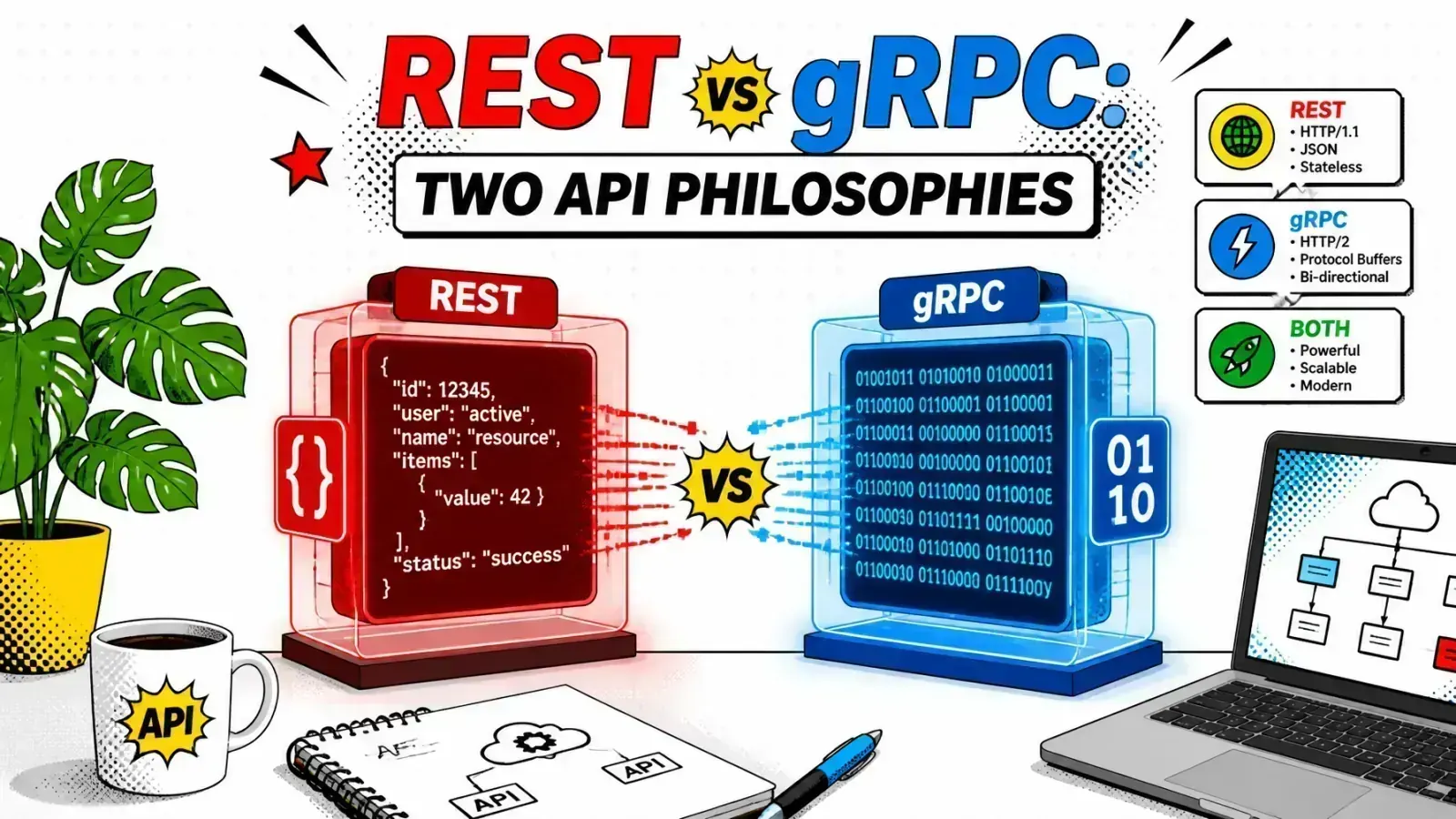
REST is built for humans and browsers. gRPC is built for machines talking to machines. Good architectures use each where it fits.
Choosing between REST and gRPC is a choice of architectural philosophy as much as protocol, and it shapes how your services communicate.
Pick the wrong one for a high-traffic microservice environment and you will spend your time fighting network latency and rising cloud costs as JSON payloads bloat under load.
Force a binary protocol onto a public-facing web client and you break the interoperability that makes the modern web work.
The choice between Representational State Transfer (REST) and gRPC (a Google-built RPC framework whose name is a recursive joke: “gRPC Remote Procedure Calls”) is a trade-off between human readability and machine efficiency.
REST has been the champion of the web for decades, while gRPC has quickly become the preferred choice for internal service-to-service communication. Understanding both is essential for any engineer building scalable systems in 2026.
The mechanical advantage of gRPC
At its core, gRPC is built to be fast. It gets there by moving away from the text-based nature of REST and using a binary format called Protocol Buffers (Protobuf).
The JSON overhead
In a typical REST interaction, your server takes an object, serializes it into a JSON string, and sends it over the wire. The receiving server then parses that string back into an object.
This process is CPU-intensive and creates large payloads, because JSON includes every key name in every single message.
How Protobuf avoids it
Protobuf is a strongly typed binary serialization format. Because the schema is defined in advance in a .proto file, the messages do not need to include field names. Instead, they use small numeric tags to identify each field.
The payload savings depend heavily on data shape. Numeric and structured data shrinks a lot, often to several times smaller than the equivalent JSON, while large free-text fields see less benefit.
Either way, binary Protobuf parsing is typically much faster than JSON parsing, which cuts serialization CPU in high-throughput environments.
HTTP/2 underneath
Another pillar of gRPC is HTTP/2. Many REST implementations still run on HTTP/1.1, but gRPC requires HTTP/2, which brings request multiplexing.
In HTTP/1.1, a client effectively sends one request at a time over a connection, which leads to application-level head-of-line blocking. HTTP/2 multiplexes many requests and responses over a single TCP connection and removes that HTTP-layer blocking.
(TCP-level head-of-line blocking still exists under packet loss. That is the problem HTTP/3 and QUIC were designed to solve.) This efficiency matters for modern API gateway architectures that handle thousands of concurrent requests.

The universality of REST
If gRPC is so much faster, why hasn’t it replaced REST? The answer lies in the browser.
Browsers cannot speak native gRPC directly. gRPC-Web exists, but it needs a proxy in front of your services and does not support every streaming mode.
Resources and verbs
REST was born from the architecture of the web itself. It treats every piece of data as a resource that can be accessed with standard HTTP verbs like GET, POST, PUT, and DELETE. This resource-oriented approach makes it intuitive and easy to consume.
Every web browser, every language, and every command-line tool like curl understands REST. If you are building a public API that third-party developers will use, REST is usually the right choice.
Inspectability
The barrier to entry is almost zero. A developer can open their browser console and immediately see what your API returns in a human-readable format. This “inspectability” is a big advantage for debugging and onboarding.
Flexibility
REST is also flexible. It does not require a strict contract to function. Tools like OpenAPI (Swagger) provide structure, but a REST API can still evolve loosely.
This flexibility suits startups and small teams that need to iterate quickly. When you are deploying a new SaaS product on Coolify or Docker, the simplicity of a RESTful interface often outweighs the performance gains of gRPC in the early stages.
Schema-first vs resource-first development
One of the biggest differences between these two philosophies is how you actually write code. gRPC forces a “contract-first” approach.
You must define your service and your message types in a .proto file before you write a single line of application logic.
// A typical gRPC service definition
service ProductService {
  rpc GetProduct (ProductRequest) returns (ProductResponse);
}

message ProductRequest {
  string id = 1;
}

message ProductResponse {
  string name = 1;
  double price = 2;
}
Generated stubs, shared types
Once this file is defined, gRPC tools generate client and server stubs in the language of your choice. This gives you strong typing across services.
If you have a Go backend talking to a Python microservice, the Protobuf contract ensures both sides agree on the data structure. This removes a whole class of bugs caused by missing fields or incorrect types in JSON.
The risk of API drift
REST typically follows a “resource-first” or “implementation-first” approach. You define your routes and your controllers, and then you might generate documentation later.
This allows faster prototyping, but it can lead to “API drift,” where the documentation and the actual implementation fall out of sync. In a large microservice ecosystem, this lack of strict contracts can become a maintenance nightmare.
REST: resource-first
gRPC: contract-first
.proto contract first, generate typed stubs for every language. Slower to start, hard to drift.Streaming and real-time capabilities
Another area where gRPC shines is native streaming. Because it is built on HTTP/2, gRPC supports four types of communication:
- Unary: A single request and a single response (the typical REST pattern).
- Server streaming: The client sends one request and the server sends back a stream of messages.
- Client streaming: The client sends a stream of messages and the server responds once.
- Bidirectional streaming: Both client and server send a stream of messages simultaneously.
Streaming as a first-class feature
This makes gRPC a strong candidate for real-time applications like chat services, stock tickers, or IoT telemetry feeds.
In the world of REST, you would typically reach for WebSockets or Server-Sent Events (SSE) to get similar results. These are often treated as “add-ons” to the API rather than a core part of the protocol. With gRPC, streaming is built in.
A streaming example
Imagine a system that processes a large dataset of vector embeddings for an AI application. A client could stream the data to the server, and the server could stream back the results as they are processed.
This reduces the memory footprint on both ends, because the entire dataset never needs to be loaded into RAM at once.
Choosing between REST and gRPC for 2026
Base the decision on your “consumer.”
Humans and browsers: REST
If your consumer is a human developer or a web browser, choose REST. The ecosystem of tools, from Postman to Chrome DevTools, is simply too mature to ignore. REST is the language of the public web.
Servers and constrained devices: gRPC
If your consumer is another server, or a performance-constrained device like a mobile phone or an IoT sensor, gRPC is usually the better choice. The gains in serialization and the reduced network overhead save you money on bandwidth and compute.
Both, in one architecture
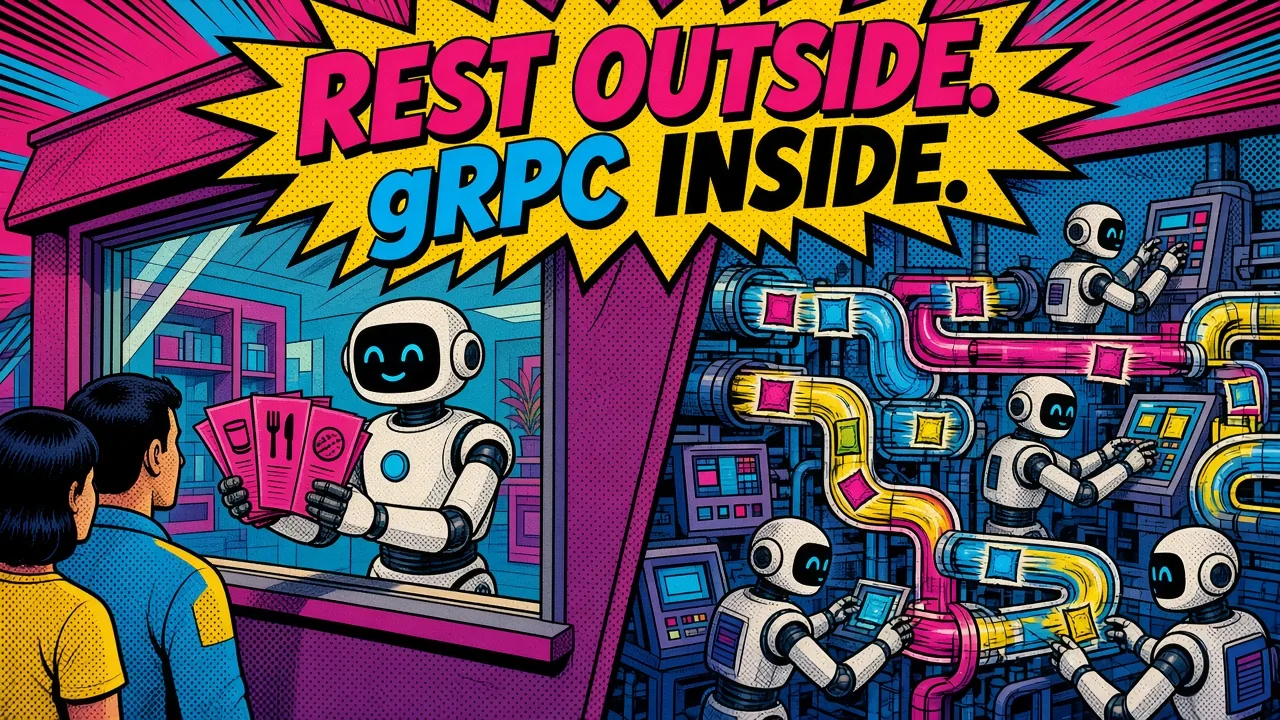
In a modern architecture, it is common to see both living together. A RESTful API gateway handles incoming traffic from the internet, then talks to internal microservices using gRPC.
As we move further into AI-integrated development, the efficiency of these data pipelines matters even more. Large language models and agentic systems need low-latency access to data, which makes gRPC a natural fit for the “inner loop” of AI infrastructure.
Key takeaways
- Performance: gRPC is usually faster than REST thanks to binary serialization (Protobuf) and HTTP/2 multiplexing.
- Payload size: Protobuf messages are smaller than JSON because they omit redundant field names and use compact binary encoding, though the gain depends on data shape.
- Contract-first: gRPC requires a strict schema definition, leading to better type safety and less “API drift” in large systems.
- Interoperability: REST remains the king of the public web and browser-based clients due to its human-readable JSON format and native browser support.
- Streaming: gRPC supports native bidirectional streaming, making it ideal for real-time data pipelines and IoT.
- Hybrid approach: Many modern architectures use REST for the public-facing edge and gRPC for internal service-to-service communication.
If you’re designing services like this for production, here’s how I help teams ship it.
Are you prepared to handle the added complexity of a contract-first architecture in exchange for smaller payloads and faster serialization?