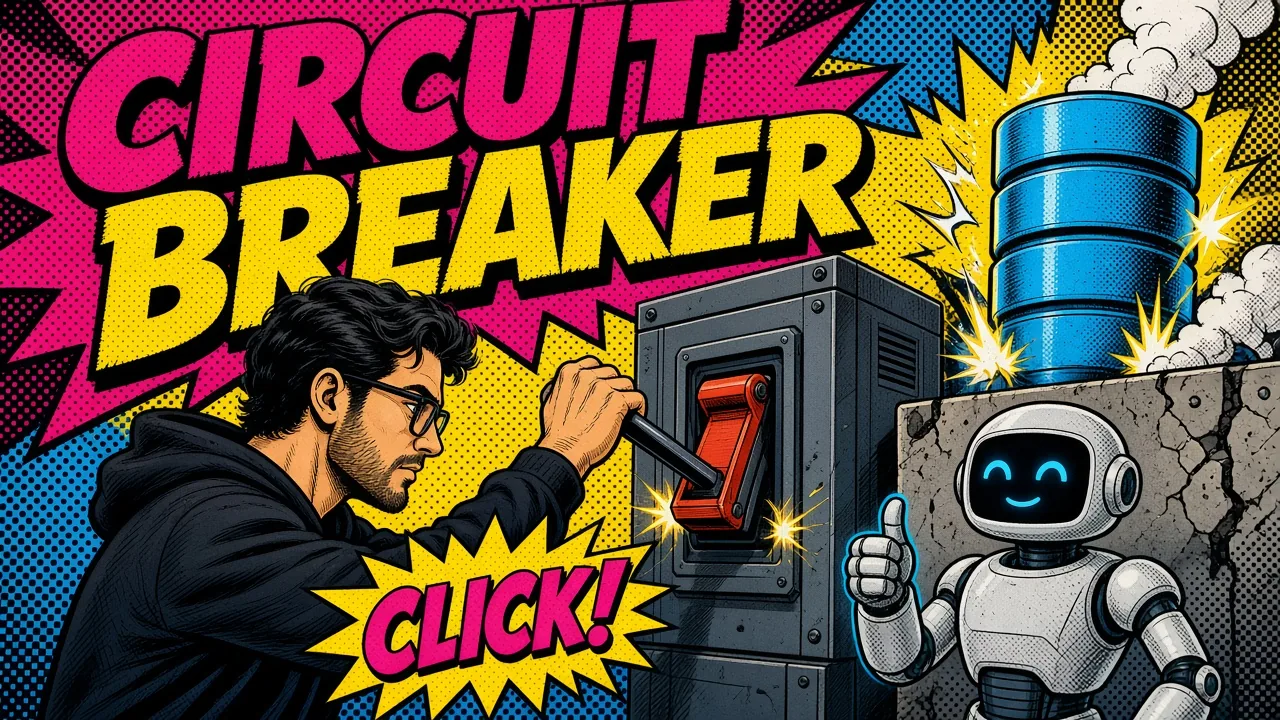
A slow vector database can take your whole app down without ever going offline. A circuit breaker is the switch that stops that from happening.
You built a beautiful RAG pipeline. It works perfectly on your machine with a few hundred vectors. Then you launch, traffic spikes and your managed vector database starts sweating.
A similarity search that used to take 50ms now takes 5 seconds. Your web workers are all tied up waiting for responses that aren’t coming.
Slow is the new down
The database isn’t technically down, but it is slow enough to kill your entire application. Your users see spinning loaders until the request finally times out.
This is a classic cascading failure (the kind a circuit breaker exists to stop), and it is the fastest way to drain your “innovation budget” and your users’ patience.
Why waiting hurts
We often treat external APIs and databases as if they are always healthy. We write code that assumes the vector DB will return results. When it doesn’t, we wait, and while we wait we hold onto memory and CPU cycles.
The fix is an old-school electrical engineering concept applied to software: the circuit breaker. This guide shows you how to wrap your AI infrastructure in protective logic so a slow dependency doesn’t take your whole SaaS down with it.
How the circuit breaker pattern works
The circuit breaker pattern is a state machine that sits between your application code and your external service.
The idea comes straight out of Michael Nygard’s Release It!. It monitors every call you make and has three states that dictate how it handles traffic.
| State | What happens to calls | Moves on when |
|---|---|---|
| Closed | Calls flow through while the breaker counts failures | The failure threshold is hit, then it opens |
| Open | Calls fail fast or get a fallback, no network call | The cooldown ends, then it goes half-open |
| Half-open | A few test calls go through | Tests pass (closed) or fail (open again) |
Closed: the healthy state
In the closed state, the circuit is complete. Requests flow through to your vector database or LLM provider normally.
The breaker is silently watching. It keeps a count of how many requests failed or took too long. As long as the failure rate stays below your threshold, it stays closed. This is the “everything is fine” mode.
Open: the fail-fast state
Once the failure threshold is hit (say 50% of requests failed in the last 30 seconds), the breaker “trips” and moves to the open state.
Now every call to the vector DB immediately throws an error or returns a fallback response, without even attempting the network call. This gives your database room to breathe and recover, and your application stops wasting time on a service that is clearly struggling.
Half-open: the recovery test
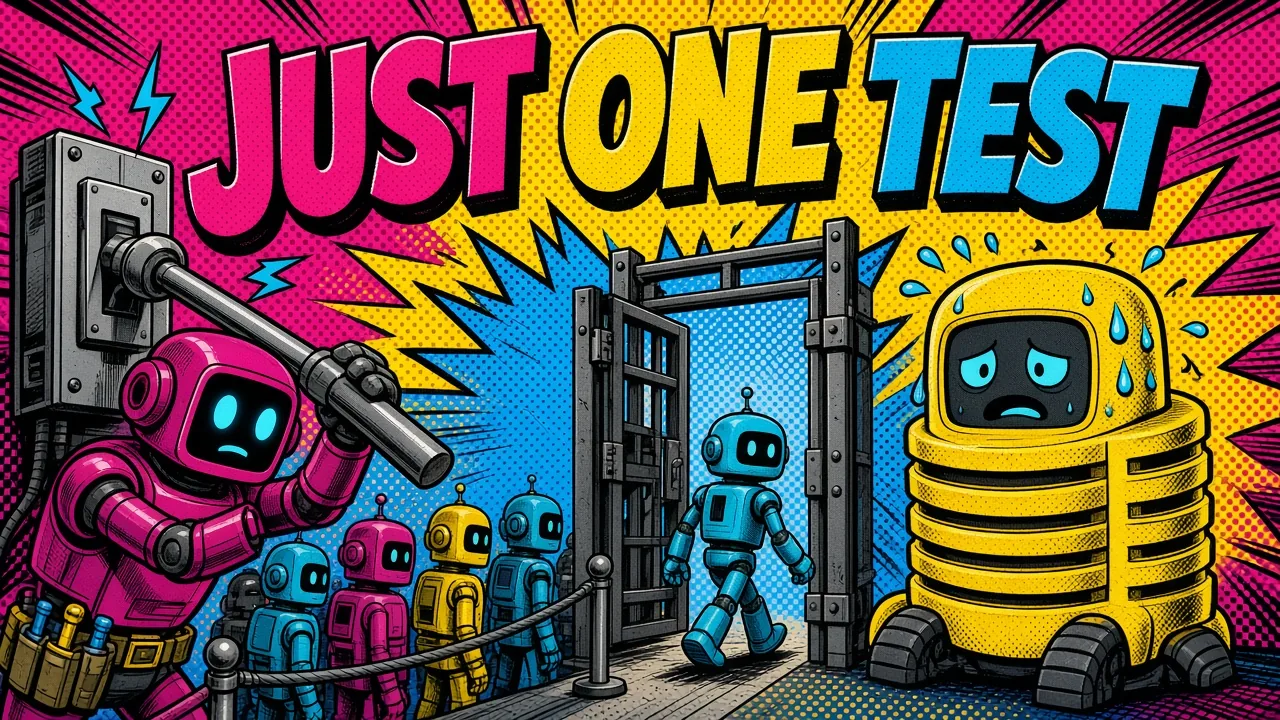
After a cooldown period, the breaker moves to the half-open state and lets a small number of “test” requests through.
If these test calls succeed, the breaker assumes the service is healthy again and moves back to closed. If they fail, it goes straight back to open for another cooldown cycle. This is a controlled way to probe the system before fully re-engaging.
Why your RAG pipeline needs this
RAG pipelines are particularly vulnerable because they usually involve several high-latency network hops. You embed the query, search the vector DB, then call the LLM. If any of these pieces fail or slow down, the whole experience breaks.
Hard errors are the easy part
Most developers only handle hard errors like a 404 or a 500 status code. But in production, “slow” is often more dangerous than “down.”
A slow vector DB creates a bottleneck that backs up your entire request queue. By the time you notice, your server is out of memory because it is holding open thousands of connections.
If you have read my post on 7 RAG mistakes in production, you know that reliability is the difference between a demo and a product. The circuit breaker is your insurance policy against these outages.
Implementing fallback strategies
Tripping the breaker shouldn’t always mean showing an error message to the user. Good AI systems use fallbacks to keep some level of service even when parts of the stack are failing.
Hot and cold tiers
Think of your vector DB as your “hot” knowledge tier. If it fails, you should have a “cold” fallback, such as a standard keyword search in your primary Postgres or MySQL database.
The results might be less relevant than a vector search, but a “decent” answer is always better than a “timed out” error.
Cached responses
Another strong strategy is semantic caching with Redis. If the circuit is open, check the cache for similar queries that were answered recently.
Even if you can’t generate a fresh answer, you might be able to serve a cached one. This keeps the user moving while your backend recovers.
LLM-only mode
If retrieval is what’s failing, you can still send the user’s prompt to the LLM with a note that external knowledge is currently unavailable. The LLM then answers from its general training data.
It is a degraded experience, but it still works. Be open about it: tell the user that “live” data isn’t available so they know to verify the response.
No breaker
With a breaker
Building it in Laravel
Since I spend a lot of time in the Laravel ecosystem, I lean on patterns that make this easy. You don’t need to write the state machine from scratch.
A community package like ackintosh/ganesha (a PHP circuit breaker), or a small custom wrapper around the illuminate/http client with a Redis-backed failure counter, gets the job done.
Wrap the client, catch the open state
The goal is to wrap your API calls in a block that understands these states. When you call your vector DB client, you wrap it in the breaker. If the call fails several times, the breaker trips.
In the catch block, you handle the CircuitBreakerOpenException by returning your fallback data. This keeps your controllers clean and the failure handling in one place.
Keep health checks honest
You can also pair this with your SaaS hosting on Coolify so your containers don’t get killed by health checks just because an external API is slow. The breaker prevents the resource bloat that usually triggers those health-check failures.
Live telemetry and smart routing
Don’t set a circuit breaker and walk away. Monitor it. You need live telemetry to see how often your circuits trip, and tools like Prometheus (or even simple logs piped to a dashboard) can tell you a lot.
Route around the failing region
If your primary vector DB in us-east-1 keeps tripping but your secondary in eu-west-1 is healthy, you can add smart routing. The breaker can act as a signal to your load balancer or internal router to shift traffic to the healthy region.
This kind of event-driven architecture makes your system self-healing. It doesn’t wait for a human to wake up at 3am. It detects the failure, trips the breaker, uses the fallback and tries to recover on its own.

Practical steps to get started
If you are ready to harden your AI infrastructure, start here:
- Identify your weakest links. List every external call in your RAG pipeline. Usually it is the embedding API and the vector DB.
- Define your thresholds. How many slow requests will you tolerate? Start with a 50% failure rate over 30 seconds and a 2-second timeout.
- Choose your fallbacks. Decide what happens when the breaker is open: an error, a cache or keyword search.
- Wrap your clients. Use a library to wrap your HTTP or database calls. Don’t build the state machine yourself unless you have a very specific use case.
- Monitor the trips. Alert when a circuit stays open for more than a few minutes. This usually means a major provider outage that needs your attention.
The goal is to fail gracefully. Every system has issues, but the ones that survive don’t let a small fire in a dependency burn down the whole house.
Key takeaways
- Treat “slow” as a failure, not only
500errors. - Closed, open, half-open: fail fast once the threshold is hit, then probe before you trust the service again.
- Always have a fallback: keyword search, a cached answer or LLM-only mode with an honest notice.
- Use a library such as
ackintosh/ganeshainstead of writing the state machine yourself. - Monitor trips and alert when a circuit stays open.
If your RAG stack stalls every time the vector database slows down, here’s how I help teams add circuit breakers and fallbacks to AI infrastructure, or reach out through contact.
Have you ever had a slow dependency take down your entire application, or are you still relying on long timeouts and luck?