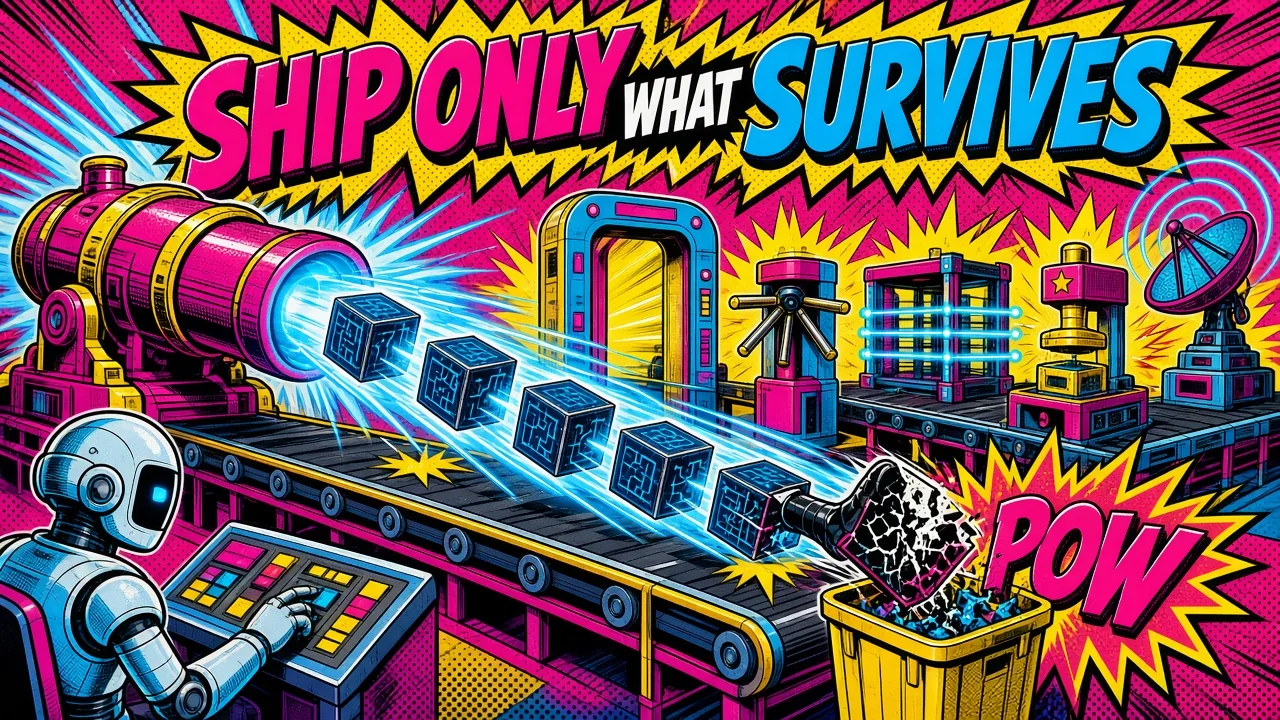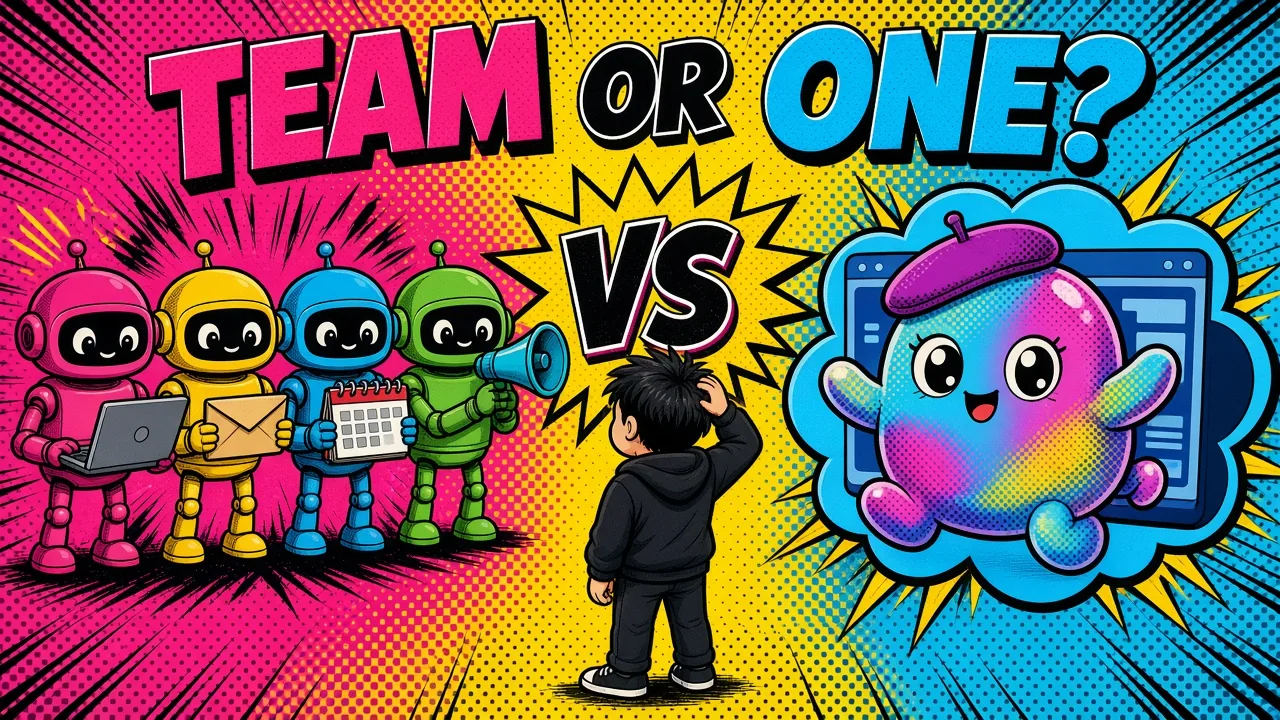
Traditional RAG retrieves once and hopes. Agentic RAG plans and loops. Corrective RAG checks the context before it answers. Each step up costs more latency and tokens.
Most developers build a basic RAG system only to find it hallucinating or failing on complex questions within a week of deployment.
If your vector search returns the wrong context, your LLM will confidently lie to your face. This gap between basic search and reliable answers is why RAG architectures have grown from simple pipelines into self-correcting, agentic systems.
The problem with many first AI implementations is their static nature. You feed a query into a vector database, pull some chunks, and hope the LLM makes sense of them.
This is the traditional RAG model. It works for simple FAQs, but it breaks down when a query needs multi-step reasoning or when the retrieved data is irrelevant. The result is “garbage in, garbage out”: the model burns tokens trying to answer from junk context.
This guide compares three RAG architectures so you can pick the right one for your workload: the speed of a traditional pipeline, the reasoning of agentic RAG, or the verification of corrective RAG (CRAG).
Traditional RAG: the linear standard
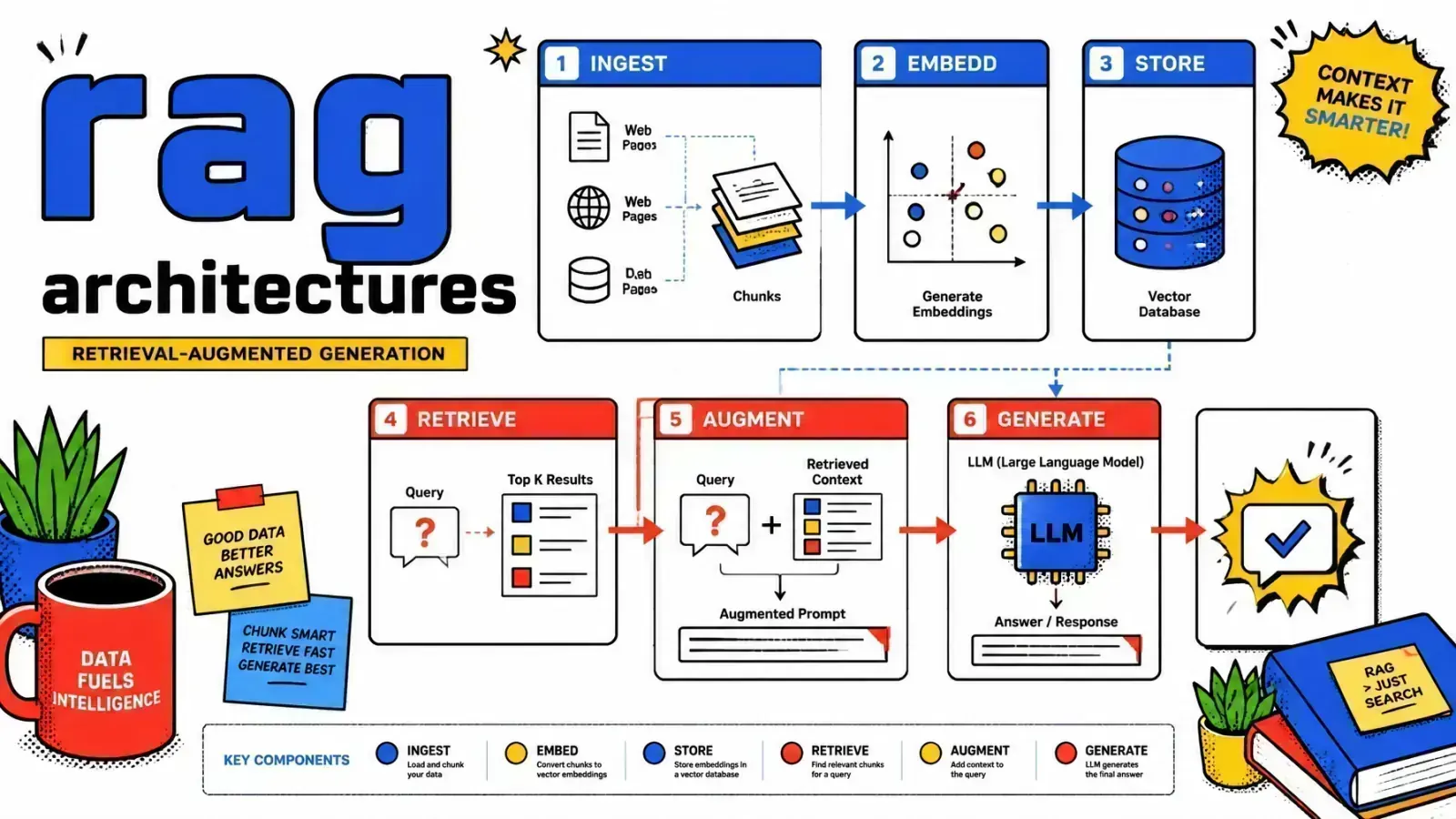
Traditional RAG is the foundation of most AI-driven applications. It follows a strictly linear, one-shot path: retrieve, then generate.
You start by converting your documents into vector embeddings and storing them in a database like pgvector or Pinecone. When a user asks a question, the system embeds the query, runs a similarity search, and injects the top results into the prompt.
Fast and cheap
This architecture is prized for its low latency and simplicity. If you are building a simple internal search tool for a Shopify store or a basic documentation bot, Traditional RAG is often enough.
It is cost-effective because it typically involves only one LLM call and one vector search.
No way to notice bad context
Its simplicity is also its biggest weakness. It assumes the first retrieval always succeeds.
If the vector search returns noise, the LLM has no mechanism to tell that the context is wrong. It will try to answer regardless. This often leads to the 7 RAG mistakes in production that plague early-stage AI projects.
Key components of traditional RAG
- Vector store: holds document chunks as embeddings.
- Retriever: a similarity search function that pulls the top-k relevant chunks.
- Generator: the LLM that synthesizes an answer from the retrieved chunks.
Agentic RAG: the strategic pivot
Agentic RAG turns retrieval from a passive pipeline into an active control loop. Instead of a fixed sequence, an LLM agent acts as a “brain” that manages the whole workflow.
The agent can plan its approach, decide which tools to use, and iterate until it finds a satisfactory answer.

Splitting the question
In an Agentic RAG system, the agent might decide that a single search is not enough. It might break a complex request into three sub-queries, search different data sources for each, and then combine the results into one answer.
This is particularly useful for agentic commerce on Shopify, where a user might ask for a comparison between several products across different categories.
The plan-act-observe cycle
The core of this architecture is the plan-act-observe cycle (the same loop behind ReAct-style agents). The agent plans a step, performs an action (like calling a search tool), observes the result, and decides whether it needs more information.
This lets it solve multi-hop problems, where the answer to the first part of a question provides the search terms for the second.
The price of loops
Agentic RAG is more capable, but it is also more expensive and slower than traditional methods. Each iteration requires another LLM call, which increases both the token cost and the time the user waits.
Managing these loops takes solid infrastructure, often including an API gateway in the AI stack to handle the extra traffic and orchestration complexity.
Corrective RAG (CRAG): the self-healing layer
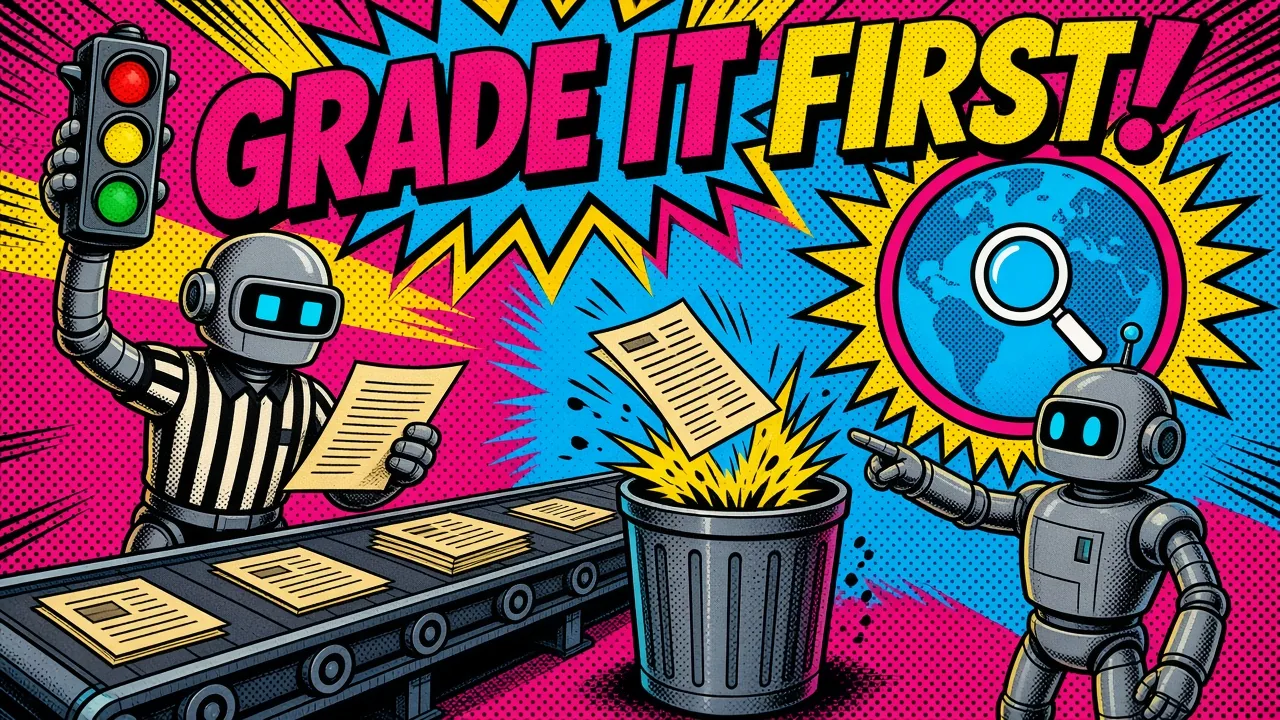
Corrective RAG, or CRAG, adds a self-correction step to retrieval. Its goal is to cut hallucinations by putting a lightweight retrieval evaluator between the retrieval and generation steps to judge how relevant the retrieved documents are.
The original CRAG paper uses a fine-tuned T5-large model as that evaluator.
Three confidence levels
The evaluator sorts each retrieval into one of three confidence levels: correct, incorrect, or ambiguous.
- Correct: CRAG keeps the retrieved context but refines it with a decompose-then-recompose step that strips out irrelevant text before generation.
- Incorrect: CRAG discards the retrieval and triggers a large-scale web search to pull in more reliable knowledge.
- Ambiguous: CRAG combines both, using refined retrieval plus web search results.
Grounded verification
CRAG suits high-stakes environments where accuracy is non-negotiable. It adds a layer of grounded verification to the otherwise probabilistic behavior of LLMs, deciding whether to trust, refine, or replace retrieved context.
How the CRAG loop works
- Retrieve: fetch initial context chunks.
- Evaluate: a lightweight evaluator scores each chunk’s relevance into correct, incorrect, or ambiguous.
- Correct: if confidence is low, trigger a secondary retrieval (commonly a web search) and refine the context.
- Generate: synthesize the final answer only from verified or corrected context.
Comparison: speed vs accuracy vs reasoning
Choosing between these RAG architectures is a trade-off between performance, cost, and complexity. Use the table below to guide your decision.
If you are still settling on the storage layer underneath, picking the right RAG stack covers the vector database choices in depth.
| Feature | Traditional RAG | Agentic RAG | Corrective RAG |
|---|---|---|---|
| Flow Type | Linear | Cyclic / Iterative | Evaluative Loop |
| Latency | Low | High | Medium |
| Cost | Low | High | Medium-High |
| Use Case | Simple FAQ, Lookup | Complex Research, Workflows | High-Accuracy Q&A |
| Reliability | Moderate | High (Reasoning) | Very High (Grounding) |
| Implementation | Easy | Complex | Moderate |
A sensible path
For most startups, the most logical path is to start with Traditional RAG and then add a Corrective layer. You ship quickly and still have a roadmap for more reliability as your dataset grows.
Implementation in production: Laravel and cloud
Building these architectures takes more than an LLM API key. It needs a solid backend to handle state, queues, and data processing.
In a Laravel environment, you can run the agentic loops with job queues and dedicated service classes. Laravel’s ecosystem suits the orchestrator logic that drives an agentic RAG system.
// Conceptual Laravel Service for a Corrective RAG Flow
class RagOrchestrator {
    public function handleQuery(string $userQuery) {
        // 1. Retrieve initial chunks
        $chunks = $this->vectorStore->search($userQuery);

        // 2. Evaluate with a Critic
        $evaluation = $this->critic->evaluate($userQuery, $chunks);

        if ($evaluation->isIrrelevant()) {
            // 3. Corrective action: Web Search or Retry
            $chunks = $this->webSearch->search($userQuery);
        }

        // 4. Final generation
        return $this->llm->generate($userQuery, $chunks);
    }
}
Scale the pieces separately
When deploying these systems, Docker and cloud infrastructure management matter a lot. You need to scale your vector database and your orchestration layer independently.
Tools like Coolify for self-hosting, or managed GCP services, help with the compute demands of multi-step agentic loops.
Match the architecture to the task
- Traditional RAG is for speed and simplicity. It is the baseline for all projects.
- Agentic RAG is for thinking tasks. Use it when the user needs a consultant, not just a search bar.
- Corrective RAG is for truth tasks. Use it when hallucinations are a business risk.
- Caching is non-negotiable in agentic RAG. Cache the results of sub-queries to cut cost and latency for recurring questions.
Key takeaways
RAG is no longer “one size fits all.” The move toward Agentic and Corrective systems shifts the focus of AI engineering to reliability, so pick the architecture that gives your users answers instead of noise.
- Start with Traditional RAG to validate your data and basic retrieval quality.
- Implement a Critic layer (Corrective RAG) early if accuracy is your primary KPI.
- Reserve Agentic RAG for workflows that require actual decision-making and tool use.
- Monitor your retrieval hit rate and token usage religiously.
- Use a modular backend structure like Laravel to manage the complexity of multi-loop architectures.
If you’re deciding which RAG architecture fits your product, here’s how I help teams ship it.
Which architecture currently provides the best balance of cost and accuracy for your production workloads?